
Finance Guru
PluginSelf-hosted family office system: 11 specialist agents use tested Python calculators for risk, Monte Carlo and backtests, store broker CSVs in local SQLite and gate purchases with guardrails; mostly US equities. Needs Python 3.12+, uv and CLI comfort. Educational only, not investment advice.

Finance Guru
Your brokerage account is not a spreadsheet problem. It is an operating system problem.
A self-hosted family office engine: typed Python calculators, a private SQLite ledger, and specialist agents that run inside Claude Code or Codex. Your data never leaves your machine unless you point it somewhere.






Quick Start · How it works · What's free · Docs · For agents
One command, a full risk profile against live end-of-day data. No portfolio data required. Market analysis works from a fresh clone.
uv run python -m src.analysis.risk_metrics_cli TSLA --days 252 --benchmark SPY
The split
You paste a screenshot into a chat model and ask whether a position is too big. The answer is plausible and unchecked. Chat models are excellent at deciding what question to ask and terrible at being the calculator. So split the job.
Agents propose. Typed code computes.
Guardrails fail closed, in Python, with tests.
A self-hosted family office for $0.
This is for a household that wants its books on its own machine: what you hold, the risk in it, and a check that refuses to guess when a number is missing. The software in this repository is free to clone and run. You bring a terminal, your own Claude Code or Codex session if you want the agents, and broker CSV exports you already have.
Not financial advice, and this project makes no return claims.
Every number an agent quotes comes from a Pydantic-validated calculator with a CLI you can run yourself. Every irreversible action passes through a guardrail that blocks when its inputs are missing rather than guessing. The AI gets judgment. The math gets a test suite.
If a model can lie about it, a calculator owns it.
Quick start
Prerequisites
Python 3.12 or later, uv, and Git. Bun only if you work on the SimpleFIN sync app.
Install
git clone https://github.com/AojdevStudio/Finance-Guru.git
cd Finance-Guru
uv run python -m src.cli.instance_init ~/finance-guru-data --repo .
The instance is a small uv project outside the repo that depends on the engine. Private data lives there and nowhere else.
Run
cd ~/finance-guru-data
uv run python -m src.integrations.refresh_all --show
uv run python -m src.analysis.risk_metrics_cli TSLA --days 252 --benchmark SPY
The first command prints your position, transaction, and expense tables (empty on a new instance). Drop broker CSV exports into imports/ to work CSV-first, or wire up live sync later.
Install as a Claude Code plugin
claude plugin marketplace add AojdevStudio/Finance-Guru
claude plugin install finance-guru@finance-guru
Then run the instance-onboarding skill. It scaffolds the instance with --plugin, so the plugin is the single source of agents and skills and the checkout path's symlinks are skipped. The checkout path above remains the fully supported one.
What is in the box
Finance Guru is the open-core engine behind Keepfolio, a "claude-code for personal finance." This repo is the free, self-hosted, CLI-native experience: the whole engine, every skill, every agent, no withheld tier.
| Component | What it does | Why it matters |
|---|---|---|
Typed calculators (src/) | 20 CLIs for risk, momentum, volatility, correlation, optimization, backtesting, options, factors, hedging, total return, and margin metrics. Every one is Pydantic input, calculator class, CLI wrapper. | Calculations are testable outside any AI session. The suite is 1,100+ tests behind an 80% coverage gate. |
| Private instance | A directory outside the repo holding family_office.db, your .env, broker CSVs, and every artifact the engine writes. | No spreadsheet, no cloud sync, no vendor dashboard between you and your ledger. Tracked files never carry personal values. |
Sync layer (src/integrations/) | refresh_all pulls SnapTrade (brokerage) and SimpleFIN (bank and card) into SQLite with your own read-only credentials. | Partial provider responses raise before any write. You get an error instead of a coverage ratio computed on half your accounts. |
| Fail-closed guardrails | Concentration cap, margin coverage, and ITC risk run against trusted inputs before a buy ticket persists. | A block on missing NAV, missing rate, or an unrun Layer 3 score. A bad ticket needs a number to pass, not a prompt to agree. |
Skills and specialists (.claude/) | Skills and 11 specialist agents coordinated by a finance orchestrator. They read the DB, run the CLIs, and write Markdown into your instance. | Every output carries its data source, date stamp, and the educational-only disclaimer. You can trace any claim back to a CLI run. |
| Compliance scan on push | A pre-push hook scans history and the diff for secrets and PII. | The repo is public. Your data is not. The hook is what keeps that true. |
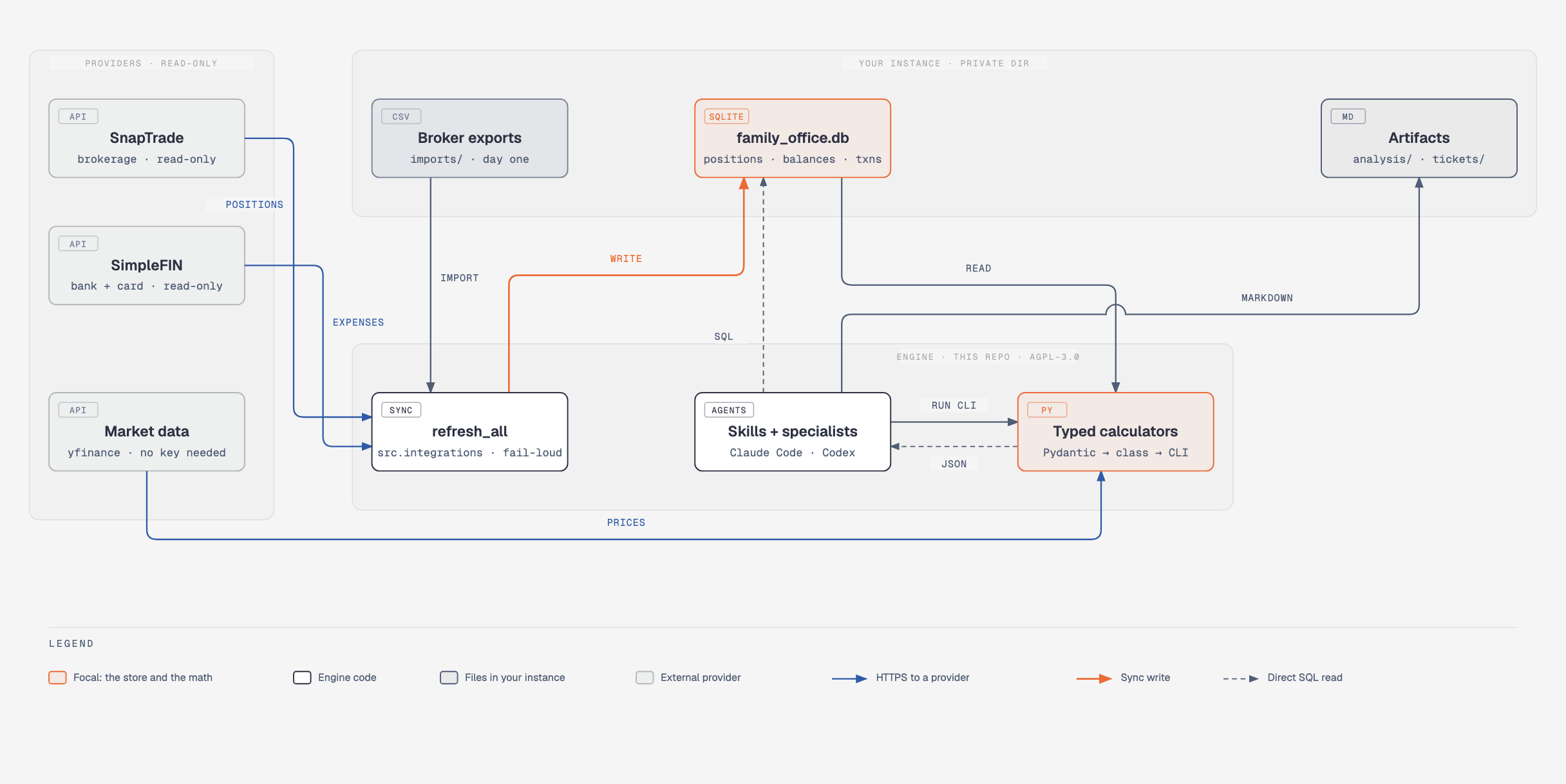
How it works
The guardrail loop
The buy-ticket pipeline is the clearest example of the split between judgment and arithmetic.
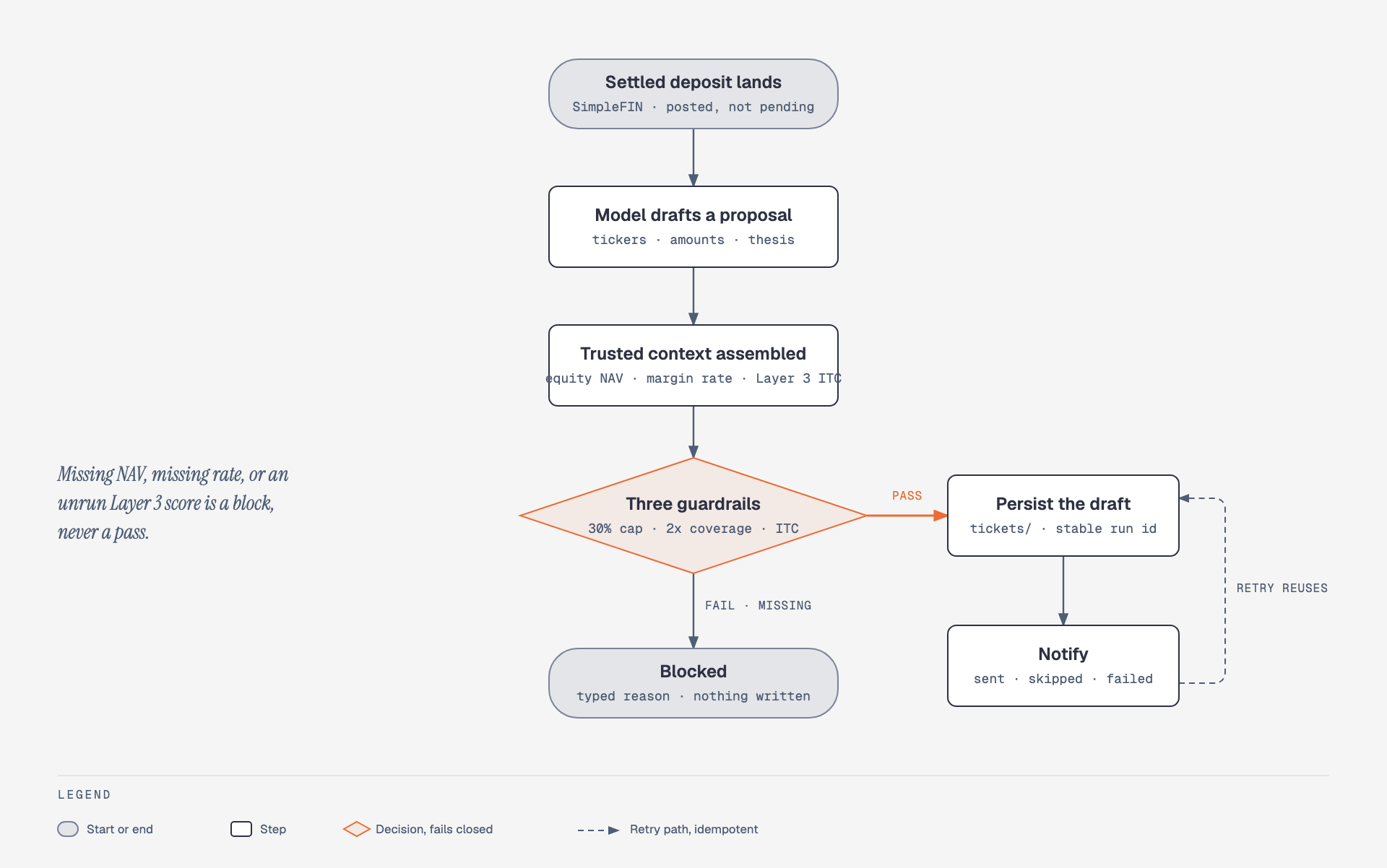
The model drafts a proposal. It has no say over the inputs that judge it. GuardrailContext carries the pre-borrow equity NAV, the configured annual margin rate, and the Layer 3 ITC score, and the checks run against those:
CONCENTRATION_LIMIT = 0.30   # of pre-borrow equity NAV, never of a margin-inflated total
MIN_MARGIN_COVERAGE = 2.0    # dividend income over projected interest, new borrowing included
MAX_ITC_RISK = 0.7           # from Layer 3 output only; missing, not-run, or failed blocks
A block returns a typed reason (equity_nav_unavailable, margin_rate_unavailable, coverage<2x) and writes nothing. A pass persists the draft under a stable run id, then notifies. A failed notification is its own outcome, so a retry reuses the draft instead of writing a second one.
The three-layer pattern
src/analysis/risk_metrics.py        Pydantic input model + RiskCalculator
src/analysis/risk_metrics_cli.py    argparse wrapper, --output json, disclaimer
tests/python/test_risk_metrics.py   the math, tested without a network
Every tool in the engine follows this shape, so an agent can only ever call a CLI and quote its output. Nineteen of the twenty CLIs take --output json; margin metrics prints JSON by default. That is the contract the skills consume, so what an agent reports is exactly what the calculator returned. See the CLI reference for all 20.
uv run python -m src.analysis.risk_metrics_cli TSLA --days 252 --benchmark SPY --output json
The private instance
The engine reads every private file from an instance directory outside the repository, resolved from FIN_GURU_DATA_ROOT or the current working directory. The instance holds .env, user-profile.yaml, config.yaml, family_office.db, snaptrade-accounts.yaml, and the working directories imports/, analysis/, tickets/, strategies/, hedging/, reports/, auto-tickets/, and notes/. Tracked files describe behaviour and never carry personal values. The full rule and its enforcement live in DataClassification and PRIVACY.md.
Local-first does not mean network-free. Market data, brokerage, and LLM integrations send request data to their configured providers. Configure only the integrations you intend to use.
If you are an agent
You are the intended operator of this engine, not an afterthought. A few things that make you effective here:
- Read
CLAUDE.mdfirst. It is the single source of truth for the skills index, the agent roster, the path variables, and the output rules.AGENTS.mdpoints Codex at the same tree through the instance's.agentssymlink. - Run
datebefore any market work. Every specialist here is expected to know the current date before it searches or analyzes. - Never do the arithmetic yourself. Call the CLI with
--output jsonand quote what it returned. That is the whole reason the calculators exist. - Private data lives in the instance, not the repo. Resolve
FIN_GURU_DATA_ROOTor the working directory, read fromfamily_office.db, and write artifacts intoanalysis/ortickets/. Tracked files never carry personal values, and the pre-push scan will stop you if you try. - Every financial output carries the educational-only disclaimer, a date stamp, and its data source. The CLIs print it; the skills expect it.
- Fail closed. If a guardrail input is missing, the answer is a block with a typed reason. Do not fill the gap with an estimate.
- Contributing a tool means all three layers. Pydantic input model, calculator class, CLI wrapper, plus a test that runs without a network.
Skills in .claude/skills/ are the workflows; specialists in .claude/agents/ are the subagents; the finance orchestrator is the main session and routes between them.
Why this exists
Finance Guru started as one operator's answer to a personal constraint. Its author spent over a decade in pharmacy operations before teaching himself to build software, and along the way stopped using a checking account at all. Everything ran through a brokerage: paychecks in, margin as operating capital, dividends as the second income layer. No consumer finance app models that. They all assume a bank.
The stopgap was a chat model and a habit of pasting screenshots into it. Every answer was plausible. None of it was checked. The model did the arithmetic in its head, the positions lived in a CSV exported three weeks earlier, and the guardrail that should have stopped a bad ticket was a sentence in a prompt, not a line of code. Nothing was repeatable, so nothing was auditable.
"A fully autonomous, unbiased family office with agentic personalities grounded in math and truth, helping me achieve financial freedom." The vision statement in docs/VISION.md, March 2026.
The first commits were agent personas and prompts. Persuasive, and unverifiable. The fix was not a better prompt. It was moving every calculation into typed Python with a CLI, so the agent's only move is to run the tool and read the answer. That split, judgment in the agent and arithmetic in code, is the whole architecture.
The second lesson came from sync. SimpleFIN can return HTTP 200 with a dropped account buried in an errors array, and the sync used to count that and move on. Now the rule is that anything financial fails loud or fails closed. Missing data blocks. Partial data raises. A guardrail without its inputs is a block, not a pass.
The repo is public because the pattern is more useful than the portfolio. The commercial macOS product, Keepfolio, is built on this engine. The engine stays free and complete.
The artifacts are the argument.
Roadmap
- Three-layer calculators for risk, momentum, volatility, correlation, optimization, backtesting, options, factors, hedging, and margin
- Local SQLite system of record fed by SnapTrade and SimpleFIN
- Fail-closed buy-ticket guardrails with Layer 3 ITC authority
- Diátaxis documentation site on GitHub Pages
- Claude Code plugin as the primary install path (#131)
- Retirement-account sync migration gate (#74)
- Automated releases through release-please (#112)
Open items carry the roadmap label. Defects carry bug.
Recent changes are in the changelog.
Contributing
Read Contributing first. It covers the accepted surfaces, the quality gates, and the privacy rules every push must pass. The required Python gates mirror CI:
uv sync --dev
uv run ruff format --check .
uv run ruff check .
uv run mypy src/
uv run pytest -m "not integration"
Documentation
| Document | Purpose |
|---|---|
| Documentation site | Tutorials, how-to guides, reference, and explanation |
| Setup | Install the engine and create an instance |
| CLI reference | Commands, arguments, and output |
| Live sync credentials | Bring-your-own-credentials setup for SnapTrade and SimpleFIN |
| Runbooks | Recurring portfolio and operations workflows |
| Troubleshooting | Common installation and runtime failures |
Acknowledgments
Market data through yfinance. Brokerage connectivity through SnapTrade. Bank and card connectivity through SimpleFIN. Agent surfaces on Claude Code and Codex. Diagrams drawn with the diagram-design skill; terminal recording with vhs.
What's free / licensing
Everything tracked in this repository is free under the GNU Affero General Public License v3.0, or, at your option, any later version. That covers the Python calculators, the ledger code, the skills, the specialist agents, the docs, and the apps. There is no paid tier here, and no feature of this engine is held back. You can run it, change it, and share it. If you run a modified version as a network service, the license requires you to offer that version's source to the people who use it.
Keepfolio is a separate commercial macOS product built on this engine. Its source is not in this repository, and this repository does not state Keepfolio's license. This repo is the free terminal-native engine. Keepfolio is the polished app for someone who will not run one.
The copyright notice and the same split are in LICENSING.md.
License
Finance Guru is licensed under the GNU Affero General Public License v3.0, or any later version. See LICENSING.md.
Financial disclaimer
Not financial advice, and this project makes no return claims. Finance Guru is educational software. Financial markets involve risk, including possible loss of principal. Verify all data and calculations independently and consult appropriately licensed financial, tax, and legal professionals before acting.
Agents propose. Typed code computes.
If the split between judgment and arithmetic is the thing you were missing, star the repo.
Recursos relacionados

Finance Skills
PluginPlugin marketplace for investment research: six plugin groups covering yfinance market data, earnings previews and recaps, DCF valuation, option payoff charts, ETF premiums, read-only news from X, Discord and other social sources, and TradingView data. Research only, not investment advice.
himself65/finance-skills3.4kFinance Skills
SkillFinance skills for investment research: pulls quotes and financials via yfinance for DCF valuation, earnings previews and recaps, option payoff charts, and correlation and liquidity analysis, plus read-only feeds from Twitter, Discord and more. For research reference only.
himself65/finance-skills3.4k
Longbridge Skills
PluginLongbridge's official plugin: ask for quotes, technicals, derivatives, financials, valuation, analyst ratings, watchlists and holdings across US, HK, A-share and Singapore markets, plus earnings recaps and morning briefs. Needs a Longbridge account and its CLI or MCP. Not investment advice.
longbridge/skills64
TradingAgents
CLIMulti-agent investment research framework where fundamental, sentiment, news and technical analysts, bull and bear researchers, a trader and risk managers debate a stock and produce a report and rating. Covers US, Hong Kong and A-shares. Needs Python and an LLM API key; not investment advice.
TauricResearch/TradingAgents111k
AI Hedge Fund
CLIMulti-agent simulated hedge fund: agents modeled on investors like Buffett and Munger work with quant and risk modules to analyze stocks, with backtesting. Good for teaching investment frameworks. Needs Financial Datasets and model API keys; no real trading, not investment advice.
virattt/ai-hedge-fund64k
S&P Global Plugin
PluginPartner plugin from Kensho, part of S&P Global: uses Capital IQ data to produce one- to two-page company tearsheets as Word docs, earnings previews, and M&A deal summaries by sector or company. Needs a Capital IQ Pro or S&P LLM-ready API subscription; needs expert review.
anthropics/financial-services40.1k