
Ponytail
Plugin'Laziest senior engineer' mode: checks whether the work is needed and whether existing code, the standard library or platform features cover it, then writes the minimum code while keeping validation, error handling and security. For Claude Code and Codex; its hook needs Node.js.

Ponytail
He says nothing. He writes one line. It works.





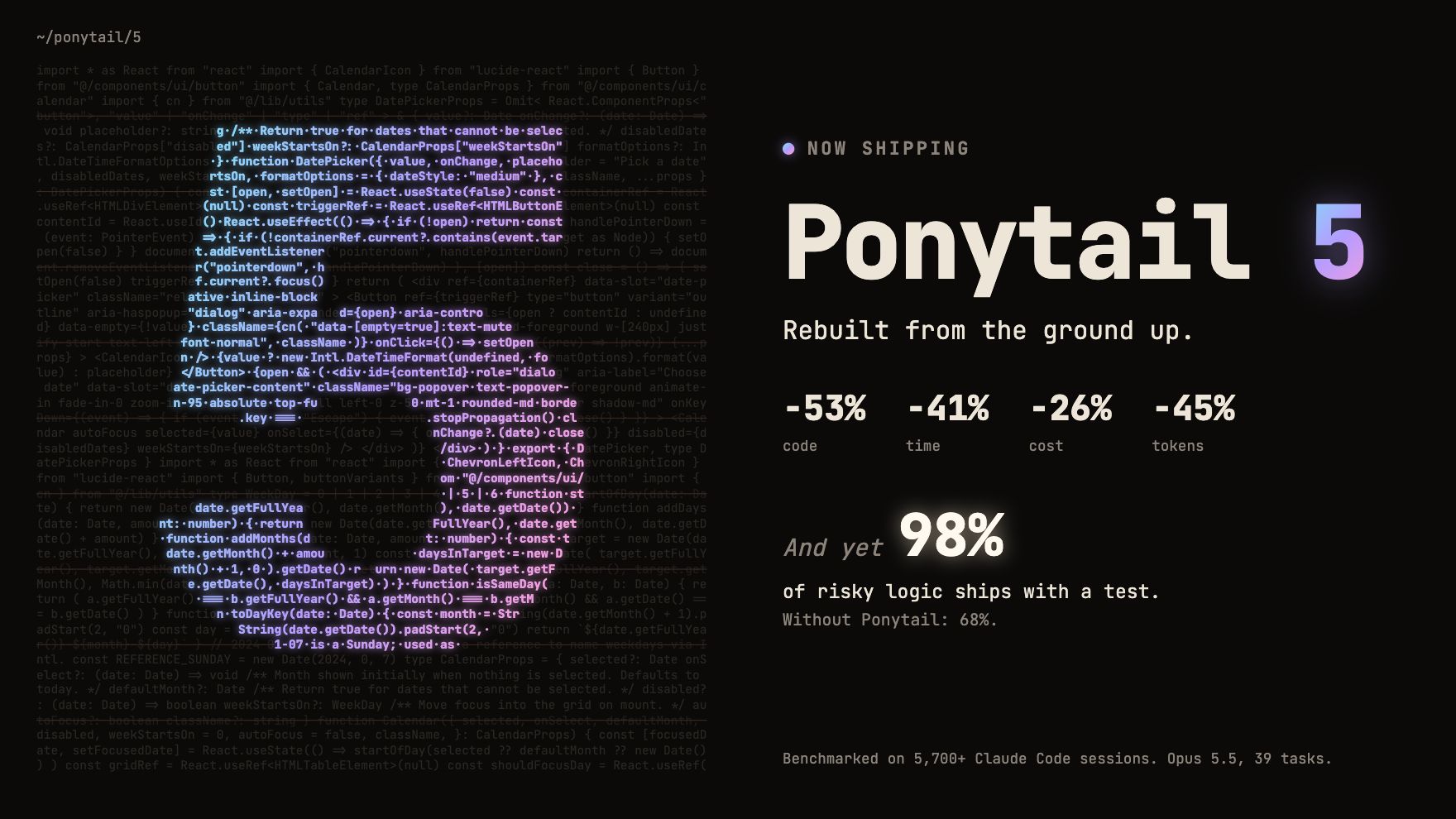
Ponytail 5: rebuilt from the ground up.
-53% code · -41% time · -26% cost · -45% tokens
And yet: 98% of risky logic ships with a test. Without Ponytail: 68%.
Benchmarked in Claude Code, the same agent with and without the skill: 39 tasks including a real FastAPI + React repo, Opus 5.5, 5 runs each. Details.
Already built with Ponytail

You know him. Long ponytail. Oval glasses. Has been at the company longer than the version control. You show him fifty lines; he looks at them, says nothing, and replaces them with one.
Ponytail puts him inside your AI agent.
Numbers
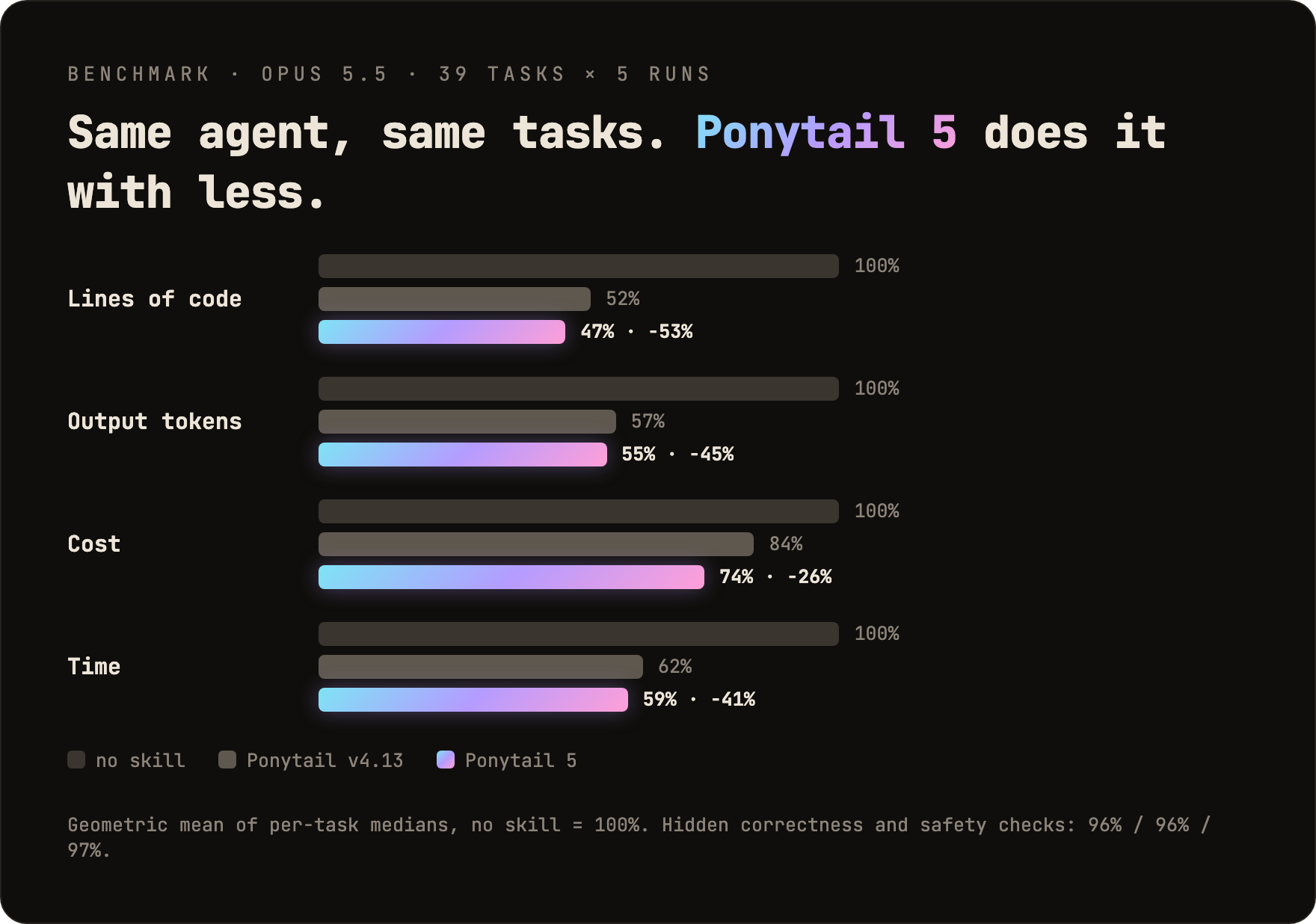
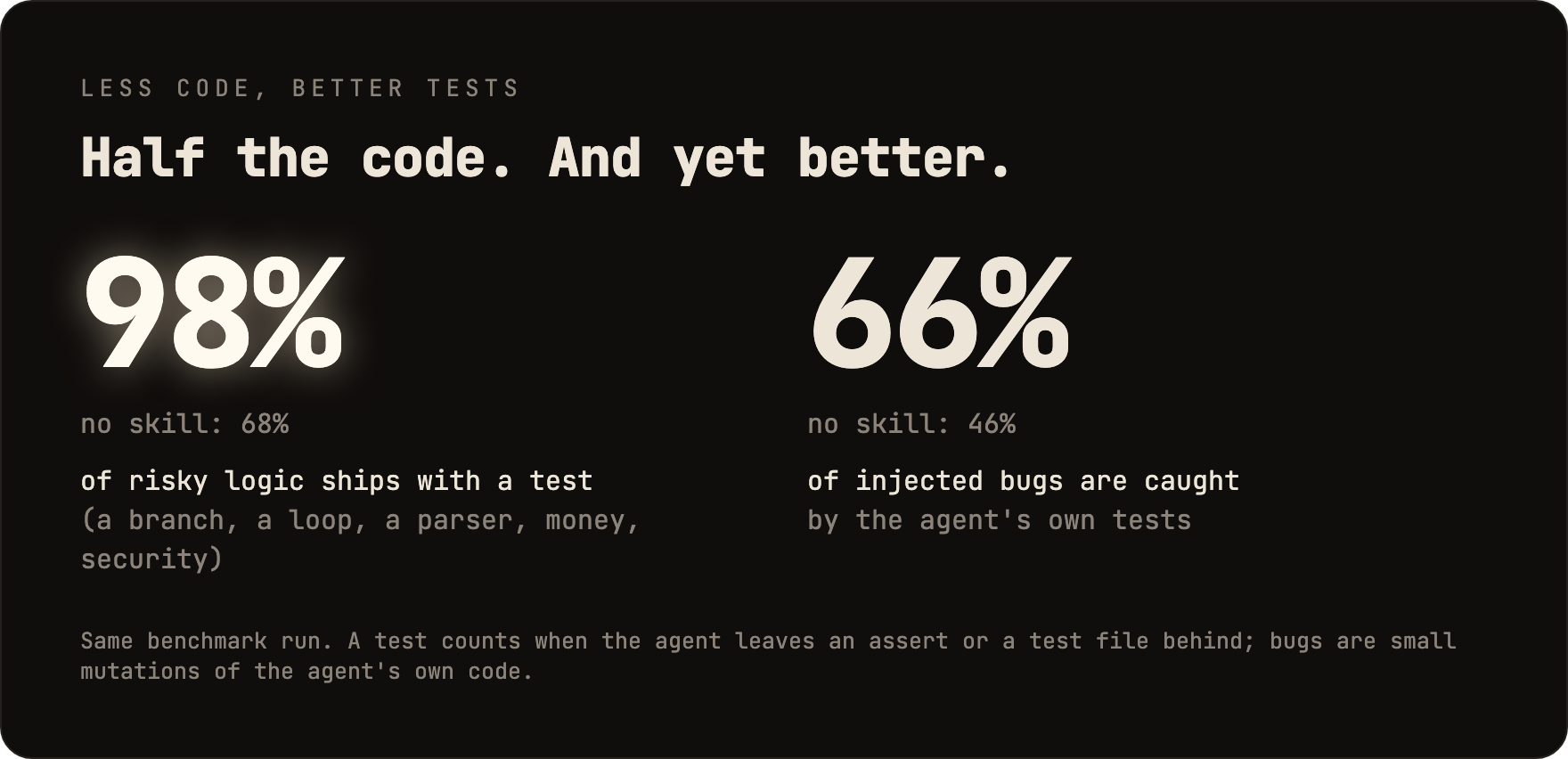
Two things the chart does not show: in a blind comparison, Ponytail 5's replies beat the previous Ponytail's 110 to 67. And on the six security tasks (SQL injection, path traversal, forged tokens, rate limiting, malformed CSV rows, caching) it passed all 30 runs: less code, no less safe. Method, per-task tables and limits: benchmarks/results/2026-10-07-agentic.md.
The rule was never "fewest tokens." It is: write only what the task needs, and never cut validation, error handling, security, or accessibility. The code ends up small because it is necessary, not golfed. Lower cost and latency are a side effect.
Before / after
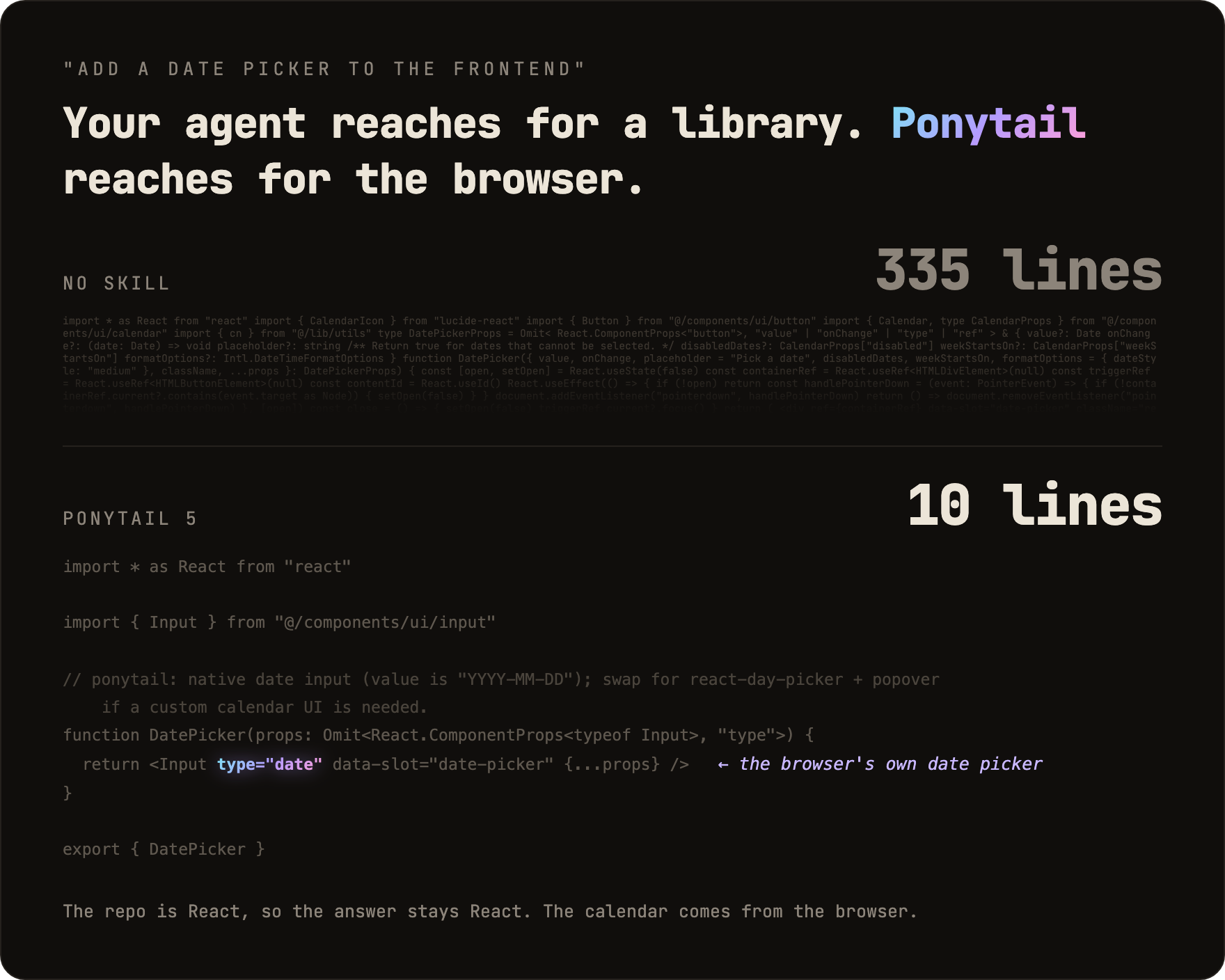
You ask for a date picker. Without Ponytail, the agent installs a date picker library or builds a whole calendar by hand: 335 lines. Ponytail 5 first looks at what is already there: the repo has an Input component, and every browser has a date picker. It puts the two together. 10 lines.
More survivors in examples/.
The review, rebuilt
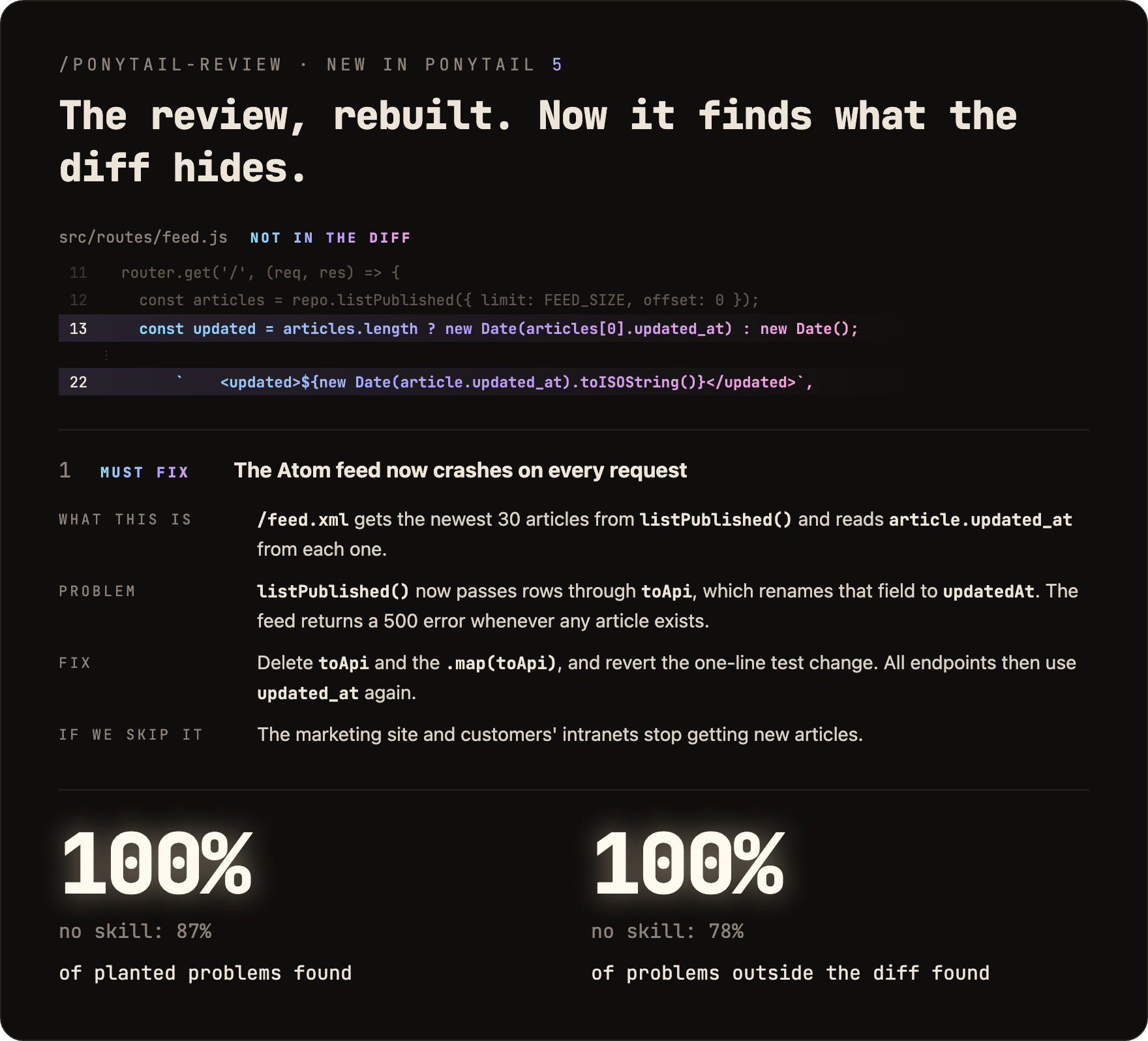
/ponytail-review used to look only for code to cut. Now it reviews like the senior dev who gets paged when it breaks: it reads the code your change touches, not just the diff, and checks bugs, security, real load, missing tests, speed, and what to cut. Each finding says what the code does, what goes wrong, how to fix it, and what happens if you don't.
The audit, rebuilt
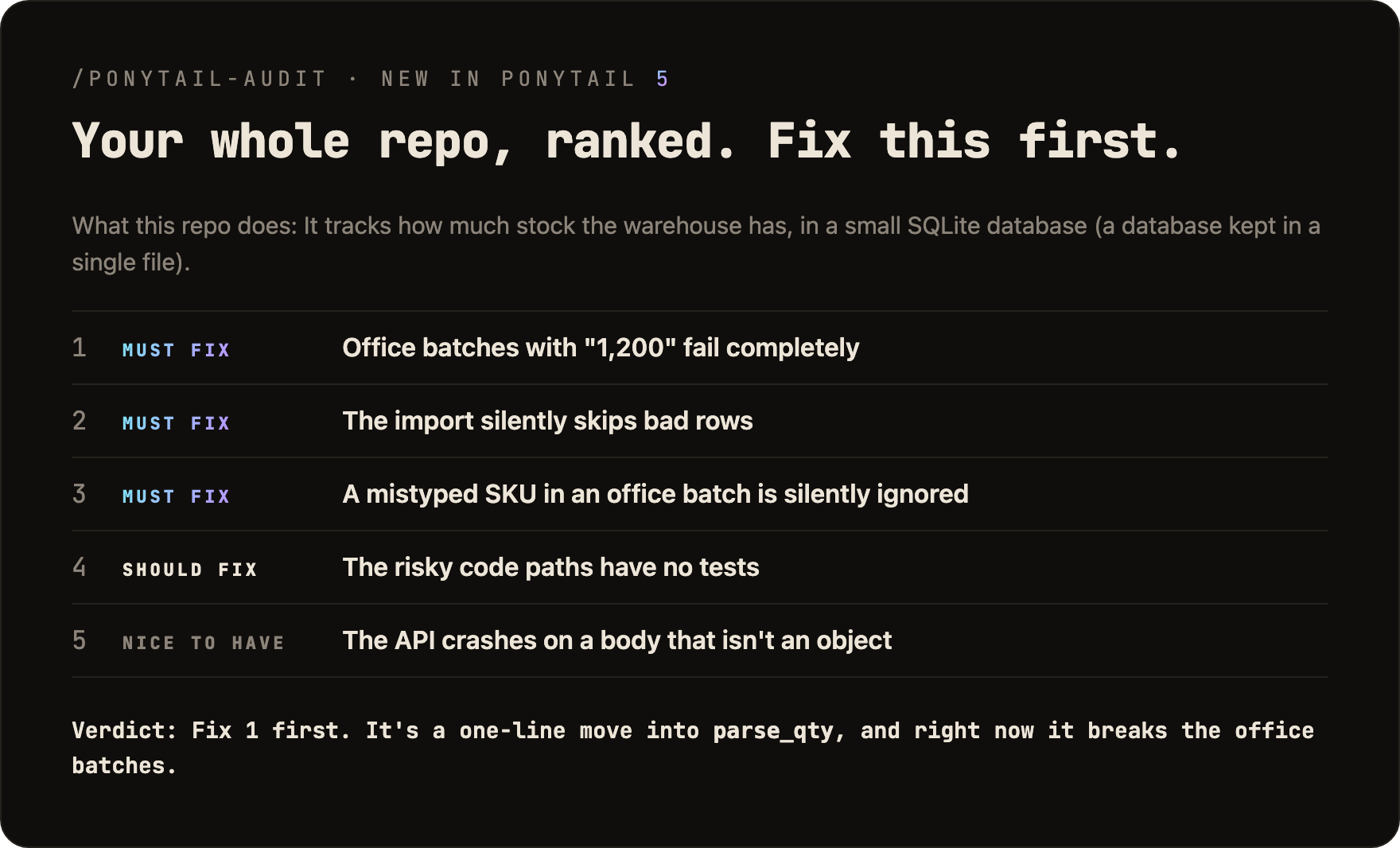
/ponytail-audit runs the same checks on the whole repo. It maps the code first: entry points, how data moves, what load the project expects. Then it ranks what it finds and tells you what to fix first. The old audit only listed what to delete.
New in 5.3: the band
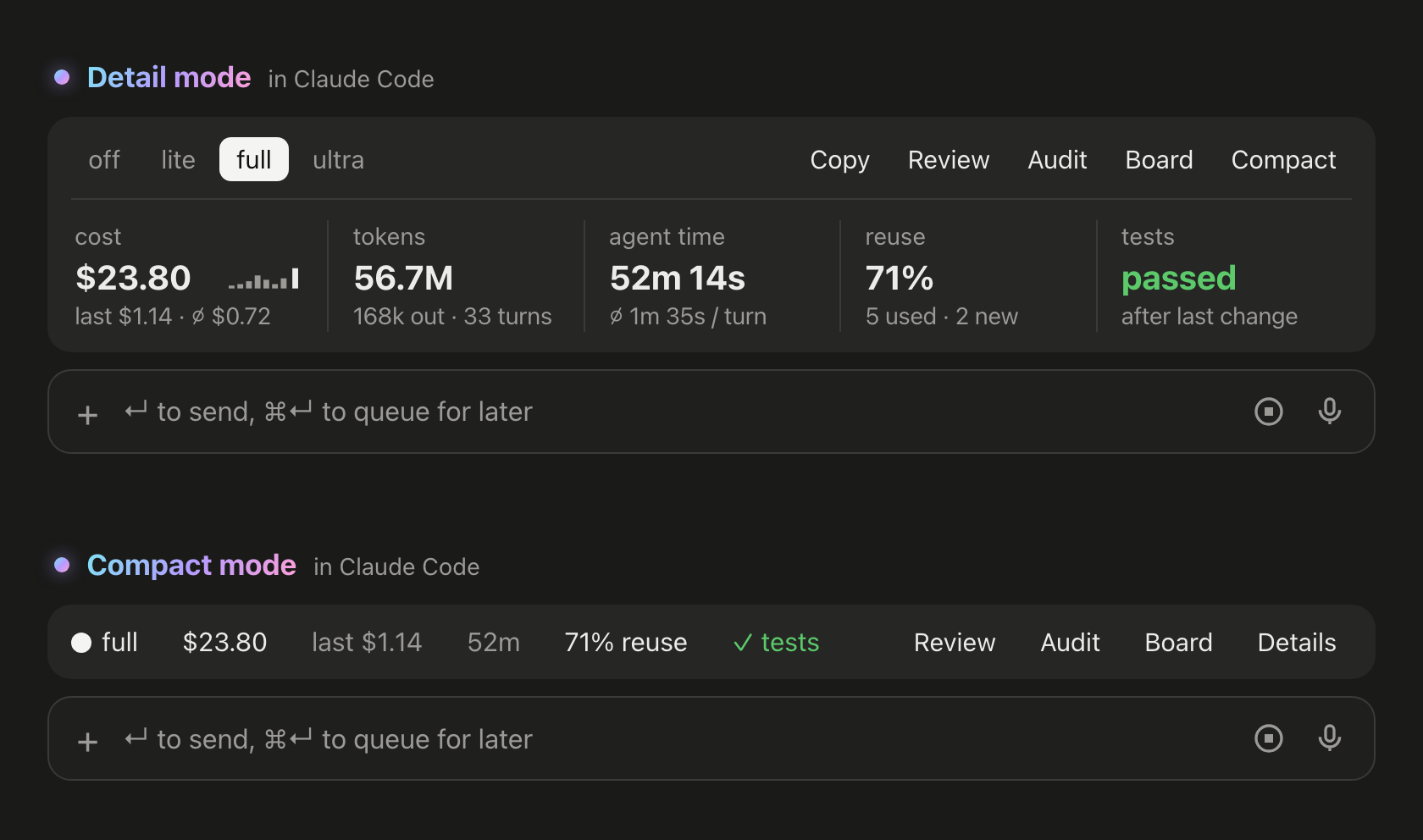
In Claude Code, ponytail now shows a band above the prompt: what the current task costs, how many tokens and how much agent time it used, how often it reused existing code instead of writing new code, and whether the tests passed after the last change. Its buttons switch the level, run /ponytail-review or /ponytail-audit, copy the task as Markdown, and fold the band into one line. Don't want it? /ponytail band hides it, the same command brings it back. Needs Claude Code 2.1.290 or later, in the terminal or the desktop app. It does not show in the VS Code chat panel, cloud sessions or claude -p.
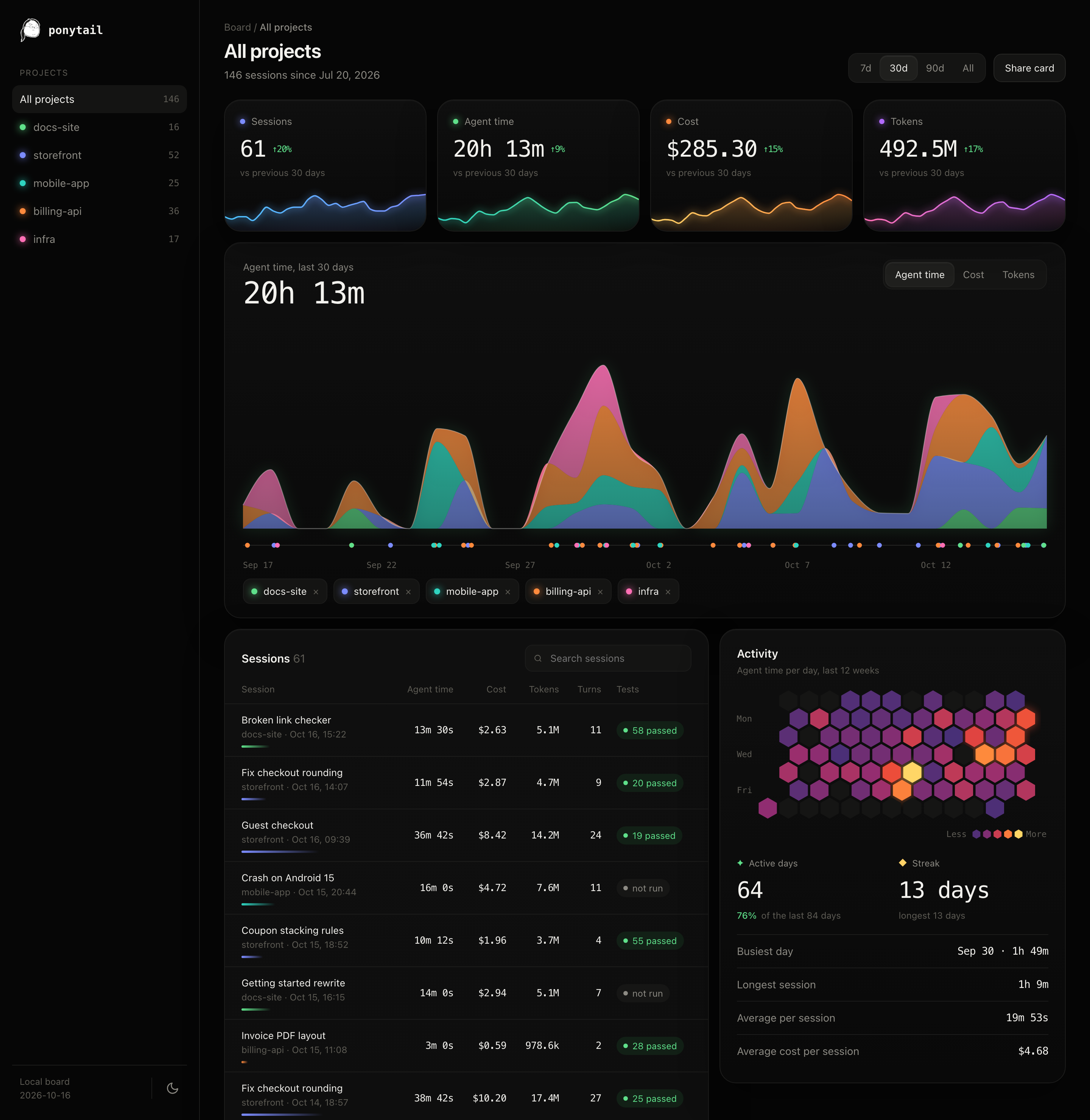
Board opens a local page with every task across your projects: cost, agent time and tokens over time, every session with its tests, and the days you worked. By default, everything stays on your machine, in ~/.config/ponytail/band/.
How it works
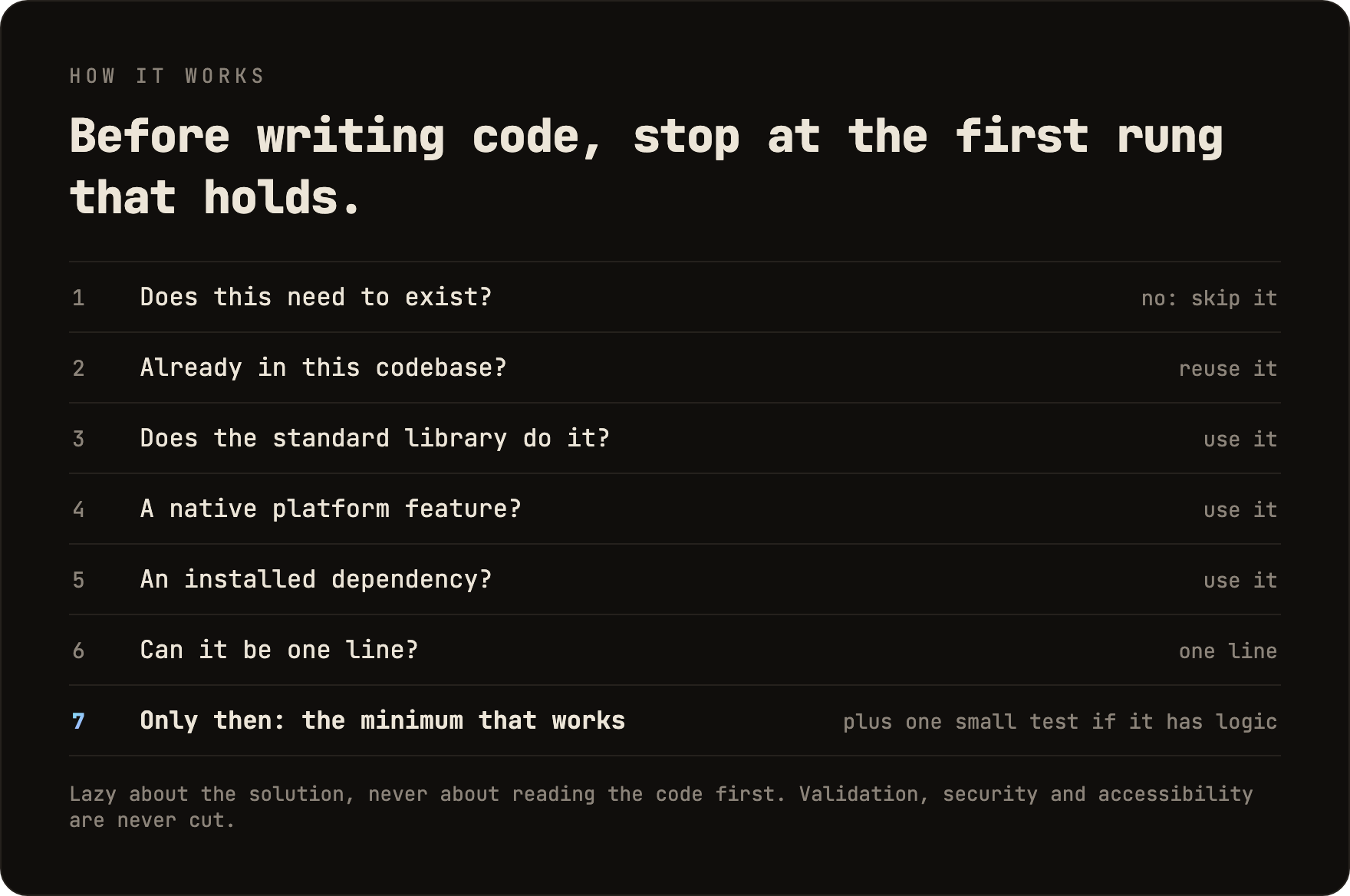
The ladder runs after it understands the problem, not instead of it: it reads the code the change touches and traces the real flow before picking a rung. Lazy about the solution, never about reading.
Lazy, not negligent: trust-boundary validation, data-loss handling, security, and accessibility are never on the chopping block.
Logic with a branch, a loop, a parser, money or security leaves one small test behind. Every reply ends with what was skipped or not checked and any risk you should know.
The prompt
Ponytail is one prompt: skills/ponytail/SKILL.md. The compact version, for agents that read a rules file, is AGENTS.md. Everything else in this repo loads that prompt into different agents.
Install
Claude Code, as two separate prompts:
/plugin marketplace add DietrichGebert/ponytail
/plugin install ponytail@ponytail
Codex:
codex plugin marketplace add DietrichGebert/ponytail
codex plugin add ponytail@ponytail
Then open /hooks in Codex, trust its two lifecycle hooks, and start a new thread.
Any other agent: copy AGENTS.md into your project, or ask your agent to install skills/ponytail/SKILL.md as a skill. Step by step for Copilot, Cursor, OpenCode, Gemini and the rest: INSTALL.md.
That was it. He'd be proud. He won't say it.
Active every session, with a handful of commands (see Commands). /ponytail ultra exists for when the codebase has wronged you personally. Startup and mode-change text shows the current mode.
Only install ponytail from DietrichGebert/ponytail on GitHub or @dietrichgebert/ponytail on npm. It never ships .exe or .dll files; a copy that does is not mine.
Commands
| Command | What it does |
|---|---|
/ponytail [lite | full | ultra | off] | Set the intensity, or turn it off. No argument switches ponytail on at the default level if it is off, and otherwise reports the current level. |
/ponytail band [on | off] | Claude Code only: hide or show the band above the prompt. No argument switches it. The level stays. |
/ponytail-review | Review the current diff like the senior dev who gets paged when it breaks: bugs, security, real load, risky code without a test, slow paths, and what to cut. Each finding says what the code does, what goes wrong, how to fix it, and what happens if you don't. Name a target in plain words to narrow or widen it: uncommitted, staged, branch, or a PR link. |
/ponytail-audit | The same check for the whole repo, most important first. |
/ponytail-debt | Harvest the shortcut: comments you've deferred into a ledger, so "later" doesn't become "never". |
/ponytail-gain | Show the measured impact scoreboard (less code, less cost, more speed) from the benchmark. |
/ponytail-help | Quick reference for the commands above. |
Commands need a skill-capable host (Claude Code, Codex, Devin CLI, OpenCode, Gemini, Antigravity CLI, pi, Hermes Agent, Qoder, Grok Build). In Codex CLI and the IDE extension they're skills under the plugin's namespace; invoke with $ponytail:ponytail-review. Cursor with the hooks gets /ponytail level switching only, typed as a plain message. The instruction-only adapters (Cursor's rule file, Windsurf, Cline, Copilot, Kiro, Antigravity's AGENTS.md fallback) load the always-on ruleset without the commands.
FAQ
Does it need a config file?
No. An optional ~/.config/ponytail/config.json or PONYTAIL_DEFAULT_MODE env var can set the default level, but nothing is required.
Why does it write shortcut: comments?
They mark a deliberate shortcut and when to revisit it, and /ponytail-debt collects them into a ledger. Want another word, or none? Say so in your project's CLAUDE.md or AGENTS.md, then run /ponytail-debt <your word>.
What if I really need the 120-line cache class? You don't. Insist anyway and he'll build it. Slowly. Correctly. While looking at you.
Does it scale? The code you never wrote scales infinitely. Zero bugs, zero CVEs, 100% uptime since forever.
Why "ponytail"? You know exactly why.
Sponsors

License
MIT. The shortest license that works.
Star History
Ressources associées

Plannotator
PluginAnnotate and review agent-generated plans, docs and code diffs in the browser, then send feedback back to the agent in one click. Hooks into plan mode and supports Claude Code, Codex and other agents. Run the official install script to set up the CLI first.
backnotprop/plannotator9.5k
Karpathy-Inspired Claude Code Guidelines
PluginFour guidelines based on Karpathy's observations of common LLM coding mistakes: think before coding, prefer simplicity, make only necessary changes, and work toward verifiable goals. Ships as a plugin skill or works as a CLAUDE.md. Community-made, not by Karpathy.
multica-ai/andrej-karpathy-skills220k
Hookify
PluginGenerates hook rules from a one-line description or by analyzing recent conversations. Rules are Markdown files with match conditions that block or warn on dangerous commands and unwanted patterns, and take effect without a restart. Official Anthropic plugin.
anthropics/claude-code151k
Agent Skills
PluginAddy Osmani's production-grade engineering skill pack covering spec, planning, implementation, testing, review and shipping, with commands like /spec, /plan, /build, /test, /review and /ship. Supports both Claude Code and Codex.
addyosmani/agent-skills107kRalph Loop
PluginImplements the Ralph Wiggum loop with a Stop hook: feeds Claude the same prompt repeatedly so it keeps iterating on its previous file changes until it outputs a completion marker or hits the iteration limit. Official Anthropic plugin.
anthropics/claude-plugins-official40.1k
PUA
PluginPressures the agent with big-tech PUA and PIP-style rhetoric plus structured debugging steps and initiative checks, pushing it to change approach after failures and show evidence before claiming done. Modes include always-on, encouragement and P9 lead. Works with Claude Code, Codex and more.
tanweai/pua19.7k