
promptfoo
CLICLI and library for evaluating and red-teaming LLM apps: compare prompts and model outputs in bulk, scan for security vulnerabilities and plug into CI/CD, with evals running locally. Now part of OpenAI and still open source under MIT.
Promptfoo: LLM evals & red teaming





promptfoo is a CLI and library for evaluating and red-teaming LLM-based apps. Stop using trial-and-error... start shipping secure, reliable agents
Website · Getting Started · Red Teaming · Documentation · Discord
Promptfoo is now part of OpenAI. Promptfoo remains open source and MIT licensed. Read the company update.
Quick Start
npm install -g promptfoo
promptfoo init --example getting-started
Also available via brew install promptfoo and pip install promptfoo. Or use npx promptfoo@latest to run any command without installing.
Most LLM providers require an API key. Set yours as an environment variable:
export OPENAI_API_KEY=sk-abc123
Run an eval and view results:
cd getting-started
promptfoo eval
promptfoo view
See Getting Started (evals) or Red Teaming (vulnerability scanning) for more!
What can you do with Promptfoo?
- Test your prompts and models with automated evaluations
- Secure your LLM apps with red teaming and vulnerability scanning
- Compare models side-by-side (OpenAI, Anthropic, Azure, Bedrock, Ollama, and more)
- Automate checks in CI/CD
- Review pull requests for LLM-related security and compliance issues with code scanning
- Share results with your team
Here's what it looks like in action:
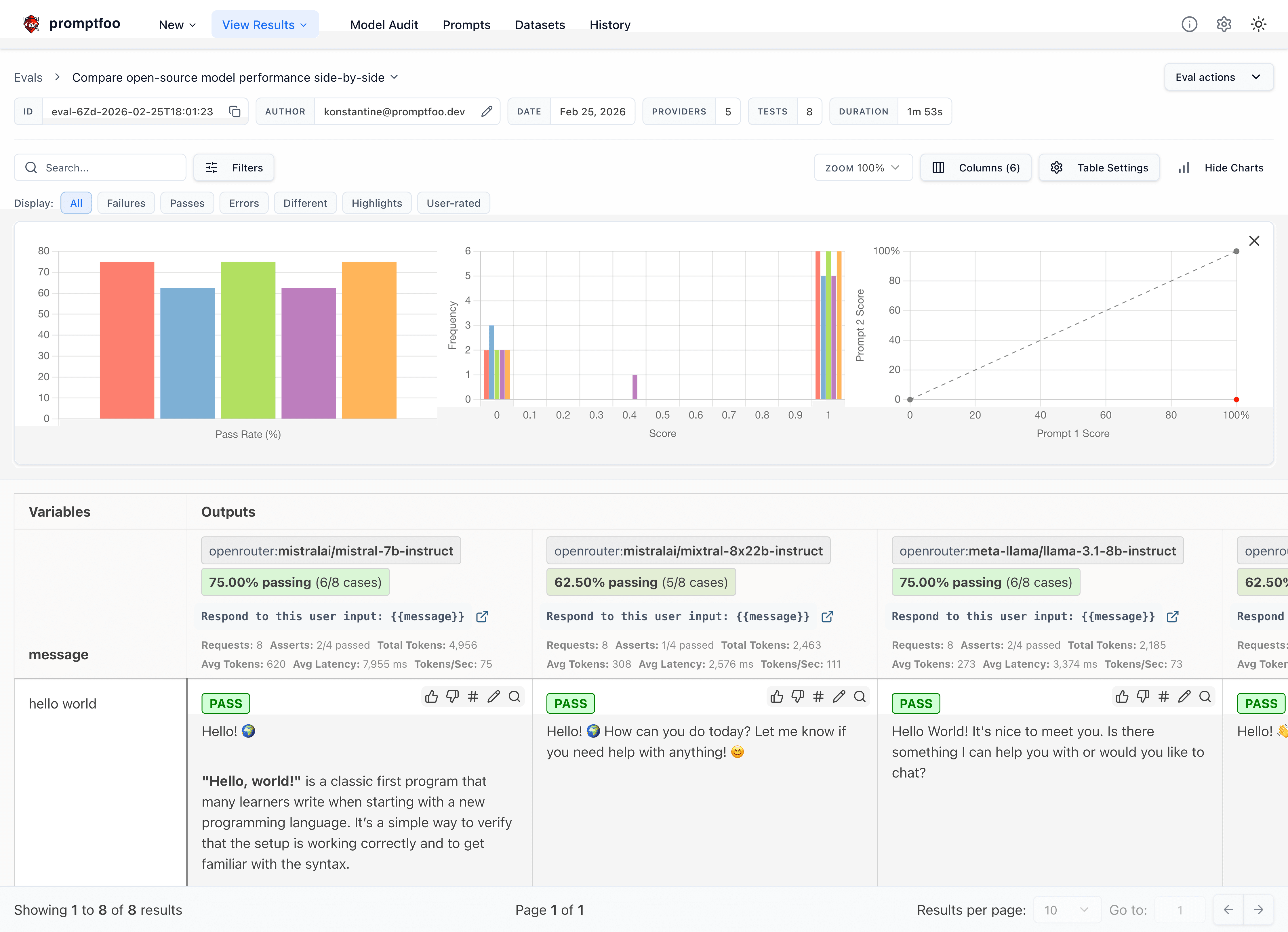
It works on the command line too:

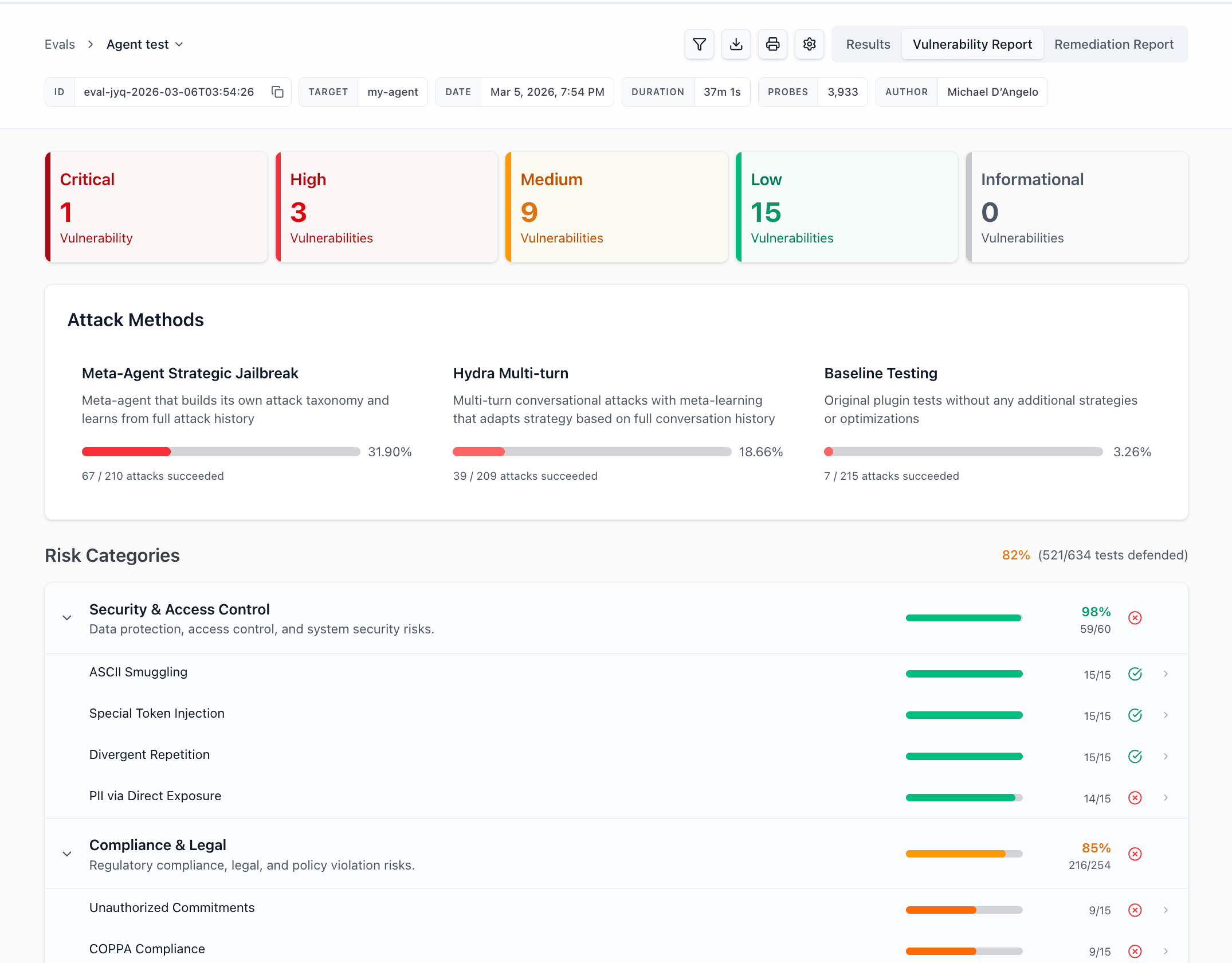
It also can generate security vulnerability reports:
Why Promptfoo?
- Developer-first: Fast, with features like live reload and caching
- Private: LLM evals run 100% locally - your prompts never leave your machine
- Flexible: Works with any LLM API or programming language
- Battle-tested: Powers LLM apps serving 10M+ users in production
- Data-driven: Make decisions based on metrics, not gut feel
- Open source: MIT licensed, with an active community
Learn More
- Getting Started
- Full Documentation
- Red Teaming Guide
- CLI Usage
- Node.js Package
- Supported Models
- Code Scanning Guide
Contributing
We welcome contributions! Check out our contributing guide to get started.
Join our Discord community for help and discussion.
関連リソース

Arize Phoenix MCP Server
MCPConnects to the Arize Phoenix observability platform so agents can query LLM traces and sessions, manage prompts, browse datasets and read experiment evaluation results. Maintained by Arize; needs a self-hosted or cloud Phoenix instance.
Arize-ai/phoenix11.9k
garak
CLINVIDIA's open-source LLM vulnerability scanner that probes for prompt injection, jailbreaks, data leakage, hallucination and harmful content, supporting OpenAI, Hugging Face, Bedrock and most REST-accessible models. Scanning cloud models needs their API keys.
NVIDIA/garak9.6k
Semgrep
CLISemantic multi-language static analysis: find vulnerabilities and bugs with rules that look like source code, across 30+ languages with custom rules. Scans locally by default without uploading code; cross-file analysis and Pro rules require sign-in.
semgrep/semgrep17.1k
Grype
CLIScans container images, filesystem directories and SBOMs for known vulnerabilities across major Linux distro packages and many language ecosystems, ranks risk by EPSS and KEV, and filters results with OpenVEX. Good for vulnerability gates in CI. Maintained by Anchore.
anchore/grype13k
Codex Security
CLIOpenAI's official security CLI and TypeScript SDK: scans codebases to find, validate and fix security vulnerabilities, and can draft a SECURITY.md policy. Needs Node.js 22.13+, Python 3.10+, and a ChatGPT sign-in or API key.
openai/codex-security11.1k
zizmor
CLIStatic security analysis for CI/CD config: finds template injection, credential leaks, excessive permissions and more in GitHub Actions workflows, also covers Dependabot and pre-commit configs, and auto-fixes some findings.
zizmorcore/zizmor6.7k