
On-Call Kit
SkillPuts Claude in your incident channel: builds triage runbooks from past incidents, investigates alerts read-only and gives an evidence-backed first diagnosis while humans decide fixes, plus handoffs and status reports. Anthropic reference code, no longer maintained; needs Claude Team or Enterprise.
On-Call Kit
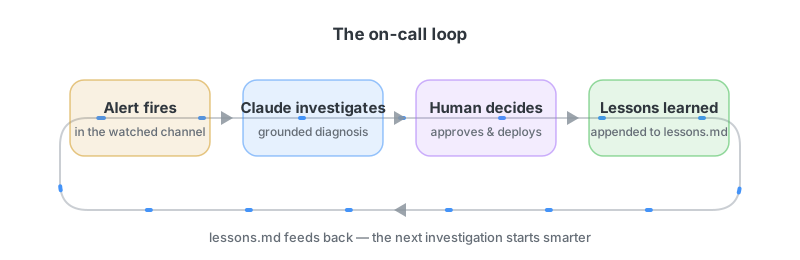
Put Claude in your team's incident channel. When an alert fires, it investigates and posts a first-pass diagnosis with a link behind every claim. A human decides what to do. Claude then watches the fix land and writes down what was learned, so the next incident starts smarter.
Reference implementation. Not maintained and not accepting contributions.
This is the kit behind the blog post on building a CI on-call with Claude: the playbooks, templates, and a guided setup that drafts those playbooks from your team's own incident history. (Throughout: a skill is a markdown instruction file that tells Claude how to do one job — triage an alert, write a handoff. You review and change skills like code.)
Two properties worth knowing up front:
- It works with whatever tools you already use. No skill names a
specific vendor. Skills refer to capabilities — the metrics source,
the log store, the pager, the code host — and one generated file,
STACK.md, maps each capability to the tool your channel actually has connected. Swap Datadog for Grafana, or PagerDuty for Opsgenie, and no skill changes. - You don't write the playbooks from scratch. Setup reads your team's past incidents — alert threads, pager history, postmortems — and drafts the playbooks from what your team actually did. You review and correct the drafts.
Try it in 10 minutes
Zero connections, zero admin. Clone this repo anywhere, open Claude Code
in it, and paste the one instruction from test-fixtures/RUNBOOK.md.
You'll watch the whole setup run against a fictional team's 48-incident
history: mining, playbook drafting, the sign-off gates, a graded
validation against an answer key. Nothing real is touched, so there is
nothing to clean up if you stop here.
The fixture doubles as the kit's regression test: change a skill, re-run it, diff against the key.
What you get
One Slack channel where:
- an alert landing in a watched channel (or a human declaring an incident) starts an investigation automatically
- Claude posts a grounded first-pass diagnosis — every claim linked to the log line or dashboard panel behind it — and proposes a fix
- a human decides, a human (or gated automation) deploys, and Claude watches the metrics land back at baseline
- anyone can ask for status on demand ("safe to merge?") and get an answer grounded in the open incident records
- every incident appends to
lessons.md, so the next investigation starts smarter - Monday morning, the handoff writes itself
The division of labor is fixed and non-negotiable (see CLAUDE.md):
Claude gathers evidence, proposes, verifies, and communicates. Humans
decide what to mitigate and when.
Words this kit uses
Eight terms, defined once:
- Capability binding — the line in
STACK.mdmapping an abstract capability ("metrics") to your real tool ("Grafana"). - Routine — a standing task Claude runs in the Slack channel on a schedule or trigger ("watch #ci-alerts", "post the handoff Monday 9am"). You create one by pasting or saying the request in the channel; anyone in the channel can list or disable them.
- Canvas — Slack's built-in document attached to a channel. The kit uses one to list the channel's routines and, optionally, to hold the weather report.
- Shadow period — the trial phase: Claude posts diagnoses to a review channel while humans handle incidents as before. It goes live only after its answers prove reliable.
- Holdout — a past incident deliberately kept out of playbook drafting, so it can serve as an unseen test in the Validate phase.
- Provenance tag — the annotation on every mined playbook claim
saying how many incidents support it, e.g.
(seen 2×, unverified). - Page-tier vs. morning log — the two urgency tiers: a page wakes
a human now; a morning log line waits for the daily summary.
ONCALL.mddecides which is which. - MCP — the connector protocol Claude uses to reach tools like your
metrics source or pager. Your Claude org Owner attaches these
connections (see
TAG-SETUP.md).
How it works: the incident loop
sequenceDiagram
    participant A as Alert channel
    participant C as Claude
    participant H as Human on-call

    A->>C: Alert fires
    Note over A,H: Page-worthy alerts page the human directly - Claude is never the detector
    C->>C: Classify the symptom,<br/>load the matching playbook,<br/>check past lessons
    C->>H: First-pass diagnosis with evidence links<br/>and a proposed fix
    H->>C: Pushback - could it be something else?
    C->>H: Checks the new hypothesis against the data,<br/>reports back either way
    H->>H: Decides on the fix and deploys it
    C->>H: Watches the metrics return to normal,<br/>confirms in the thread
    H->>H: Closes the incident - humans always close
    C->>C: Appends what was learned to lessons.md
Stage by stage:
| Lifecycle stage | Who/what |
|---|---|
| Detection | Your existing alerting stays primary: alerts fire into channels, and page-worthy ones page humans directly. Claude is never the detector. It watches the alert channels, triages what fires, and correlates across them — five alerts are often one incident. For a new service with no alerts yet, it drafts conservative starter rules for a human to install before launch |
| Diagnosis | The triage skill: classify the symptom, load the matching reference file, check lessons.md for known causes, post a grounded diagnosis with evidence links |
| Mitigation | Human decides. Claude proposes — including, where your team uses feature flags, a ready-to-execute canary ramp plan: the flag, the percentage steps, the hold time at each step, and the single metric that aborts the ramp. The human cross-examines, chooses, and deploys (or approves a gated action). The kit never touches a flag; it writes the plan a human runs |
| Verification | "Watch it land": Claude polls the affected metrics until baseline, posts confirmation |
| Communication | On-demand: anyone asks in the channel and gets a fresh-reader answer from the open incident records and ONCALL.md's health signals. Incident records are whatever your team already uses — threads, channels, pager incidents, tickets — bound in STACK.md, always opened by a human. Standing status is opt-in via the weather skill (see below) |
| Status (optional) | The weather routine: report written every cycle to one linkable page, channel posted only on event gates, always diffed against the last post the channel actually received — never against a report nobody saw |
| Learning | Every resolved incident appends to lessons.md; recurring patterns get promoted into reference files by PR |
| Handoff | The handoff skill, Monday morning: what happened / what it means / what you should do, triage-ready |
Open incidents move through four states. Every arrow into or out of the closed states is a human action; the one arrow Claude drives is the stale flag — an evidence-backed nudge, never a closure:
stateDiagram-v2
    [*] --> active: a human declares an incident
    active --> stale: quiet past the policy window
    stale --> active: a human posts an update
    active --> mitigated: a human ships a fix
    mitigated --> active: the symptom comes back
    mitigated --> resolved: a human confirms it is done
    active --> resolved: a human closes it
    stale --> resolved: a human closes it
    resolved --> [*]

    note right of stale
        Claude may flag an incident stale
        only on three independent signs
        of abandonment, and posts the
        evidence with the flag. It is a
        nudge, never a closure.
    end note
    note right of mitigated
        Fix is in and Claude is watching
        the metrics land. Only a human
        marks anything resolved.
    end note
Setting up: five gated phases
flowchart TD
    P0["Phase 0 - Discover<br/>List which tools Claude can read"] --> G0{"Gate: you confirm<br/>the tool map"}
    G0 -->|approved| P1["Phase 1 - Mine<br/>Read past incidents<br/>and draft the playbooks"]
    P1 --> G1{"Gate: you review<br/>every draft"}
    G1 -->|approved| P2["Phase 2 - Interview<br/>You set thresholds,<br/>routing, and severity"]
    P2 --> G2{"Gate: you sign off<br/>the policy file"}
    G2 -->|approved| P3["Phase 3 - Validate<br/>Replay held-back incidents<br/>and grade the answers"]
    P3 --> G3{"Gate: at least 70 percent pass<br/>and zero harmful answers"}
    G3 -->|pass| P4["Phase 4 - Install<br/>You paste the scheduled jobs<br/>into the Slack channel"]
    G3 -->|fail| P1
    P4 --> S["Shadow mode<br/>Diagnoses go to a review channel<br/>until they prove reliable"]

    style G0 fill:#fff3cd,stroke:#b8860b
    style G1 fill:#fff3cd,stroke:#b8860b
    style G2 fill:#fff3cd,stroke:#b8860b
    style G3 fill:#fff3cd,stroke:#b8860b
Every yellow diamond is a hard stop: Claude delivers the phase's output and waits for your sign-off. Nothing activates before Phase 4, and nothing pages anyone until after shadow mode.
| Phase | What happens | Output | Gate |
|---|---|---|---|
| 0. Discover | Enumerate the channel's connections; probe read access on each | STACK.md | human confirms the capability map |
| 1. Mine | Read the last 30–90 days of resolved incidents (pager history, alert-channel threads, postmortems); cluster into failure classes; draft one reference file per class; seed lessons.md; propose a routing tree from CODEOWNERS + who actually responded | draft skills/triage/references/*.md, seeded lessons.md, routing tree in ONCALL.md | human reviews every draft; low-confidence entries stay marked |
| 2. Interview | Ask the human only what can't be mined: paging thresholds (with suggested values from alert history), deploy windows, severity norms, escalation owners | completed ONCALL.md | human signs off the policy |
| 3. Validate | Replay 5–10 held-out past incidents (reserved during Mine and never used for drafting, so the test is blind) against the drafted playbooks; grade each ✅/⚠️/❌/🚫 | grading table | ≥70% ✅+⚠️ and zero 🚫, or return to Mine |
| 4. Install | Emit the paste-ready routine messages with real channel and tool names filled in | routines live in the channel | human pastes each routine |
The rhythm is identical every phase: a four-line briefing (what happens, how long, what changes, what the gate will ask), the work, a hard stop for your sign-off. Nothing rolls into the next phase on momentum. A few phase-specific notes:
- Mine opens with a scope-consent message — exactly which sources it
will read, exclusions honored — and ends with your failure classes,
playbook drafts tagged with provenance, a seeded
lessons.md, an alert-coverage report, and any routing conflicts or bus-factor findings. All proposals, nothing installed. - Interview is ~15 minutes of questions only a human can answer:
thresholds (with mined suggestions), severity, routing, deploy
windows, escalation timeout and fallback, alert-rule install mode.
Output: a completed
ONCALL.mdworth PR-reviewing. - Validate replays holdouts blind and grades them in a fresh context. The grading table is also what you show teammates who ask whether this is worth adopting.
- Install verifies the channel can actually read this repo. Then Claude hands you each routine as a short ready-to-paste message; you paste them into the Slack channel one at a time, smallest scope first. The alert-watch routine runs in shadow until the evidence clears the bar — two weeks triggers a mandatory review, not automatic graduation — and paging gets its own go/no-go decision after that.
One rule runs through everything: when a diagnosis is wrong, fix the playbook that produced it, not just the answer. One-off misses get corrected in the thread; a repeated miss means a playbook file needs amending. (The idea comes from the migration kit.)
Life after setup is three loops at three speeds: per incident (triage → verify → log), weekly (handoff with on-call health, drift check, promotion PRs), and quarterly (replay re-validation, especially after infrastructure changes). Your time goes to reading the handoff and merging small PRs; the judgment calls stay yours.
Installing for real
You don't need to memorize this list. The first time Claude opens a
session in a fresh clone (no STACK.md yet), it introduces itself, lays
out the five setup phases, and offers to start. Nothing runs, probes, or
connects without your explicit yes — there are no install-time triggers,
by design.
- Check your stack. Before asking anyone for anything, verify a
read-only connection exists for each capability you'll bind: metrics
(Grafana/Datadog/…), logs, code host, pager, and your alert channels.
Missing one is fine: the kit works around each gap, and the Gaps
section of
STACK.mdrecords exactly what you lose. Just know what's missing before the admin conversation, not after. - Copy the kit in. Copy these into the repository your on-call
channel will read (usually your team/infra repo):
CLAUDE.md's rules (merge the whole rules block into your repo'sCLAUDE.md, verbatim),skills/(oncall-setup, triage, handoff, and optionally weather),templates/,eval/replay.md,ONBOARD.md, and thisREADME.md(the oncall-setup skill reads it by name). Optional:test-fixtures/(the demo + regression test) andhooks/(plugin installs only). Setup will generate the rest at the root:STACK.md,ONCALL.md,lessons.md,paging-log.md,alert-coverage.md,eval/replay-results.md. - Connect the channel. Invite
@Claudeto your incident channel (/invite @Claude) and have an Owner attach the read-only connections from step 1. This uses Claude Tag — @Claude as a member of your Slack channels, available on Claude Team and Enterprise plans. New to it?TAG-SETUP.mdcovers what you can do yourself vs. what needs your Claude org Owner, including a paste-ready request message with a suggested pilot spend limit. - Run setup. In the channel, say
@Claude run the oncall-setup skill(or type the same in a Claude Code session opened in the repo). Each phase stops and waits for your sign-off before the next begins; nothing activates until the final phase. - Start in shadow. For the first stretch, Claude posts its
diagnoses to a separate review channel while humans handle incidents
exactly as before — you grade it without depending on it. Graduate it
when it clears the accuracy bar in
eval/replay.md, not after a fixed number of weeks.
What's in the kit
your-repo/
├── CLAUDE.md            # repo-wide context (yours; import the kit's rules)
├── ONCALL.md            # standing policy: paging criteria, routing, severity
├── STACK.md             # capability → connector map (generated by setup)
├── lessons.md           # living incident log (Claude appends, humans prune)
└── skills/
    ├── triage/          # SKILL.md router + references/<failure-class>.md
    ├── handoff/         # the weekly handoff
    └── weather/         # optional: the event-gated standing status report
Everything in the kit is one of four kinds of content. Every other doc defers to this table:
| Thing | Lives where | Who changes it | How |
|---|---|---|---|
| Skills (how to investigate, report, hand off) | this repo, skills/ | humans (Claude proposes) | pull request |
Policy (thresholds, routing, severity — ONCALL.md) | this repo, root | humans only | pull request |
| Routines (scheduled instructions telling Claude when and where to run standing work) | the Slack channel | anyone in the channel | say it in the channel |
Memory (lessons.md, paging-log.md; channel memory) | repo root (files) / Anthropic-side (channel memory) | Claude appends files freely; humans prune | direct append; files always outrank channel memory |
Rule of thumb: if it decides when/where, it's a routine; if it decides how and you'd want review before it changes, it's a file. Paging thresholds are policy, so they live in git.
Is it working?
Two levels, both in eval/replay.md:
- Per-incident: every diagnosis must carry evidence links; the human cross-examines; and within the hour, the metrics either return to baseline or they don't.
- Per-playbook: replay held-out historical incidents and grade. Track agreement rate, time-to-first-response, and escalation rate over time. Re-run the replay after any substantial playbook change.
What this kit deliberately does not do
-
Standing status is opt-in — and never a fast-polling agent. The default is status on demand: ask in the channel, get an answer grounded in the open incident records. If your team wants a standing "weather report" — one page compiling open incidents, build health, merge-queue stats, and deploy lag — install the optional
weatherskill and routine. It is built to be cheap and quiet. Each cycle starts with a fast check of whether a report is even due — frequent while a page-severity incident is open, hourly when quiet — and exits if it isn't time yet. The full report is written every cycle to one linkable page. The channel gets a post only when a defined event fires: a new incident, trunk blocked or cleared, a health tier crossed, an incident's status/severity/ETA changed, or a staleness check-in. Silence is the common case — a handful of posts a day in bad weather, near zero when it's sunny. An agent that re-investigates and posts on every cycle is explicitly out of scope. Full design:skills/weather/SKILL.md.
-
Not an incident-management framework. Severity levels, incident command, and stakeholder communications remain your team's existing process — the kit plugs into it (ONCALL.md links to yours) and never runs an incident or talks to stakeholders beyond the channel.
-
No auto-mitigation, period. The agent is read-only toward every system it monitors — its only outputs are messages, log entries, the opt-in weather report page, proposed PRs, and pages. There is no allowlist to widen. If your team wants automated mitigation, build it as its own system, with its own review and its own named owner — outside this kit. Proposing is fully in scope: a diagnosis may end with a paste-ready flag-ramp plan or an opened revert PR. Executing either is a human act, and verification (watch the metric land back at baseline at each ramp step) is Claude's job again once the human acts.
-
No vendor coupling. If a skill in your fork names a specific tool, that's a bug; put the binding in
STACK.md. -
No unreviewed memory. Channel memory — the facts Claude retains between conversations in a channel — is convenient, but nobody reviews it. Anything load-bearing (criteria, routing, lessons) lives in git, where it gets reviewed.
Adapting beyond CI
The kit is written for a CI/build-infrastructure on-call because that's
the worked example, but nothing binds it there. The failure classes in
skills/triage/references/ are yours to replace: a payments on-call
would have card-declines.md and webhook-lag.md instead of
test-failures.md and merge-queue.md. The setup skill's mining phase
discovers your classes from your history; the CI names in the
templates are placeholders, not defaults. The resolution patterns
transfer too: a payments team's card-declines reference would carry a
"proposing a ramp-down" block — the pattern is worked in
skills/triage/references/deploy-rollout.md. For a complete fictional
non-CI run — with the filled policy file and about 2 hours of total
human time — see examples/run1-webshop/.
Project status
Status: Reference code. Fork it and it becomes your team's code; your fork is expected to diverge as your playbooks grow. The one file worth diffing against upstream occasionally is
CLAUDE.md(the safety rules).
Support
This project is provided AS IS. Issues and pull requests are not monitored, so we cannot guarantee fixes for bugs or implementation of feature requests.
関連リソース
Engineering
PluginEveryday software engineering plugin: standup summaries, code review, structured debugging, architecture decision records, incident response and pre-deploy checks. Official from Anthropic, built mainly for Cowork but also usable in Claude Code.
anthropics/knowledge-work-plugins29.9k
PagerDuty
PluginPagerDuty's official plugin: analyzes your current git diff against the service's past incidents and change events, gives a 0-5 risk score and suggestions before you commit, and can create PagerDuty SRE Agent skills (early access program required). Needs a PagerDuty API token.
PagerDuty/claude-code-plugins7
Google Agent Skills
SkillGoogle's official skill library, focused on Google Cloud: 100+ skills for gcloud, Cloud Run, GKE, BigQuery, IAM, monitoring and logging, and the Well-Architected Framework, plus Ads and Analytics.
google/skills21.4k
Azure Skills
SkillMicrosoft's official Azure skill set: deployment prep and validation, deployment, production diagnostics, AKS, quota lookup, compliance audits, cloud migration and Foundry; the plugin version also connects the Azure MCP Server. Needs an Azure account and az login.
microsoft/azure-skills1.6k
Elastic Agent Skills
SkillElastic's official skills teaching agents to use Elasticsearch and Kibana correctly: index design, ES|QL queries, search relevance tuning, dashboards, observability troubleshooting and security alert triage. Currently a technical preview.
elastic/agent-skills593
Grafana Skills
SkillGrafana Labs' official skills: dashboards and alerting, PromQL, Loki, Tempo, Mimir and Pyroscope queries, Prometheus cardinality troubleshooting, Grafana Cloud management and cost optimization, k6 load testing and plugin development. Some skills need Grafana Cloud.
grafana/skills286