
MiniMax CLI (mmx)
CLIMiniMax's official CLI, built for agents: chat with MiniMax models from the terminal and generate images, video and speech, plus speech transcription, image understanding and web search. Works with the international platform. Requires a MiniMax Token Plan subscription.
The official CLI for the MiniMax AI Platform
Built for AI agents. Generate text, images, video, and speech — from any agent or terminal.


中文文档 · Global Platform · CN Platform · Example
Features
- Text — Multi-turn chat, streaming, system prompts, JSON output
- Image — Text-to-image with aspect ratio and batch controls
- Video — Async video generation with progress tracking
- Speech — TTS with 30+ voices, speed control, streaming playback; speech-to-text transcription (json, verbose_json, srt, vtt)
- Vision — Image understanding and description
- Search — Web search powered by MiniMax
- Dual Region — Seamless Global (
api.minimax.io) and CN (api.minimaxi.com) support
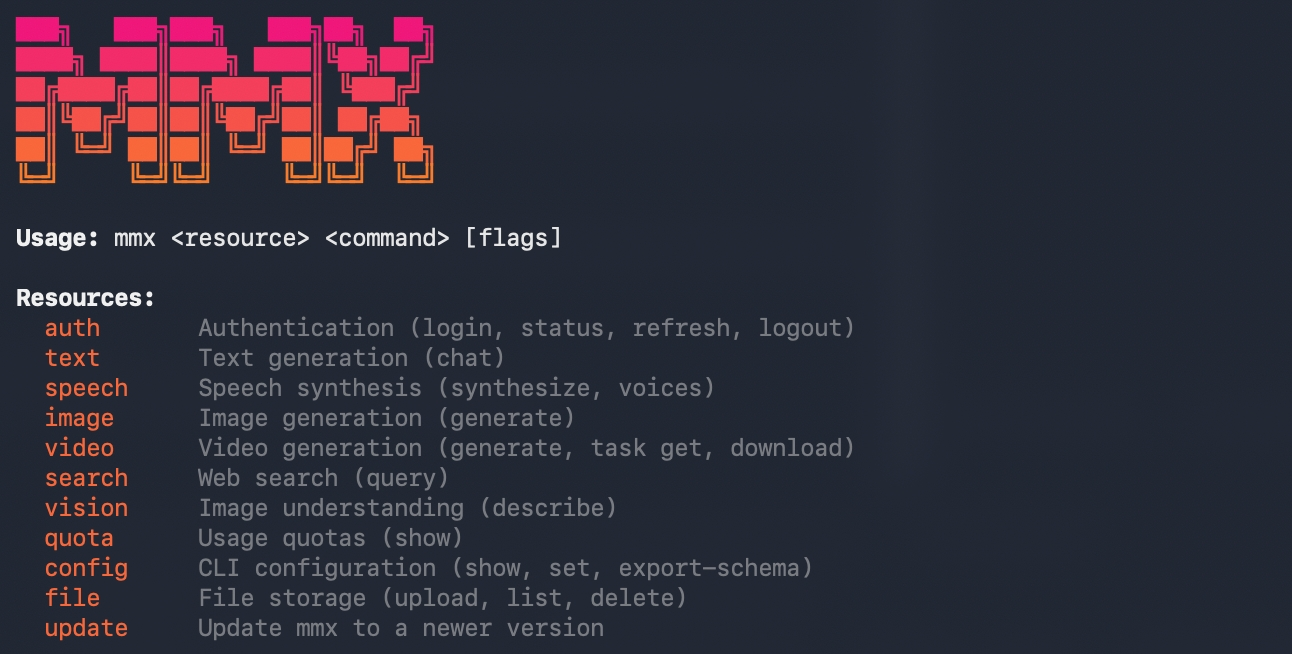
Install
# For AI agents (OpenClaw, Cursor, Claude Code, etc.): add skill to your agent
npx skills add MiniMax-AI/cli -y -g

# Or install CLI globally for terminal use
npm install -g mmx-cli
Requires Node.js 18+
Quick Start
# Authenticate (interactive — choose MiniMax OAuth or paste an API key)
mmx auth login

# Or non-interactive
mmx auth login --api-key sk-xxxxx

# Start creating
mmx text chat --message "What is MiniMax?"
mmx image "A cat in a spacesuit"
mmx speech synthesize --text "Hello!" --out hello.mp3
mmx speech transcribe --file meeting.mp3
mmx video generate --prompt "Ocean waves at sunset"
mmx search "MiniMax AI latest news"
mmx vision photo.jpg
mmx quota
Releasing
Maintainers publish releases by pushing a SemVer Git tag; the release workflow derives the npm package version from that tag. See the release guide.
Commands
mmx text
text chat and text repl default to MiniMax-M3.1-Flash-Preview. An explicit --model or saved default-text-model takes precedence. This preview currently requires M Plan or MiniMax Code; with a pay-as-you-go key, select MiniMax-M3 explicitly. See the model guide.
mmx text chat --message "Write a poem"
mmx text chat --model MiniMax-M3.1-Flash-Preview --message "Hello" --stream
mmx text chat --system "You are a coding assistant" --message "Fizzbuzz in Go"
mmx text chat --message "user:Hi" --message "assistant:Hey!" --message "How are you?"
cat messages.json | mmx text chat --messages-file - --output json
mmx image
mmx image "A cat in a spacesuit"
mmx image generate --prompt "A cat" --n 3 --aspect-ratio 16:9
mmx image generate --prompt "Logo" --out-dir ./out/
mmx video
# Hailuo-2.3 (Video Generation V1)
mmx video generate --prompt "Ocean waves at sunset" --download sunset.mp4
mmx video generate --prompt "A robot painting" --async

# MiniMax-H3 (Video Generation V2)
mmx video generate --api-key "$MINIMAX_API_KEY" --model MiniMax-H3 --prompt "Ocean waves at sunset"
mmx video generate --api-key "$MINIMAX_API_KEY" --model MiniMax-H3 --prompt "The subject walks forward" --image start.jpg
mmx video generate --api-key "$MINIMAX_API_KEY" --model MiniMax-H3 --prompt "Keep the same character" --reference-image character.png --reference-video motion.mp4

mmx video task get --task-id 123456
mmx video task get --task-id 424010985738629 --model MiniMax-H3
mmx video download --file-id 176844028768320 --out video.mp4
For MiniMax-H3, local files and Base64 data URIs are preflight-checked against the documented limits: image 30 MB, reference video 50 MB, reference audio 15 MB, and total JSON request body 64 MB. The API validates dimensions, aspect ratio, duration, frame rate, and codecs for all media.
--region is an existing global CLI option, not an H3 parameter. Normal video generation does not need it; the CLI uses the saved or automatically detected region. H3 defaults to 2K, 5 seconds, and 16:9 for text-to-video.
mmx speech
mmx speech synthesize --text "Hello!" --out hello.mp3
mmx speech synthesize --text "Stream me" --stream | mpv -
mmx speech synthesize --text "Hi" --voice English_magnetic_voiced_man --speed 1.2
echo "Breaking news" | mmx speech synthesize --text-file - --out news.mp3
mmx speech voices
# Speech-to-text (asr-1.0)
mmx speech transcribe --file meeting.mp3
mmx speech transcribe --file call.mp3 --language zh
mmx speech transcribe --file talk.mp3 --response-format verbose_json --output json
mmx speech transcribe --file talk.mp3 --response-format srt --out talk.srt
mmx speech transcribe --file long.mp3 --stream
mmx speech transcribe accepts wav, aiff, flac, m4a, mp3, aac, opus, and ogg files up to
50 MB and 500 seconds. Audio above 50 MB is rejected locally before upload; the 500 second
limit is enforced by the API. Omitting --language enables mixed-language recognition.
--response-format json (default) prints the transcript, verbose_json adds speakers and
per-segment timestamps, and srt / vtt return subtitle documents. n_speakers and
segments are part of the response, so pass --output json to see them. --stream prints
incremental text and requires json; when stdout is not a terminal it accumulates into a single
JSON result unless --output text is passed. mmx speech recognize is an alias for
mmx speech transcribe.
mmx vision
mmx vision photo.jpg
mmx vision describe --image https://example.com/img.jpg --prompt "What breed?"
mmx vision describe --file-id file-123
mmx search
mmx search "MiniMax AI"
mmx search query --q "latest news" --output json
The
/v1/coding_plan/searchAPI returns at most 10 results per call and does not currently expose a pagination parameter (see #107). Refine your query if you need different results.
mmx auth
mmx auth login                              # interactive: pick OAuth (Global / China) or paste an API key
mmx auth login --api-key sk-xxxxx           # save an API key directly
mmx auth login --recommend                  # skip the menu, pick OAuth region interactively
mmx auth login --recommend --region=global  # OAuth → api.minimax.io
mmx auth login --recommend --region=cn      # OAuth → api.minimaxi.com
mmx auth status
mmx auth refresh
mmx auth logout
mmx auth status is the canonical way to verify active authentication.
OAuth uses the Device Authorization Grant (RFC 8628) with PKCE —
the CLI opens your browser, you enter a code, and access_token + refresh_token
are saved to ~/.mmx/config.json. Tokens refresh automatically (5-min buffer);
manual refresh via mmx auth refresh.
API key auth auto-detects the correct region by probing both Global and CN.
Useful for CI/CD (mmx auth login --api-key sk-xxxxx), or pass per-command via --api-key.
OAuth and API key are mutually exclusive — logging in with one clears the other.
Credential priority: --api-key flag > OAuth (config) > api_key (config).
Environment variables
| Variable | Description |
|---|---|
MINIMAX_REGION | global or cn. |
MINIMAX_BASE_URL | Override the API base URL. |
MINIMAX_OUTPUT | text or json. |
MINIMAX_TIMEOUT | Request timeout in seconds. |
MINIMAX_VERBOSE | 1 to enable verbose HTTP logging. |
MMX_CONFIG_DIR | Directory containing the config.json file (default: ~/.mmx). Set this when mmx runs from a subprocess, service, or CI job whose home directory differs from where you logged in. |
mmx config · mmx quota
mmx quota
mmx config show
mmx config set --key region --value cn
mmx config set --key default-text-model --value MiniMax-M3.1-Flash-Preview
mmx config export-schema | jq .
mmx agent setup
Configure MiniMax for Claude Code, Codex, Grok Build, OpenCode, Hermes, Pi, or Oh my Pi while preserving unrelated settings. Run without options for the interactive wizard; supplying options makes the command non-interactive and suitable for scripts.
mmx agent setup
mmx agent setup --agent codex --agent claude-code --api-key "$MINIMAX_API_KEY" --region global
mmx agent setup --all --api-key "$MINIMAX_API_KEY" --region cn --output json
mmx agent setup --agent oh-my-pi --api-key "$MINIMAX_API_KEY" --region global
# --agent omp is an alias for --agent oh-my-pi
agent setup defaults to MiniMax-M3.1-Flash-Preview for subscription keys and to MiniMax-M3 for pay-as-you-go keys (sk-api-...). In non-interactive mode, --model overrides this selection.
The command verifies the key and selected region before writing. Existing files are backed up when changed; use --dry-run to preview without a live request. In the interactive wizard, compatible agents that are missing from PATH can be installed from a second multi-select list using their official packages or installer scripts. The Hermes install uses its official core CLI stages and skips optional system packages, Node workspace, browser, computer-use, setup, and gateway stages. After installation, mmx applies the MiniMax configuration while preserving installer settings. Agents that fail a platform or prerequisite check are explained and left configuration-only. Non-interactive invocations remain configuration-only, and the command never launches an agent.
Oh my Pi uses its native ~/.omp/agent/models.yml and config.yml (existing .yaml files are updated in place). Configuration honors OMP_PROFILE / PI_PROFILE, PI_CONFIG_DIR, and the default-profile PI_CODING_AGENT_DIR override. Run omp once to migrate legacy JSON-only configuration before using setup. Interactive installation uses the official prebuilt-binary installer, so it does not require Bun or npm.
mmx update
mmx update
mmx update latest
Thanks to
License
관련 리소스
MiniMax MCP
MCPMiniMax's official MCP: text-to-speech, voice cloning and voice design, text-to-image and video generation. Needs a MiniMax API key; the key and API host must belong to the same region (global or mainland China). Pay as you go.
MiniMax-AI/MiniMax-MCP1.6k
Higgsfield
PluginHiggsfield's official Codex plugin: uses its remote MCP to generate images and video from text or photos, like product-shot video ads or animated stills, with built-in flows for faceless narration, voiceover and burned-in captions. Needs a Higgsfield account; billed in credits.
openai/plugins7.5k
fal.ai Skills
SkillOfficial fal.ai skills: agents use the genmedia CLI to call fal's 1,000+ models for text-to-image, image-to-video, voiceover, product shots and ad creatives, and storyboard shorts, with prompting guides per model. Needs a fal.ai account and API key (pay as you go) and the genmedia CLI.
fal-ai-community/skills251genmedia CLI
CLIOfficial agent-first CLI from fal: search and run 1,200+ image, video and speech generation models on fal.ai, check parameters and pricing, upload inputs and download results, with structured JSON output. Good for batch image and promo asset generation. Needs a fal.ai API key, billed per use.
fal-ai-community/genmedia-cli80
MCP Servers for Google Cloud Genmedia APIs
MCPExperimental open-source generative media MCP servers from Google Cloud: Nano Banana images, Veo video, Gemini TTS and Chirp voices, Lyria music, and AVTool for compositing. Each registers separately; needs a billing-enabled Google Cloud project and gcloud login; AVTool needs FFmpeg.
GoogleCloudPlatform/genmedia-creative-studio1.2k
Pixelle MCP
MCPTurns ComfyUI workflows into MCP tools with no code, covering generation and conversion across text, image, speech and video; works with local ComfyUI or RunningHub in the cloud. Start the server with uvx pixelle and configure an LLM first.
ATH-MaaS/Pixelle-MCP1.1k