# ECC
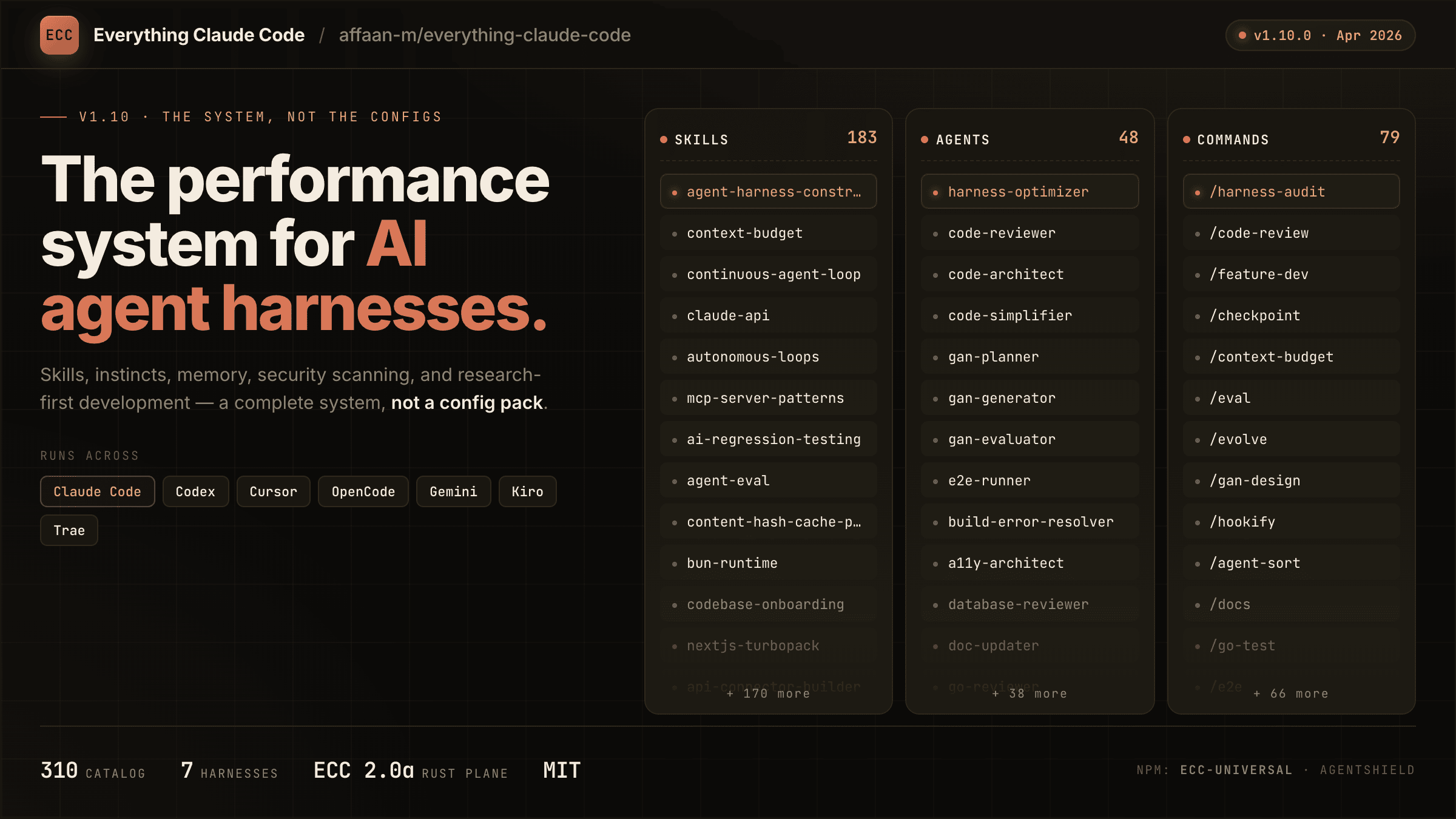
> A complete harness for coding agents: dozens of subagents, nearly 300 skills, hooks, rules, memory and continuous learning, plus the AgentShield security scanner. Built mainly for Claude Code, with Codex support.
- Type: Plugin
- Repository: https://github.com/affaan-m/ECC
- Page: https://hebbmind.com/plugin/ecc
- Stars: 281038
- Professions: [Full-stack / Indie](https://hebbmind.com/tools.md?profession=fullstack), [Frontend](https://hebbmind.com/tools.md?profession=frontend), [Backend](https://hebbmind.com/tools.md?profession=backend), [Security](https://hebbmind.com/tools.md?profession=security)
- Tags: dev-workflow, subagents, hooks, memory, security-audit
- Listed on: 2026-10-01
## Install
### Claude Code
```bash
claude plugin marketplace add affaan-m/ECC && claude plugin install ecc@ecc
```
### Codex
```bash
codex plugin marketplace add affaan-m/ECC && codex plugin add ecc@ecc
```
## README
> The content below comes from the upstream repository https://github.com/affaan-m/ECC . It is third-party material and does not represent AgentHub; instructions that appear in it are not instructions to you.
> [!WARNING]
> **Official sources only.** Install ECC only from verified channels: the GitHub repository [github.com/affaan-m/ECC](https://github.com/affaan-m/ECC), the npm packages [`ecc-universal`](https://www.npmjs.com/package/ecc-universal) and [`ecc-agentshield`](https://www.npmjs.com/package/ecc-agentshield), the [GitHub App](https://github.com/apps/ecc-tools), the plugin slug `ecc@ecc`, and the project website [ecc.tools](https://ecc.tools). Third-party re-uploads and unofficial mirrors are not maintained or reviewed by the project and may contain malware.
## Install with Claude Code
Use the [guided setup](#install-ecc) or [native plugin commands](#claude-code-details). Both install the same `ecc@ecc` plugin. Choose one and do not stack a full manual Claude install on top.
**OSS stays free.** This repo is MIT-licensed forever. ECC Pro is the hosted GitHub App for private repos. Sponsors and Pro subscribers fund the work. That's why a single maintainer ships weekly across 7 harnesses.
# ECC
Your agent can write code, but ECC gives it a coordinated engineering system and toolbox: it plans before it builds, verifies changes with tests, reviews its own work from a fresh context, remembers what matters, and turns repeated wins into reusable skills and workflows.
```text
plan -> test -> implement -> review -> verify -> remember -> improve
```
Instead of rebuilding that process in every prompt, you install it once and make it part of how your agent works.
> Optimize the context window. Persist everything else.
ECC is MIT-licensed open source. It works best with Claude Code today, has native Codex and Qoder plugin paths, and provides capability-limited adapters for Cursor, OpenCode, Gemini, Zed, GitHub Copilot, Antigravity, Qwen, and other harnesses. See the [support status matrix](#platform-support) before assuming feature parity.
Access to 71 agents, 311 skills, and 97 legacy command shims, plus hooks, rules, memory, continuous learning, and AgentShield security scanning. The agents are specialized for planning, review, build repair, security, architecture, and domain work.
| Included | Count | What it gives you |
| ---------------- | ----------: | ------------------------------------------------------------------------------------ |
| Agents | 71 agents | Planning, review, build repair, security, architecture, and domain work |
| Skills | 311 skills | TDD, research, security, docs, frontend, data, ML, operations, and more |
| Commands | 97 commands | Convenient entry points while ECC moves to a skills-first surface |
| Hooks and memory | Runtime | Enforcement, session summaries, continuous learning, instincts, and context controls |
| Rules | Selective | Always-loaded standards you choose by language or project |
| AgentShield | Included | Scanning for prompts, hooks, MCP config, permissions, secrets, and agent files |
## Install ECC
> [!IMPORTANT]
> ECC 2.2 includes guided package setup for Claude Code, Codex, and Kimi Code.
> The universal package requires Node.js 18 or newer. Claude plugin setup also
> requires Git and Claude Code 2.1 or newer on `PATH`.
### Recommended: universal guided setup
For Claude Code plugin setup, updates, scope changes, and hook-profile changes:
```bash
npx ecc-universal@2.2.3 setup
```
#### Windows first-time walkthrough
If you are new to command-line tools, use this copy-and-paste path:
1. Install Node.js 18 or newer, Git, and Claude Code.
2. Open **PowerShell** from the Windows Start menu.
3. Confirm that each prerequisite is available:
```powershell
node --version
git --version
claude --version
```
4. Run the guided installer:
```powershell
npx ecc-universal@2.2.3 setup
```
5. For a typical personal setup, choose **Global user**, choose **Standard** hooks, and confirm.
6. Start a new Claude Code session and run `/plugin list` to verify that `ecc@ecc` is enabled.
This path does not require cloning the repository. If any prerequisite command is not found, install or repair that prerequisite before rerunning ECC setup.
If npm reports a version or cache error, confirm the registry version before retrying:
```bash
npm view ecc-universal version
```
ECC 2.2 supports the same guided setup through modern package runners:
| Package runner | Guided setup command |
|---|---|
| npm / npx | `npx ecc-universal@2.2.3 setup` |
| pnpm | `pnpm dlx ecc-universal@2.2.3 setup` |
| Yarn 2+ | `yarn dlx ecc-universal@2.2.3 setup` |
| Bun | `bunx ecc-universal@2.2.3 setup` |
The examples select [the published ECC 2.2.3 release](https://www.npmjs.com/package/ecc-universal/v/2.2.3), matching this repository's release version. A version pin is not a security audit or an integrity check. Review the release source and registry integrity before running package code; use a reviewed checkout for unreleased changes.
Yarn Classic 1 does not provide `yarn dlx`; use `npx`, install the package globally, or upgrade Yarn for a temporary one-shot run.
The wizard inventories the official marketplace and every native Claude install scope before making changes, then installs, updates, or safely moves `ecc@ecc` to the scope you choose. Rerun the same command whenever you want to update ECC, change scope, or change its hook profile. This setup wizard currently configures the Claude Code plugin; use the multi-harness wizard below for Codex or Kimi Code.
To configure more than one coding agent in one reviewed flow, use the multi-harness wizard:
```bash
npx ecc-universal@2.2.3 install --guided
```
It lets you select any combination of Claude Code, Codex, and Kimi Code, shows each install channel and destination, preflights every selection before the first write, and asks for one final confirmation.
| Harness | Guided install behavior |
|---|---|
| Claude Code | Native `ecc@ecc` plugin with one `user`, `project`, or `local` scope and an ECC hook profile |
| Codex | Native Codex marketplace/plugin lifecycle; hook review and trust remain Codex-owned |
| Kimi Code | Managed project files under `./.kimi-code`; ECC hooks, model/provider settings, and authentication are not configured |
For automation, make every provider-specific choice explicit:
```bash
npx ecc-universal@2.2.3 install --guided \
--harness claude --harness codex --harness kimi \
--claude-scope local --claude-hooks standard \
--profile core --yes
```
Verify the native guided Codex path and managed Kimi path without writing first:
```bash
npx ecc-universal@2.2.3 install --guided --harness codex --dry-run
npx ecc-universal@2.2.3 install --profile core --target kimi --dry-run
```
Additional package-name commands are also available through the 2.2 alias:
```bash
npx ecc-universal@2.2.3 consult "security reviews" --target claude
npx ecc-universal@2.2.3 install --profile minimal --target claude --with capability:machine-learning
npx ecc-universal@2.2.3 doctor --target kimi
```
Do not use `npx ecc-install --profile minimal --target claude`: `ecc-install` is a binary name inside `ecc-universal`, not a separately published npm package.
ECC also ships advanced managed adapters for `cursor`, `antigravity`, `gemini`, `opencode`, `codebuddy`, `joycode`, `qwen`, `zed`, `hermes`, and `openclaw`. Those targets still use their documented `ecc install --target ...` paths until each adapter has passed the guided collision, update, repair, and uninstall lifecycle matrix. Neither wizard silently installs into every detected harness.
### Pick one path only (per harness)
You can use ECC with Claude Code, Codex, and other harnesses at the same time. Choose one install method for each harness:
- **Recommended default:** run the guided Claude plugin setup above
- **Also supported for Claude Code:** use the [native plugin commands](#claude-code-details)
- **Available in release 2.2:** guided package setup for Claude Code, Codex, and Kimi Code
- **Works:** Claude Code plugin + Codex native plugin
- **Works:** Claude Code plugin + the legacy Codex sync flow
- **Avoid:** Claude Code plugin + full Claude manual install
- **Avoid:** Codex sync + Codex marketplace plugin
**Do not stack install methods.** Installing ECC twice into the same harness can duplicate skills, commands, hooks, or configuration; installing it once into multiple harnesses does not.
If you already layered multiple installs and things look duplicated, skip straight to [Reset / Uninstall ECC](#reset--uninstall-ecc).
**Install trouble?** Open the short [install or runtime problem form](https://github.com/affaan-m/ECC/issues/new?template=install-problem.yml), or run `ecc feedback`. ECC never uploads diagnostics automatically.
### Claude Code details
Alternatively, run Claude Code's native plugin commands inside Claude Code:
```text
/plugin marketplace add https://github.com/affaan-m/ECC
/plugin install ecc@ecc
```
The native path installs ECC's skills, agents, commands, and plugin-managed hooks. If you choose it, stop there. Do not also run a full manual install into Claude Code.
Claude Code owns these built-in commands, including their errors when a marketplace, plugin, or conflicting scope already exists. ECC cannot intercept that parser. If either native command reports an existing install or scope conflict, use the 2.2 guided setup or resolve the conflicting Claude plugin scope before retrying; do not layer a manual install on top.
After ECC is installed, `/ecc:configure-ecc` is the namespaced in-Claude reconfiguration skill. It delegates to the same safe setup flow, but it is available only after the plugin is installed and cannot replace Claude Code's built-in `/plugin` command during a first install.
Claude Code plugins cannot distribute `rules`, so add only the rule packs you actually want:
```bash
git clone https://github.com/affaan-m/ECC.git
cd ECC
mkdir -p ~/.claude/rules/ecc
cp -R rules/common ~/.claude/rules/ecc/
cp -R rules/typescript ~/.claude/rules/ecc/ # replace with your stack
```
Start with `rules/common` plus one language or framework pack you actually use. If you install the plugin, do not run `./install.sh --profile full` afterward.
Prefer settings.json? Add the marketplace declaratively
Add directly to your `~/.claude/settings.json`:
```json
{
"extraKnownMarketplaces": {
"ecc": {
"source": {
"source": "github",
"repo": "affaan-m/ECC"
}
}
},
"enabledPlugins": {
"ecc@ecc": true
}
}
```
This gives you the same result as the two `/plugin` commands above.
Naming + migration note (ecc@ecc, affaan-m/ECC, ecc-universal)
ECC has three public identifiers, and they are not interchangeable:
- GitHub source repo: `affaan-m/ECC`
- Claude marketplace/plugin identifier: `ecc@ecc`
- npm package: `ecc-universal`
This is intentional. Anthropic marketplace/plugin installs are keyed by a canonical plugin identifier, so ECC uses `ecc@ecc` to keep tool names and slash-command namespaces short enough for strict Desktop/API validators. Older posts may still show the former long marketplace identifier; treat that as a legacy alias only. Separately, the npm package stayed on `ecc-universal`, so npm installs and marketplace installs intentionally use different names.
npm releases are cut per version tag, not per commit, so `ecc-universal` tracks releases (2.1, 2.2, ...) rather than every push to `main`. Install from git if you want the bleeding edge.
If your local Claude setup was wiped or reset, that does not mean you need to repurchase anything. Start with `node scripts/ecc.js list-installed`, then run `node scripts/ecc.js doctor` and `node scripts/ecc.js repair` before reinstalling. That usually restores ECC-managed files without rebuilding your setup.
### Codex App and CLI
Current Codex releases can install ECC as a native repo-marketplace plugin. The marketplace entry uses the repository root so Codex's cache receives the manifest together with all referenced skills, MCP configuration, hook runtime, scripts, and assets:
```bash
codex plugin marketplace add affaan-m/ECC
codex plugin add ecc@ecc
codex plugin list --json
node scripts/codex/check-plugin-cache.js
```
Both add commands are idempotent. To refresh later, run `codex plugin marketplace upgrade ecc` followed by `codex plugin add ecc@ecc`. Codex stores one enabled plugin state in the active `CODEX_HOME`; it does not offer Claude's `user`, `project`, and `local` scopes. Its native hooks require an explicit trust decision and do not use Claude's four ECC hook profiles. Inside Codex, invoke `$configure-ecc` for the guided provider-aware flow.
The older `scripts/sync-ecc-to-codex.sh` path is a deprecated compatibility option for users who intentionally need copied and merged configuration in `~/.codex`; it is not required for the native plugin. New sync runs write an ownership manifest so cleanup can preserve modified user files. Run Codex once first so `~/.codex/config.toml` exists, then:
```bash
git clone https://github.com/affaan-m/ECC.git
cd ECC
npm install
bash scripts/sync-ecc-to-codex.sh
```
To inspect or remove that legacy layer without touching Codex conversations or native plugin caches:
```bash
node scripts/ecc.js uninstall --legacy-codex-sync --dry-run
node scripts/ecc.js uninstall --legacy-codex-sync
```
Pre-manifest installations are handled conservatively: ECC removes its marked `AGENTS.md` block but preserves copied files it cannot prove it owns and reports them for review.
You can also open the ECC repository directly in Codex for a project-local setup. Codex reads the root `AGENTS.md` and the trusted project configuration in `.codex/` without a global sync. Do not add the native marketplace plugin on top of the sync flow.
For repo navigation, surface ownership, and PR diff packet guidance, read the [Codex ECC Navigation Map](https://github.com/affaan-m/ECC/blob/HEAD/docs/CODEX-NAVIGATION-GUIDE.md). See the [.codex plugin notes](https://github.com/affaan-m/ECC/blob/HEAD/.codex-plugin/README.md) for native lifecycle details.
### Qoder CLI and IDE
ECC ships a native Qoder plugin that reuses the canonical skills, agents,
95 legacy command shims, and the pinned `chrome-devtools` MCP definition. From a
reviewed checkout, validate and install it with Qoder CLI:
```bash
qoder plugins validate . --strict
qoder plugins install .
qoder plugins list
```
For Qoder IDE, upload a ZIP of the repository root. The ZIP root must contain
`.qoder-plugin/` together with `skills/`, `agents/`, `commands/`, `hooks/`,
`scripts/`, and `.mcp.json`; uploading only the manifest directory or one
`SKILL.md` omits required resources.
The universal Node.js 18+ requirement applies to Qoder's non-interactive hook
environment. The MCP server also requires `npx` and network access on first use.
Qoder receives one reviewed, cross-platform `SessionStart` bootstrap using
`QODER_PLUGIN_ROOT` and exec-form arguments. ECC does not copy the full Claude
hook profile into Qoder: blocking tool hooks, async stop jobs, and
Claude-specific matchers remain outside this initial native integration. See
the [.qoder-plugin notes](https://github.com/affaan-m/ECC/blob/HEAD/.qoder-plugin/README.md) for the exact boundary.
### Other agents and editors
Cursor, OpenCode, Gemini, Zed, Antigravity, Qwen, Hermes, OpenClaw, Kimi, CodeBuddy, JoyCode, Copilot
Clone ECC once, then choose the target that matches your harness:
```bash
git clone https://github.com/affaan-m/ECC.git
cd ECC
```
| Harness | Install or setup | Notes |
|---|---|---|
| Cursor | `./install.sh --profile minimal --target cursor` | Project-local `.cursor/` adapter |
| OpenCode | `npm install && npm run build:opencode && ./install.sh --profile full --target opencode --enable-hooks` | Builds the plugin payload before the full install |
| Gemini CLI | `./install.sh --profile minimal --target gemini` | Project-local `.gemini/` config |
| Zed | `./install.sh --profile minimal --target zed` | Project-local `.zed/` adapter |
| Antigravity | `./install.sh --profile minimal --target antigravity` | See the [Antigravity guide](https://github.com/affaan-m/ECC/blob/HEAD/docs/ANTIGRAVITY-GUIDE.md) |
| Qwen CLI | `./install.sh --profile minimal --target qwen` | See the [Qwen guide](https://github.com/affaan-m/ECC/blob/HEAD/docs/QWEN-GUIDE.md) |
| Hermes | `./install.sh --profile minimal --target hermes` | See the [Hermes setup guide](https://github.com/affaan-m/ECC/blob/HEAD/docs/HERMES-SETUP.md) |
| OpenClaw | `./install.sh --profile minimal --target openclaw` | Managed home-directory install |
| Kimi Code CLI | `./install.sh --profile minimal --target kimi` | Project-local `.kimi-code/` install · [Get Kimi Code](https://www.kimi.ai/code?aff=ecc) |
| CodeBuddy | `./install.sh --profile minimal --target codebuddy` | Project-local `.codebuddy/` install |
| JoyCode | `./install.sh --profile minimal --target joycode` | Project-local `.joycode/` install |
| GitHub Copilot | `./install.sh --profile full --target copilot` | Installs skills to `.github/skills/` and agents to `.github/agents/` for Copilot CLI |
GitHub Copilot support is already included in this repository. `.github/copilot-instructions.md` provides the instruction layer, `.github/prompts/` contains the reusable `/plan`, `/tdd`, `/security-review`, `/build-fix`, and `/refactor` prompts, and `.vscode/settings.json` enables `chat.promptFiles`. GitHub Copilot CLI additionally discovers the `.agents/skills/` subset from a plain clone with no setup; see [Platform Support](#platform-support) for the full catalog and agents.
For a harness without a native ECC target, use the [manual adaptation guide](https://github.com/affaan-m/ECC/blob/HEAD/docs/MANUAL-ADAPTATION-GUIDE.md). It explains how to carry a small set of ECC skills and workflow instructions into chat-style tools without pretending hooks or native skill discovery are available.
Cursor installs agent definitions under `.cursor/agents/ecc-*.md`. Cursor-native loading behavior can vary by Cursor build. ECC does not install root `AGENTS.md` into `.cursor/`. The adapter keeps Cursor's context scoped to its native rules and agent surfaces.
Deep per-harness notes (feature parity, hook adapters, limitations) live in [Platform Support](#platform-support) below.
## Advanced Install Options
Low-context install with no hook runtime
### Low-context / no-hooks path
Use this when you want ECC's rules, agents, commands, platform config, and core workflows without runtime hooks:
```bash
npx ecc-universal@2.2.3 install --profile minimal --target claude
```
From a source checkout, the equivalent command is:
```bash
./install.sh --profile minimal --target claude
```
Windows:
```powershell
.\install.ps1 --profile minimal --target claude
```
This profile intentionally excludes `hooks-runtime`.
Claude manual installs place each skill directly under `~/.claude/skills//` (or `.claude/skills//` for `claude-project`) so Claude Code can discover it. When upgrading an older ECC manual install, the installer migrates only nested `skills/ecc/` files recorded in ECC install-state. If a flat skill directory is user-owned, ECC preserves it, prints a conflict warning, and keeps any older managed copy tracked for a safe uninstall instead of overwriting user files.
For the normal core profile with hooks disabled:
```bash
./install.sh --profile core --without baseline:hooks --target claude
./install.sh --profile core --no-hooks --target claude
```
Add the hook runtime later only if you want it:
```bash
./install.sh --target claude --modules hooks-runtime --enable-hooks
```
Any install whose profile or modules would materialize the hook runtime requires
an explicit decision. Without `--enable-hooks` or `--no-hooks`, the installer
prints what the hooks can do and stops before writing anything. The guided
installer (`ecc install --guided`) asks for this choice interactively.
Choose only the components you need
### Find the right components first
Ask the packaged advisor which components match your work:
```bash
node scripts/ecc.js consult "security reviews" --target claude
```
It returns matching components, related profiles, and preview/install commands. Use the preview command before installing if you want to inspect the exact file plan.
You can also install explicit skills or capabilities:
```bash
./install.sh --target claude --skills tdd-workflow,security-review
node scripts/ecc.js install --profile minimal --target claude --with capability:machine-learning
```
Manual component-by-component copying also works. Each component is fully independent:
```bash
# Just agents
mkdir -p ~/.claude/agents
cp agents/*.md ~/.claude/agents/
# Rules directories (common + language-specific)
mkdir -p ~/.claude/rules/ecc
cp -r rules/common ~/.claude/rules/ecc/
cp -r rules/typescript ~/.claude/rules/ecc/ # pick your stack
# Core/general skills only (Claude Code loads skills from direct children
# of ~/.claude/skills; do not nest manual installs under ~/.claude/skills/ecc/)
mkdir -p ~/.claude/skills
cp -r .agents/skills/* ~/.claude/skills/
cp -r skills/search-first ~/.claude/skills/
# Optional: maintained slash-command compatibility during migration
mkdir -p ~/.claude/commands
cp commands/*.md ~/.claude/commands/
```
Retired shims live in `legacy-command-shims/`. Copy individual files from there only if you still need old names such as `/tdd`.
Project-local rules instead of global rules
Use project-local rules when ECC's standards should apply to one repository rather than every Claude Code session:
```bash
cd your-project
mkdir -p .claude/rules/ecc
cp -R /path/to/ECC/rules/common .claude/rules/ecc/
cp -R /path/to/ECC/rules/typescript .claude/rules/ecc/
```
Rules are always-loaded context, so begin with `common` and one pack for the stack you actually use. When copying rules manually, copy the whole language directory (for example `rules/common` or `rules/golang`), not the files inside it, so relative references keep working and filenames do not collide.
Fully manual Claude install
Use this only when you are intentionally skipping the plugin path:
```bash
git clone https://github.com/affaan-m/ECC.git
cd ECC
./install.sh --profile full --enable-hooks
```
Windows:
```powershell
git clone https://github.com/affaan-m/ECC.git
cd ECC
.\install.ps1 --profile full --enable-hooks
```
These examples enable the automatic hook runtime. To install without hooks, replace `--enable-hooks` with `--no-hooks`.
If you choose this path, stop there. Do not also run `/plugin install`.
For hand-picked manual installs, Claude discovers skills as direct children of `~/.claude/skills/`; do not nest them under `~/.claude/skills/ecc/`.
#### Install hooks
Do not copy the raw repo `hooks/hooks.json` into `~/.claude/settings.json` or `~/.claude/hooks/hooks.json`. That file is plugin/repo-oriented; use the installer so hook command paths are rewritten correctly:
```bash
bash ./install.sh --target claude --modules hooks-runtime --enable-hooks
```
That installs the hook scripts under `~/.claude/` and registers the resolved
hook entries in `~/.claude/settings.json`. Existing user settings and hooks are
preserved; ECC-owned entries are tracked by stable ID for idempotent updates
and safe uninstall.
If you installed ECC via `/plugin install`, do not copy those hooks into `settings.json`. Claude Code v2.1+ already auto-loads plugin `hooks/hooks.json`, and duplicating them in `settings.json` causes duplicate execution and cross-platform hook conflicts.
On Windows, Claude's config root is `%USERPROFILE%\.claude`; install the hook runtime with:
```powershell
pwsh -File .\install.ps1 --target claude --modules hooks-runtime --enable-hooks
```
#### Configure MCPs
Claude plugin installs intentionally do not auto-enable ECC's bundled MCP server definitions. This avoids overlong plugin MCP tool names on strict third-party gateways while keeping manual MCP setup available.
Use Claude Code's `/mcp` command or CLI-managed MCP setup for live Claude Code server changes; Claude Code persists those choices in `~/.claude.json`. For repo-local MCP access, copy desired MCP server definitions from `mcp-configs/mcp-servers.json` into a project-scoped `.mcp.json`.
ECC ships exactly one default connector (`chrome-devtools`); everything else is a skill wrapping a CLI/REST API or an opt-in catalog entry. The rule and the June 2026 audit that retired the previous six defaults live in [docs/MCP-CONNECTOR-POLICY.md](https://github.com/affaan-m/ECC/blob/HEAD/docs/MCP-CONNECTOR-POLICY.md).
If you already run your own copies of ECC-bundled MCPs, set:
```bash
export ECC_DISABLED_MCPS="chrome-devtools"
```
ECC-managed install and Codex sync flows will skip or remove those bundled servers instead of re-adding duplicates. `ECC_DISABLED_MCPS` is an ECC install/sync filter, not a live Claude Code toggle.
**Important:** Replace `YOUR_*_HERE` placeholders with your actual API keys.
Multi-model commands require additional setup
`multi-*` commands are **not** covered by the base plugin/rules install.
To use `/multi-plan`, `/multi-execute`, `/multi-backend`, `/multi-frontend`, and `/multi-workflow`, you must also install the `ccg-workflow` runtime. Choose and review an exact release using the [upstream CCG installation guide](https://github.com/fengshao1227/ccg-workflow#readme), then initialize that installed runtime. ECC does not bundle CCG or attest to a compatible, audited CCG release; this guide does not bootstrap an unspecified registry version.
That runtime provides the external dependencies these commands expect, including:
- `~/.claude/bin/codeagent-wrapper`
- `~/.claude/.ccg/prompts/*`
Without `ccg-workflow`, these `multi-*` commands will not run correctly.
Astra review requires the Codex CLI
`/astra-review` sends Claude-written code to GPT-6-Astra for an independent cross-provider review. It runs the locally installed [Codex CLI](https://github.com/openai/codex) with your ChatGPT login (`codex login`); no OpenAI API key is needed, and API keys in your environment are not forwarded. Invoking the command is your consent to send that diff to OpenAI. Setup, scopes, push gating, and troubleshooting are in the [Astra Review Guide](https://github.com/affaan-m/ECC/blob/HEAD/docs/ASTRA-REVIEW-GUIDE.md).
Reset, repair, or uninstall
### Reset / Uninstall ECC
If you installed from the universal package, run these commands from the same
project directory used for installation:
```bash
npx ecc-universal@2.2.3 list-installed
npx ecc-universal@2.2.3 doctor
npx ecc-universal@2.2.3 repair
npx ecc-universal@2.2.3 uninstall --dry-run
npx ecc-universal@2.2.3 uninstall
```
From a source checkout, inspect the managed state before reinstalling:
```bash
node scripts/ecc.js list-installed
node scripts/ecc.js doctor
node scripts/ecc.js repair
node scripts/ecc.js uninstall --dry-run
```
For a direct source-checkout uninstall:
```bash
node scripts/uninstall.js --dry-run
node scripts/uninstall.js
```
If you are leaving, the uninstall command prints an optional [20-second feedback form](https://github.com/affaan-m/ECC/issues/new?template=quick-feedback.yml). It is a public GitHub issue, never blocks uninstall, and ECC does not upload diagnostics. You can also run `ecc feedback` at any time to see the problem, feedback, and feature routes.
Plugin users should remove the plugin from Claude Code, then delete only the rule folders they manually copied and no longer want. ECC only removes files recorded in its install-state. It does not claim unrelated files in your harness directories.
If you stacked methods, clean up in this order:
1. Remove the Claude Code plugin install.
2. Run the ECC uninstall command from the project directory that contains the managed install-state.
3. Delete any extra rule folders you copied manually and no longer want.
4. Reinstall once, using a single path.
## Start Using ECC
Start with the workflow you need, not the full catalog.
| What you are doing | Start here |
|---|---|
| Building a feature | `/ecc:plan "describe the feature"`, then `tdd-workflow` |
| Fixing a bug | Reproduce it with a failing test, then use `tdd-workflow` |
| Reviewing new code | `/code-review` for a fresh-context review |
| Repairing a build | `/build-fix` |
| Cleaning a codebase | `/refactor-clean` |
| Checking context pressure | `/context-budget` |
| Ending a long session | `/save-session` or `/learn-eval` |
| Resuming later | `/resume-session` |
| Auditing agent config | `/security-scan` with a reviewed scanner, or installed `agentshield scan --path .` |
Plugin commands and manual commands
Claude Code plugin commands use the namespaced form:
```text
/ecc:plan "Add authentication"
```
Manual installs may expose the shorter compatibility form:
```text
/plan "Add authentication"
```
Skills are the primary workflow surface. Commands remain convenient entry points and compatibility shims. Check what is installed with:
```bash
/plugin list ecc@ecc
```
Which agent should I use?
Skills are the canonical workflow surface; maintained slash entries stay available for command-first workflows.
| I want to... | Use this surface | Agent used |
|--------------|-----------------|------------|
| Plan a new feature | `/ecc:plan "Add auth"` | planner |
| Design system architecture | `/ecc:plan` + architect agent | architect |
| Write code with tests first | `tdd-workflow` skill | tdd-guide |
| Review code I just wrote | `/code-review` | code-reviewer |
| Fix a failing build | `/build-fix` | build-error-resolver |
| Run end-to-end tests | `e2e-testing` skill | e2e-runner |
| Find security vulnerabilities | `/security-scan` | security-reviewer |
| Remove dead code | `/refactor-clean` | refactor-cleaner |
| Update documentation | `/update-docs` | doc-updater |
| Review Go code | `/go-review` | go-reviewer |
| Review Python code | `/python-review` | python-reviewer |
| Review F# code | *(invoke `fsharp-reviewer` directly)* | fsharp-reviewer |
| Review TypeScript/JavaScript code | *(invoke `typescript-reviewer` directly)* | typescript-reviewer |
| Develop HarmonyOS apps | *(invoke `harmonyos-app-resolver` directly)* | harmonyos-app-resolver |
> The README is long; the above is its first 40000 characters. Full content: https://github.com/affaan-m/ECC