Markdown‑native Task Manager & Kanban visualizer for any Git repository
AI agents write the code. You review the tasks: before, during, and after.




npm i -g backlog.md
 Getting started
```bash
# Install
npm i -g backlog.md
# or: bun add -g backlog.md
# or: brew install backlog-md
# or: nix run github:MrLesk/Backlog.md
# Initialize in any Git repo
backlog init "My Awesome Project"
# Or initialize without Git for local/non-code projects
backlog init "Personal Planning" --no-git
```
> [!TIP]
> **Trying it without installing?** Use the full package name: `npx backlog.md init "My Project"`, `npx backlog.md board`.
### Run with Nix
Run Backlog.md directly from the repository flake:
```bash
nix run github:MrLesk/Backlog.md -- --version
```
Or install the named package into your Nix profile:
```bash
nix profile install github:MrLesk/Backlog.md#backlog-md
```
The Nix flake supports `x86_64-linux`, `aarch64-linux`, and
`aarch64-darwin`. The x86_64 Linux package uses
[Bun's unified x64 runtime](https://bun.com/docs/installation#cpu-requirements),
with an SSE4.2 minimum and automatic CPU-specific paths. Pre-AVX2 compatibility
is checked under Ivy Bridge emulation. Intel macOS users can use the npm, Bun,
or Homebrew installation instead.
The init wizard will ask how you want to connect AI tools:
- **CLI instructions** (recommended): creates a short instruction file that tells agents to run `backlog instructions overview`.
- **MCP connector**: optionally auto-configures Claude Code, Codex, Gemini CLI, Kiro or Cursor for teams that prefer MCP.
- **Skip**: no AI setup; use Backlog.md purely as a task manager.
For Cursor with CLI instructions, select AGENTS.md or pass `--agent-instructions cursor`; both use the same AGENTS.md target. Backlog.md preserves existing AGENTS.md content and does not migrate or remove unrelated user-managed `.cursor/rules` files.
Everything is stored as human-readable Markdown in a project-local backlog folder such as `backlog/`, `.backlog/`, or a custom project-relative path configured through `backlog.config.yml` (e.g. `backlog_directory: my-backlog`). Task IDs use a configurable prefix (`backlog init --task-prefix`): the default produces `TASK-1`-style IDs, while this repository uses `back`, so examples below show `BACK-1`-style IDs. Git is optional: `backlog init --no-git` creates a filesystem-only project.
> [!TIP]
> **Want an architecture diagram of your repo, kept up to date automatically?** See the [Backlog.md + Groma.md integration](#groma-md) below.
---
## Working with AI agents
This is the recommended flow for Claude Code, Codex, Gemini CLI, Kiro and similar tools, following the **spec‑driven AI development** approach.
After running `backlog init`, agents should start by running `backlog instructions overview`. Work in this loop:
**Step 1: Describe your idea.** Tell the agent what you want to build and ask it to split the work into small tasks with clear descriptions and acceptance criteria.
**🤖 Ask your AI Agent:**
> I want to add a search feature to the web view that searches tasks, docs, and decisions. Please decompose this into small Backlog.md tasks.
> [!NOTE]
> **Review checkpoint #1:** read the task descriptions and acceptance criteria.
**Step 2: One task at a time.** Work on a single task per agent session, one PR per task. Good task splitting means each session can work independently without conflicts. Make sure each task is small enough to complete in a single conversation. You want to avoid running out of context window.
**Step 3: Plan before coding.** Ask the agent to research and write an implementation plan in the task. Do this right before implementation so the plan reflects the current state of the codebase.
**🤖 Ask your AI Agent:**
> Work on BACK-10 only. Research the codebase and write an implementation plan in the task. Wait for my approval before coding.
> [!NOTE]
> **Review checkpoint #2:** read the plan. Does the approach make sense? Approve it or ask the agent to revise.
**Step 4: Implement and verify.** Let the agent implement the task.
> [!NOTE]
> **Review checkpoint #3:** review the code, run tests, check linting, and verify the results match your expectations.
Mark verified work Done (or the configured final status). During periodic cleanup, `backlog task archive` moves it off the board; the same command takes canceled, duplicate, or invalid work off the board at any time. An archived task keeps its ID, record, and dependency links, stays readable with `backlog task view`, and is read-only. `backlog task restore` brings an archived task back to the board with the same ID. To remove a task for good, archive it and then run `backlog task delete`, which releases its ID once no other branch or worktree still holds the task.
If the output is not good enough: clear the plan/notes/final summary, refine the task description and acceptance criteria, and run the task again in a fresh session.
---
## Working without AI agents
Use Backlog.md as a standalone task manager from the terminal or browser.
```bash
# Create and refine tasks
backlog task create "Render markdown as kanban"
backlog task edit BACK-1 -d "Detailed context" --ac "Clear acceptance criteria"
# Track work
backlog task list -s "To Do"
backlog task list --json | jq '.tasks[] | .id'
backlog task edit BACK-1 --comment "Can we split the UI work into a separate PR?" --comment-author @sara
backlog search "kanban"
backlog board
# Work visually in the browser
backlog browser
```
You can switch between AI-assisted and manual workflows at any time; both operate on the same Markdown task files. Just prefer Backlog.md commands (CLI/MCP/Web) over hand-editing task files, so field types and metadata stay consistent.
Read commands support stable, versioned JSON for scripts and integrations. Use `--json` with `task list`, `task view`, the `task
Getting started
```bash
# Install
npm i -g backlog.md
# or: bun add -g backlog.md
# or: brew install backlog-md
# or: nix run github:MrLesk/Backlog.md
# Initialize in any Git repo
backlog init "My Awesome Project"
# Or initialize without Git for local/non-code projects
backlog init "Personal Planning" --no-git
```
> [!TIP]
> **Trying it without installing?** Use the full package name: `npx backlog.md init "My Project"`, `npx backlog.md board`.
### Run with Nix
Run Backlog.md directly from the repository flake:
```bash
nix run github:MrLesk/Backlog.md -- --version
```
Or install the named package into your Nix profile:
```bash
nix profile install github:MrLesk/Backlog.md#backlog-md
```
The Nix flake supports `x86_64-linux`, `aarch64-linux`, and
`aarch64-darwin`. The x86_64 Linux package uses
[Bun's unified x64 runtime](https://bun.com/docs/installation#cpu-requirements),
with an SSE4.2 minimum and automatic CPU-specific paths. Pre-AVX2 compatibility
is checked under Ivy Bridge emulation. Intel macOS users can use the npm, Bun,
or Homebrew installation instead.
The init wizard will ask how you want to connect AI tools:
- **CLI instructions** (recommended): creates a short instruction file that tells agents to run `backlog instructions overview`.
- **MCP connector**: optionally auto-configures Claude Code, Codex, Gemini CLI, Kiro or Cursor for teams that prefer MCP.
- **Skip**: no AI setup; use Backlog.md purely as a task manager.
For Cursor with CLI instructions, select AGENTS.md or pass `--agent-instructions cursor`; both use the same AGENTS.md target. Backlog.md preserves existing AGENTS.md content and does not migrate or remove unrelated user-managed `.cursor/rules` files.
Everything is stored as human-readable Markdown in a project-local backlog folder such as `backlog/`, `.backlog/`, or a custom project-relative path configured through `backlog.config.yml` (e.g. `backlog_directory: my-backlog`). Task IDs use a configurable prefix (`backlog init --task-prefix`): the default produces `TASK-1`-style IDs, while this repository uses `back`, so examples below show `BACK-1`-style IDs. Git is optional: `backlog init --no-git` creates a filesystem-only project.
> [!TIP]
> **Want an architecture diagram of your repo, kept up to date automatically?** See the [Backlog.md + Groma.md integration](#groma-md) below.
---
## Working with AI agents
This is the recommended flow for Claude Code, Codex, Gemini CLI, Kiro and similar tools, following the **spec‑driven AI development** approach.
After running `backlog init`, agents should start by running `backlog instructions overview`. Work in this loop:
**Step 1: Describe your idea.** Tell the agent what you want to build and ask it to split the work into small tasks with clear descriptions and acceptance criteria.
**🤖 Ask your AI Agent:**
> I want to add a search feature to the web view that searches tasks, docs, and decisions. Please decompose this into small Backlog.md tasks.
> [!NOTE]
> **Review checkpoint #1:** read the task descriptions and acceptance criteria.
**Step 2: One task at a time.** Work on a single task per agent session, one PR per task. Good task splitting means each session can work independently without conflicts. Make sure each task is small enough to complete in a single conversation. You want to avoid running out of context window.
**Step 3: Plan before coding.** Ask the agent to research and write an implementation plan in the task. Do this right before implementation so the plan reflects the current state of the codebase.
**🤖 Ask your AI Agent:**
> Work on BACK-10 only. Research the codebase and write an implementation plan in the task. Wait for my approval before coding.
> [!NOTE]
> **Review checkpoint #2:** read the plan. Does the approach make sense? Approve it or ask the agent to revise.
**Step 4: Implement and verify.** Let the agent implement the task.
> [!NOTE]
> **Review checkpoint #3:** review the code, run tests, check linting, and verify the results match your expectations.
Mark verified work Done (or the configured final status). During periodic cleanup, `backlog task archive` moves it off the board; the same command takes canceled, duplicate, or invalid work off the board at any time. An archived task keeps its ID, record, and dependency links, stays readable with `backlog task view`, and is read-only. `backlog task restore` brings an archived task back to the board with the same ID. To remove a task for good, archive it and then run `backlog task delete`, which releases its ID once no other branch or worktree still holds the task.
If the output is not good enough: clear the plan/notes/final summary, refine the task description and acceptance criteria, and run the task again in a fresh session.
---
## Working without AI agents
Use Backlog.md as a standalone task manager from the terminal or browser.
```bash
# Create and refine tasks
backlog task create "Render markdown as kanban"
backlog task edit BACK-1 -d "Detailed context" --ac "Clear acceptance criteria"
# Track work
backlog task list -s "To Do"
backlog task list --json | jq '.tasks[] | .id'
backlog task edit BACK-1 --comment "Can we split the UI work into a separate PR?" --comment-author @sara
backlog search "kanban"
backlog board
# Work visually in the browser
backlog browser
```
You can switch between AI-assisted and manual workflows at any time; both operate on the same Markdown task files. Just prefer Backlog.md commands (CLI/MCP/Web) over hand-editing task files, so field types and metadata stay consistent.
Read commands support stable, versioned JSON for scripts and integrations. Use `--json` with `task list`, `task view`, the `task 
 Web Interface
Launch a web interface for visual task management on the local machine. The server listens on `127.0.0.1` and is not
reachable from other devices on the LAN or VPN:
```bash
# Start the web server (opens browser automatically)
backlog browser
# Custom port
backlog browser --port 8080
# Don't open browser automatically
backlog browser --no-open
```
**Features:**
- Interactive Kanban board with drag-and-drop
- Multi-select cards to move several tasks to one column
- Task creation and editing with forms
- Interactive acceptance criteria editor with checklists
- Real-time updates across all views
- Responsive design for desktop and mobile
- Task archiving with confirmation dialogs
- Seamless CLI integration - all changes sync with markdown files
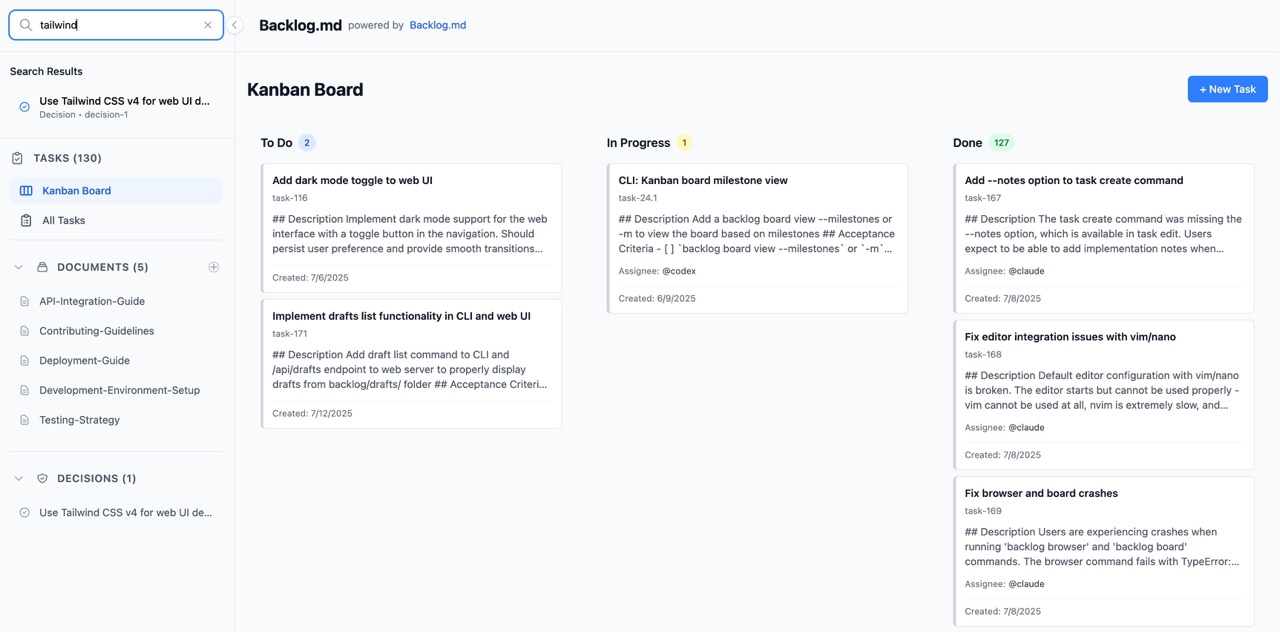
To keep the Web UI running as an auto-starting local service, see [Running Backlog.md as a Service](https://github.com/MrLesk/Backlog.md/blob/HEAD/backlog/docs/doc-003%20-%20Running-Backlog-Browser-as-a-Service.md).
---
## 🔧 MCP Integration (Model Context Protocol)
CLI instructions are the default AI setup. MCP remains supported for AI coding assistants like Claude Code, Codex, Gemini CLI and Kiro when you explicitly prefer an MCP connector.
You can run `backlog init` (even if you already initialized Backlog.md) and choose MCP integration, or follow the manual steps below.
### Client guides
Web Interface
Launch a web interface for visual task management on the local machine. The server listens on `127.0.0.1` and is not
reachable from other devices on the LAN or VPN:
```bash
# Start the web server (opens browser automatically)
backlog browser
# Custom port
backlog browser --port 8080
# Don't open browser automatically
backlog browser --no-open
```
**Features:**
- Interactive Kanban board with drag-and-drop
- Multi-select cards to move several tasks to one column
- Task creation and editing with forms
- Interactive acceptance criteria editor with checklists
- Real-time updates across all views
- Responsive design for desktop and mobile
- Task archiving with confirmation dialogs
- Seamless CLI integration - all changes sync with markdown files

To keep the Web UI running as an auto-starting local service, see [Running Backlog.md as a Service](https://github.com/MrLesk/Backlog.md/blob/HEAD/backlog/docs/doc-003%20-%20Running-Backlog-Browser-as-a-Service.md).
---
## 🔧 MCP Integration (Model Context Protocol)
CLI instructions are the default AI setup. MCP remains supported for AI coding assistants like Claude Code, Codex, Gemini CLI and Kiro when you explicitly prefer an MCP connector.
You can run `backlog init` (even if you already initialized Backlog.md) and choose MCP integration, or follow the manual steps below.
### Client guides
 CLI reference
Full command reference covering task management, search, board, docs, decisions, and more: **[CLI-INSTRUCTIONS.md](https://github.com/MrLesk/Backlog.md/blob/HEAD/CLI-INSTRUCTIONS.md)**
Quick examples: `backlog`, `backlog instructions`, `backlog task create`, `backlog task list`, `backlog task edit`, `backlog milestone add`, `backlog milestone rename`, `backlog milestone remove`, `backlog search`, `backlog board`, `backlog browser`.
Full help: `backlog --help`
---
##
CLI reference
Full command reference covering task management, search, board, docs, decisions, and more: **[CLI-INSTRUCTIONS.md](https://github.com/MrLesk/Backlog.md/blob/HEAD/CLI-INSTRUCTIONS.md)**
Quick examples: `backlog`, `backlog instructions`, `backlog task create`, `backlog task list`, `backlog task edit`, `backlog milestone add`, `backlog milestone rename`, `backlog milestone remove`, `backlog search`, `backlog board`, `backlog browser`.
Full help: `backlog --help`
---
##  Configuration
Backlog.md works with zero configuration. Settings merge from CLI flags, then the project config file (`backlog.config.yml` when present, otherwise `backlog/config.yml` or `.backlog/config.yml`), then built‑in defaults.
Run `backlog config` with no arguments to launch the interactive wizard (the same experience triggered from `backlog init` advanced setup). It walks through cross-branch accuracy (`checkActiveBranches`, `remoteOperations`, `activeBranchDays`), Git workflow (`autoCommit`, `bypassGitHooks`), ID formatting (`zeroPaddedIds`), editor integration (`defaultEditor`), Definition of Done defaults, and Web UI defaults (`defaultPort`, `autoOpenBrowser`). Skipping the wizard applies the safe built-in defaults, and rerunning `backlog init` or `backlog config` pre-populates prompts with your current values.
For filesystem-only projects (`backlog init --no-git`), the saved config forces `checkActiveBranches=false`, `remoteOperations=false`, and `autoCommit=false` so CLI, Web, and MCP local-file workflows do not depend on a Git repository.
### Definition of Done defaults
Set project-wide DoD items with `backlog config` (or during `backlog init` advanced setup), in the Web UI (Settings → Definition of Done Defaults), or by editing the project config file directly:
```yaml
definition_of_done:
- Tests pass
- Documentation updated
- No regressions introduced
```
When a project uses root config discovery, edit `backlog.config.yml` instead of `backlog/config.yml`.
These items are added to every new task by default. You can add more on create with `--dod`, or disable defaults per task with `--no-dod-defaults`.
For the full configuration reference (all options, default values, commands, and detailed notes), see **[ADVANCED-CONFIG.md](https://github.com/MrLesk/Backlog.md/blob/HEAD/ADVANCED-CONFIG.md)**.
---
## Troubleshooting
### Apple Silicon (macOS)
On M-series Macs, `backlog` can fail with `illegal hardware instruction` or `Binary package not installed for darwin-...` when Node, Bun, or Homebrew run under Rosetta (x64 emulation) and install the Intel binary instead of the arm64 one — or the other way around. The launcher runs whichever darwin variant (arm64 or x64) is actually installed, but a clean native-arch install is the reliable fix.
Check what your tools report:
```bash
uname -m # arm64 = Apple Silicon hardware; x86_64 = Intel or a Rosetta shell
node -p process.arch # architecture of your Node/Bun runtime
sysctl -in sysctl.proc_translated # 1 = current shell runs under Rosetta
which brew # /opt/homebrew = arm64 brew, /usr/local = Intel brew
```
If the architectures disagree, reinstall with the native one:
```bash
# Homebrew: make sure `which brew` prints /opt/homebrew, then
brew reinstall backlog-md
# npm
arch -arm64 npm i -g backlog.md
# Bun
arch -arm64 bun add -g backlog.md
```
Running an x64 Node under Rosetta on purpose also works: `backlog` falls back to whichever `backlog.md-darwin-*` package is present.
---
## 📺 Talks & Community
Watch Backlog.md in action:
- **Devoxx Belgium 2025**: [the spec-driven agent workflow behind Backlog.md, live on stage](https://www.youtube.com/watch?v=LSoDQU_9MMA)
- **AI Engineer Code Summit 2025**: [Backlog.md: task management for AI agents](https://www.youtube.com/watch?v=zMXKhhwiCIc)
- Slides from these and more talks: [mrlesk.com/talks](https://mrlesk.com/talks)
### Community tools
- **[vscode-backlog-md](https://marketplace.visualstudio.com/items?itemName=ysamlan.vscode-backlog-md)** - VS Code extension with issues panel, kanban view, and editing. ([ysamlan/vscode-backlog-md](https://github.com/ysamlan/vscode-backlog-md))
---
## License
Backlog.md is released under the **MIT License**: do anything, just give credit. See [LICENSE](https://github.com/MrLesk/Backlog.md/blob/HEAD/LICENSE).
Configuration
Backlog.md works with zero configuration. Settings merge from CLI flags, then the project config file (`backlog.config.yml` when present, otherwise `backlog/config.yml` or `.backlog/config.yml`), then built‑in defaults.
Run `backlog config` with no arguments to launch the interactive wizard (the same experience triggered from `backlog init` advanced setup). It walks through cross-branch accuracy (`checkActiveBranches`, `remoteOperations`, `activeBranchDays`), Git workflow (`autoCommit`, `bypassGitHooks`), ID formatting (`zeroPaddedIds`), editor integration (`defaultEditor`), Definition of Done defaults, and Web UI defaults (`defaultPort`, `autoOpenBrowser`). Skipping the wizard applies the safe built-in defaults, and rerunning `backlog init` or `backlog config` pre-populates prompts with your current values.
For filesystem-only projects (`backlog init --no-git`), the saved config forces `checkActiveBranches=false`, `remoteOperations=false`, and `autoCommit=false` so CLI, Web, and MCP local-file workflows do not depend on a Git repository.
### Definition of Done defaults
Set project-wide DoD items with `backlog config` (or during `backlog init` advanced setup), in the Web UI (Settings → Definition of Done Defaults), or by editing the project config file directly:
```yaml
definition_of_done:
- Tests pass
- Documentation updated
- No regressions introduced
```
When a project uses root config discovery, edit `backlog.config.yml` instead of `backlog/config.yml`.
These items are added to every new task by default. You can add more on create with `--dod`, or disable defaults per task with `--no-dod-defaults`.
For the full configuration reference (all options, default values, commands, and detailed notes), see **[ADVANCED-CONFIG.md](https://github.com/MrLesk/Backlog.md/blob/HEAD/ADVANCED-CONFIG.md)**.
---
## Troubleshooting
### Apple Silicon (macOS)
On M-series Macs, `backlog` can fail with `illegal hardware instruction` or `Binary package not installed for darwin-...` when Node, Bun, or Homebrew run under Rosetta (x64 emulation) and install the Intel binary instead of the arm64 one — or the other way around. The launcher runs whichever darwin variant (arm64 or x64) is actually installed, but a clean native-arch install is the reliable fix.
Check what your tools report:
```bash
uname -m # arm64 = Apple Silicon hardware; x86_64 = Intel or a Rosetta shell
node -p process.arch # architecture of your Node/Bun runtime
sysctl -in sysctl.proc_translated # 1 = current shell runs under Rosetta
which brew # /opt/homebrew = arm64 brew, /usr/local = Intel brew
```
If the architectures disagree, reinstall with the native one:
```bash
# Homebrew: make sure `which brew` prints /opt/homebrew, then
brew reinstall backlog-md
# npm
arch -arm64 npm i -g backlog.md
# Bun
arch -arm64 bun add -g backlog.md
```
Running an x64 Node under Rosetta on purpose also works: `backlog` falls back to whichever `backlog.md-darwin-*` package is present.
---
## 📺 Talks & Community
Watch Backlog.md in action:
- **Devoxx Belgium 2025**: [the spec-driven agent workflow behind Backlog.md, live on stage](https://www.youtube.com/watch?v=LSoDQU_9MMA)
- **AI Engineer Code Summit 2025**: [Backlog.md: task management for AI agents](https://www.youtube.com/watch?v=zMXKhhwiCIc)
- Slides from these and more talks: [mrlesk.com/talks](https://mrlesk.com/talks)
### Community tools
- **[vscode-backlog-md](https://marketplace.visualstudio.com/items?itemName=ysamlan.vscode-backlog-md)** - VS Code extension with issues panel, kanban view, and editing. ([ysamlan/vscode-backlog-md](https://github.com/ysamlan/vscode-backlog-md))
---
## License
Backlog.md is released under the **MIT License**: do anything, just give credit. See [LICENSE](https://github.com/MrLesk/Backlog.md/blob/HEAD/LICENSE).