



This project’s future depends on community support. Become a sponsor today.
## About `croc` is a tool that allows any two computers to simply and securely transfer files and folders. AFAIK, _croc_ is the only CLI file-transfer tool that does **all** of the following: - Allows **any two computers** to transfer data (p2p with relay fallback) - Provides **end-to-end encryption** (using PAKE) - Enables easy **cross-platform** transfers (Windows, Linux, Mac, [Browser](https://getcroc.com)) - Allows **multiple file** transfers - Allows **resuming transfers** that are interrupted - No need for local server or port-forwarding - **IPv6-first** with IPv4 fallback - Can **use a proxy**, like Tor For more information about `croc`, see [my blog post](https://schollz.com/tinker/croc6/) or read a [recent interview I did](https://console.substack.com/p/console-91). 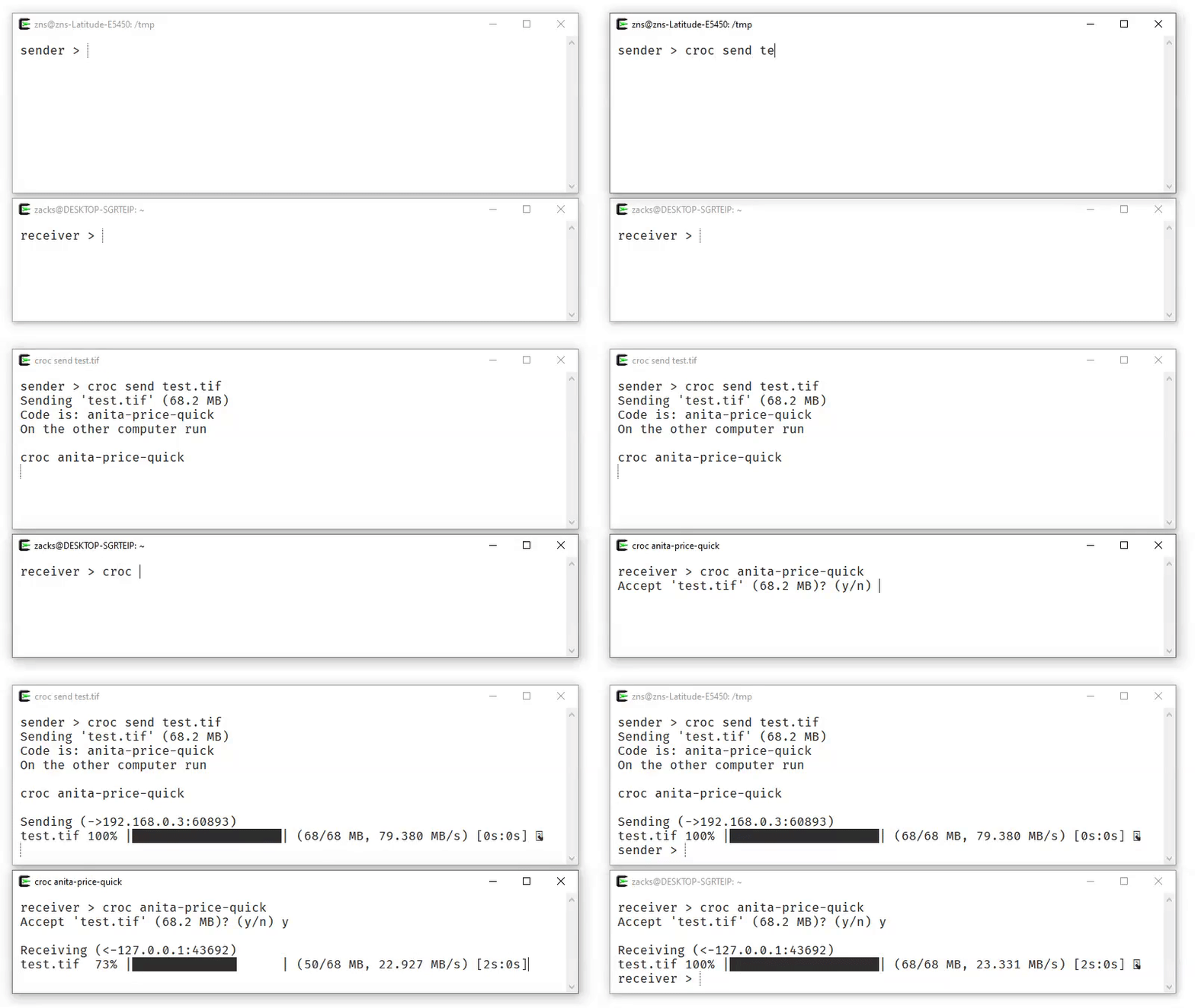 ## No-install You can use croc without installing anything at [getcroc.com](https://getcroc.com). The browser version is fully compatible with the CLI, so you can send and receive files between them. ## Install You can download [the latest release for your system](https://github.com/schollz/croc/releases/latest), or install a release from the command-line: ```bash curl https://getcroc.com | bash ``` When the CLI sends or receives a transfer, it checks for a newer croc release at most once every 24 hours. The check runs in the background and any update notice is shown after the transfer finishes. Run `croc update --check` at any time to check explicitly. Installations made by the command above can use `croc update` (`croc upgrade` is an alias) to verify and install a stable release when the executable is user-writable; pass `--yes` to skip confirmation. Package-managed and other installations are never overwritten; the command prints the appropriate upgrade guidance instead. Network and release-service failures in background checks are ignored; `--quiet` suppresses the notice. ### On macOS Using [Homebrew](https://brew.sh/): ```bash brew install croc ``` Using [MacPorts](https://www.macports.org/): ```bash sudo port selfupdate sudo port install croc ``` ### On Windows You can install the latest release with [Scoop](https://scoop.sh/) or [Chocolatey](https://chocolatey.org/): ```bash scoop install croc ``` ```bash choco install croc ``` ### Using nix-env You can install the latest release with [Nix](https://nixos.org/): ```bash nix-env -i croc ``` ### On NixOS You can add this to your [configuration.nix](https://nixos.org/manual/nixos/stable/#ch-configuration): ```nix environment.systemPackages = [ pkgs.croc ]; ``` ### On Alpine Linux Enable the community repository for your Alpine release, then install: ```bash apk add croc ``` Check the [Alpine package index](https://pkgs.alpinelinux.org/packages?name=croc) for your branch's version. Stable branches can carry older releases; see the [distribution status](https://github.com/schollz/croc/blob/HEAD/packaging/distributions/status.md) before selecting one. ### On Debian and Ubuntu The [pkg.haus archive](https://pkg.haus/) provides third-party Debian packages. Follow its repository setup and supported-release instructions before running: ```bash sudo apt install croc ``` For a release that includes upstream `.deb` downloads, download the file matching `dpkg --print-architecture` from the [release page](https://github.com/schollz/croc/releases). Replace `VERSION` and `ARCH` below with the downloaded filename: ```bash sudo apt install ./croc_VERSION-1_ARCH.deb ``` This downloaded-package method also applies to older Debian and Ubuntu releases that do not provide croc in their configured repositories. It does not add an APT repository; download a newer package to upgrade it. ### On Fedora and openSUSE For a release that includes upstream `.rpm` downloads, choose the file matching `rpm --eval '%{_arch}'` from the [release page](https://github.com/schollz/croc/releases). Replace `VERSION` and `ARCH` with the downloaded filename: ```bash sudo dnf install ./croc-VERSION-1.ARCH.rpm # On openSUSE: sudo zypper install ./croc-VERSION-1.ARCH.rpm ``` These downloads install the CLI, manual, license notices, and shell completions. They require `ca-certificates` and start no background services. Upgrade them through the package manager; `croc update` leaves package-owned binaries intact. See [Linux packaging](https://github.com/schollz/croc/blob/HEAD/packaging/README.md) for architectures and verification. ### On Arch Linux Install with `pacman`: ```bash pacman -S croc ``` ### On Termux Install with `pkg`: ```bash pkg install croc ``` ### On FreeBSD Install with `pkg`: ```bash pkg install croc ``` ### On Linux, macOS, and Windows via Conda You can install from [conda-forge](https://github.com/conda-forge/croc-feedstock) globally with [`pixi`](https://pixi.sh/): ```bash pixi global install croc ``` Or install into a particular environment with [`conda`](https://docs.conda.io/projects/conda/): ```bash conda install --channel conda-forge croc ``` ### On Linux, macOS via Docker Add the following one-liner function to your ~/.profile (works with any POSIX-compliant shell): ```bash croc() { [ $# -eq 0 ] && set -- ""; mkdir -p "$HOME/.config/croc"; docker run --rm -it --user "$(id -u):$(id -g)" -v "$(pwd):/c" -v "$HOME/.config/croc:/.config/croc" -w /c -e CROC_SECRET docker.io/schollz/croc "$@"; } ``` You can also just paste it in the terminal for current session. On first run Docker will pull the image. `croc` via Docker will only work within the current directory and its subdirectories. ### Build from Source If you prefer, you can [install Go](https://go.dev/dl/) and build from source (requires Go 1.27+): ```bash go install github.com/schollz/croc/v11@latest ``` ### On Android There are F-Droid apps available: - [crocgui](https://f-droid.org/packages/com.github.howeyc.crocgui/) — original port (Go, basic UI) - [croc-app](https://f-droid.org/en/packages/com.dking.crocapp/) — native Kotlin/Jetpack Compose client with a modern, mobile-first interface - [FlCroc](https://github.com/576576/FlCroc) — cross-platform Flutter GUI (Android, Windows, Linux) that wraps the `croc` binary as its transfer core. ### On Desktop Community made desktop apps: - [Croc GUI](https://github.com/interfluve-wav/croc-gui) — unofficial desktop GUI for macOS, Windows, and Linux that bundles the `croc` binary for drag-and-drop transfers, QR codes, LAN mode, and relay/proxy options. - [croc-desktop](https://github.com/SihanTeng/croc-desktop) — unofficial desktop GUI for Linux, macOS, and Windows (experimental iOS/Android) built with Wails v3; embeds croc in-process for send/receive, QR codes, history, logs, and optional relay hosting. - [Swamp Swap](https://github.com/Ferase/SwampSwap) — unofficial PyQt6 GUI desktop app for macOS, Windows, and Linux, requires installing `croc` on its own normally in order to use. Made to be compact and simple. ## Usage To send a file, simply do: ```bash $ croc send [file(s)-or-folder] Sending 'file-or-folder' (X MB) Code is: code-phrase ``` Then, to receive the file (or folder) on another computer, run: ```bash croc code-phrase ``` The code phrase is used to establish password-authenticated key agreement ([PAKE](https://en.wikipedia.org/wiki/Password-authenticated_key_agreement)) which generates a secret key for the sender and recipient to use for end-to-end encryption. ### Share a terminal with `croc ssh` On Linux, macOS, FreeBSD, or OpenBSD, start a shared terminal with: ```bash croc ssh ``` The host receives separate six-word invitations for read/write and read-only participants. On Unix, a participant keeps the invitation out of the process list by joining with the command croc prints: ```bash CROC_SECRET='six-word-invitation' croc ssh ``` Everyone sees one persistent terminal. Multiple read/write participants may type; read-only participants receive the same output but their input is discarded. This does not expose an SSH daemon or require an account, public IP, inbound port, or SSH key setup. The invitation authenticates an ephemeral Tailcat WireGuard path and pins an ephemeral SSH host key. Tailcat uses DERP when it cannot establish a direct path; if Tailcat itself is unavailable, the client reauthenticates and carries the pinned SSH stream over the ordinary croc relay. Remote commands, forwarding, and SFTP are disabled. Anyone who receives an invitation has the role printed beside it until the host stops, so treat both invitations as secrets. See the [SSH sharing design and security guide](https://github.com/schollz/croc/blob/HEAD/src/docs/SSH_SHARING.md) for protocol, reconnection, platform, relay, and threat-model details. ### Customizations & Options #### Encrypted temporary storage When an immediate peer-to-peer transfer is inconvenient, `croc` can upload regular files as client-side encrypted ciphertext: ```bash croc store [file1] [file2] croc store --downloads 3 --expiration 3d [file1] [file2] croc store --url https://files.example.com [file1] [file2] ``` The original `croc send --store` syntax remains supported, with `--store-downloads`, `--store-expiration`, and `--store-url` settings. The command prints a browser link and a CLI token. The transfer expires after the selected lifetime, measured from successful upload completion, or after its configured number of receivers download, authenticate, and verify every file—whichever happens first. The lifetime defaults to one day and accepts whole minutes (`m`), hours (`h`), days (`d`), or weeks (`w`). The download limit defaults to one. Both values are subject to server policy. Run `croc` with no arguments and paste the token at the prompt to receive it. For automation, keep the token out of the process list: ```bash CROC_STORE_TOKEN='croc-store-v1....' croc --out ./downloads ``` The browser link has the form `https://host/s/id#v1.decryption-key`. The decryption key is after `#` because URL fragments are not included in HTTP requests, so the storage service gets the opaque transfer ID but not the key. The full link is still a secret: anyone who has it can decrypt the files and claim one of the allowed downloads. While a transfer remains available, its sender can delete it with the locally saved revoke receipt: ```bash croc --revoke [transfer-id] ``` Stored mode is opt-in and separate from croc's normal live relay transfers. A self-hosted service can be selected with `croc store --url` (or `croc send --store --store-url`) or `CROC_STORE_URL`. See [the stored-transfer design and operator guide](https://github.com/schollz/croc/blob/HEAD/src/docs/STORED_TRANSFERS.md) for protocol, privacy, limits, and deployment details. #### Using `croc` on Linux or macOS On Linux and macOS, the sending and receiving process is slightly different to avoid [leaking the secret via the process name](https://nvd.nist.gov/vuln/detail/CVE-2023-43621). You will need to run `croc` with the secret as an environment variable. For example, to receive with the secret `***`: ```bash CROC_SECRET=*** croc ``` For single-user systems, the default behavior can be permanently enabled by running: ```bash croc --classic ``` #### Custom Code Phrase You can send with your own code phrase (must be at least 6 characters): ```bash croc send --code [code-phrase] [file(s)-or-folder] ``` For default public transfers, SHA-256 of the exact code modulo the ordered three-relay pool determines which deployment both peers use. An automatically generated sender probes all three relays and generates a normal EFF code that maps to the first healthy one to respond. A custom code maps directly without probing or fallback. `--relay`, `CROC_RELAY`, `--ip`, and local-only transfers bypass this public routing rule. The generated sender caches the winning address in `best-relay` alongside croc's other configuration files, then reuses it without probing. A relay connection failure removes the cache so the following send measures the pool again; deleting the file also forces a new measurement. #### Allow Overwriting Without Prompt To automatically overwrite files without prompting, use the `--overwrite` flag: ```bash croc --yes --overwrite
```

#### Keep Both Files Without Prompt

To keep an existing file and receive the incoming one under a new name (e.g. `video (1).mkv`), use the `--rename` flag:

```bash
croc --yes --rename
```

#### Excluding Folders

To exclude folders from being sent, use the `--exclude` flag with comma-delimited exclusions. This does a case-insensitive **substring** match against each file's relative path, so any path containing one of the given strings anywhere is excluded:

```bash
croc send --exclude "node_modules,.venv" [folder]
```

If you need to exclude one specific file rather than every path containing a substring (for example, two files share a name at different depths and only one should be excluded), use `--exclude-file` instead. It takes comma-delimited relative paths and matches them **exactly**:

```bash
croc send --exclude-file "subfolder/image.jpg" [folder]
```

#### Use Pipes - stdin and stdout

You can pipe to `croc`:

```bash
cat [filename] | croc send
```

To receive the file to `stdout`, you can use:

```bash
croc --yes [code-phrase] > out
```

#### Send Text

To send URLs or short text, use:

```bash
croc send --text "hello world"
```

#### Send Multiple Files

You can send multiple files directly by listing the files and/or folders:

```bash
croc send [file1] [file2] [file3] [folder1] [folder2]
```

#### Show QR Code

To show QR code (for mobile devices), use:

```bash
croc send --qr [file(s)-or-folder]
```

The QR code opens `https://getcroc.com/?code=...`, where the web client
automatically connects in receive-only mode.

#### Use a Proxy

You can send files via a proxy by adding `--socks5`:

```bash
croc --socks5 "127.0.0.1:9050" send SOMEFILE
```

Relay hostnames are resolved by the proxy, so the client does not need a
working DNS server to reach the relay. Bare `host:port`, `socks5://host:port`,
and `socks5h://host:port` all use proxy-side relay DNS. Use an IP address for
the proxy itself when local DNS is unavailable. Set `--socks5` on both peers
(or use the `SOCKS5_PROXY` environment variable).

For a network that only permits proxy traffic, use `--transport relay` on the
sender to use the SOCKS5-capable relay transport for file data. The browser
client uses the browser's proxy settings for its WebSocket gateway connection;
the native CLI flag does not configure the browser.

### Data transport selection

The native CLI defaults to `--transport auto`. After the normal three-word-code
PAKE handshake, two compatible native clients create PAKE-bound Tailcat node
identities and open one or more TCP streams over an in-process Tailscale
userspace WireGuard network. Magicsock starts through DERP and promotes the
connection to a direct UDP path whenever NAT traversal succeeds. If the peer is
a browser, an older client, or Tailcat setup fails, both clients use croc's
existing relay data ports. The public spelling `--transport derp` is retained;
in strict mode it requires Tailcat support and disables croc-relay fallback.
Public DERP is best effort and may apply fairness limits; see Tailscale's
[DERP reference](https://tailscale.com/docs/reference/derp-servers) and
[performance guidance](https://tailscale.com/docs/reference/troubleshooting/poor-performance-tailnet).


#### Change Encryption Curve

To choose a different elliptic curve for encryption, use the `--curve` flag:

```bash
croc --curve p521
```

#### Change Hash Algorithm

For faster hashing, use the `imohash` algorithm:

```bash
croc send --hash imohash SOMEFILE
```

#### Clipboard Options

By default, the code phrase is copied to your clipboard. To disable this:

```bash
croc --disable-clipboard send [filename]
```

To copy the full command with the secret as an environment variable (useful on Linux/macOS):

```bash
croc --extended-clipboard send [filename]
```

This copies the full command like `CROC_SECRET="code-phrase" croc` (including any relay/pass flags).

#### Quiet Mode

To suppress all output (useful for scripts and automation):

```bash
croc --quiet send [filename]
```

#### Self-host Relay

You can run your own relay:

```bash
croc relay
```

By default, it uses TCP ports 9009-9013. You can customize the ports (e.g., `croc relay --ports 1111,1112`), but at least **2** ports are required.

To send files using your relay:

```bash
croc --relay "myrelay.example.com:9009" send [filename]
```

#### Self-host Relay with Docker

You can also run a relay with Docker:

```bash
docker run -d -p 9009-9013:9009-9013 -e CROC_PASS='YOURPASSWORD' docker.io/schollz/croc
```

To send files using your custom relay:

```bash
croc --pass YOURPASSWORD --relay "myreal.example.com:9009" send [filename]
```

To use custom ports, set `CROC_PORTS` (comma-separated) or `CROC_PORT` (base port):

```bash
docker run -d -p 9010-9011:9010-9011 -e CROC_PORTS='9010,9011' -e CROC_PASS='YOURPASSWORD' docker.io/schollz/croc
```

#### Web client

The React/Vite client in [`web/`](web/) can send and receive multiple files and
join `croc ssh` sessions hosted by normal CLI peers. The production client and its WebAssembly protocol
runtime are bundled only in the standalone `croc-web` server, keeping generated
assets and web-server code out of the cross-platform `croc` binary. Linux
amd64 builds of `croc-web` are published separately with each release. It
serves both the site and its same-origin WebSocket relay:

```bash
croc-web getcroc.com
```

This binds to `127.0.0.1:9014` by default for an HTTPS reverse proxy. `/`
serves the website and `/ws` bridges to the code-selected public relay at
`1.getcroc.com`, `2.getcroc.com`, `3.getcroc.com`, or `4.getcroc.com`. For a directly
accessible local development server, `croc-web localhost:5173` binds and
serves on `localhost:5173`. Use `--bind`, `--relays`, and `--ports` before the
website address to customize the local listener or upstream croc relay.

Run `make build-web` to generate the ignored production assets and build a
local server. See [`web/README.md`](web/README.md) for frontend development,
custom relay, and reverse-proxy instructions.

## Deployment

### Disco

[Disco](https://disco.cloud/) is used to deploy. The root [`Dockerfile`](Dockerfile) and [`disco.json`](disco.json) deploy the
`croc-web` web client and `croc` TCP relay as two Disco services built from the
same image.
Disco serves the website over HTTPS, while relay ports 9009-9017 are published
directly as TCP ports.

Set the deployment environment variables with:

```bash
disco env:set \
  SITE_URL=yoururl.com \
  CROC_RELAY_PORTS=9009,9010,9011,9012,9013,9014,9015,9016,9017 \
  CROC_PASS=yourpass \
  --project croc
```

`SITE_URL` must be the public website hostname without `https://`. Change the
project name if it is not `croc`. The `web` service mounts the named
`croc-store` volume at `/www/croc/storage`, which is also its configured
`--store-dir`, so stored ciphertext and metadata survive container replacement
and redeployment. The `web` service also reserves published TCP port 9020 and
maps it to unused container port 65535. This deliberate port collision makes
Disco stop the previous volume-owning web service before starting its
replacement, avoiding concurrent access to the store. Port 9020 carries no
application traffic and should remain blocked by the server firewall.

Stored-upload policy can be set per deployment without editing `disco.json`:

```bash
disco env:set \
  CROC_STORE_CREATE_RATE=60 \
  CROC_STORE_ACTIVE_UPLOADS=10 \
  CROC_STORE_UPLOAD_TIMEOUT=5m \
  CROC_STORE_TRUSTED_PROXY=VERIFIED_PROXY_IP/32 \
  --project croc --disco YOUR_DISCO_HOST
```

Replace the proxy placeholder with the socket source address seen by croc.
With Docker Swarm routing, this can be the `lb-disco-main` endpoint shown by
`docker network inspect disco-main`, rather than Caddy's container address.
Verify the source on each instance and again after Docker network changes.
Caddy's normal forwarding configuration supplies `X-Forwarded-For`; verify
that different external clients remain distinct and that a forged incoming
header cannot choose their accounting IP. Do not edit Disco-generated Caddy
configuration or trust an entire private network to work around a mismatch.

The values above are deployment overrides; croc's defaults remain five creation
attempts per hour and two unfinished uploads per IP. `CROC_STORE_DOWNLOADS`
controls downloads from each link and does not raise upload limits. See the
[stored-transfer operator guide](https://github.com/schollz/croc/blob/HEAD/src/docs/STORED_TRANSFERS.md) for timeout,
cleanup, and rate-limit response behavior.

The ports in `CROC_RELAY_PORTS` must match the `publishedPorts` entries in
the `relay` service in [`disco.json`](disco.json); do not include the web
service's deployment-only port 9020. Disco cannot generate host port mappings
from an environment variable. Make sure the relay TCP ports are also open in
the server's firewall or cloud security group.

## Acknowledgements

`croc` has evolved through many iterations, and I am thankful for the contributions! Special thanks to:

- [@warner](https://github.com/warner) for the [idea](https://github.com/magic-wormhole/magic-wormhole)
- [@tscholl2](https://github.com/tscholl2) for the [encryption gists](https://gist.github.com/tscholl2/dc7dc15dc132ea70a98e8542fefffa28)
- [@skorokithakis](https://github.com/skorokithakis) for [proxying two connections](https://www.stavros.io/posts/proxying-two-connections-go/)

And many more!