
MLflow Skills
PluginMLflow's official skills plugin: lets coding agents add MLflow Tracing to LLM apps, analyze failed traces, build evaluation datasets and scorers, and query token and latency metrics, closing the instrument, evaluate, iterate loop. Needs MLflow 3.8+.
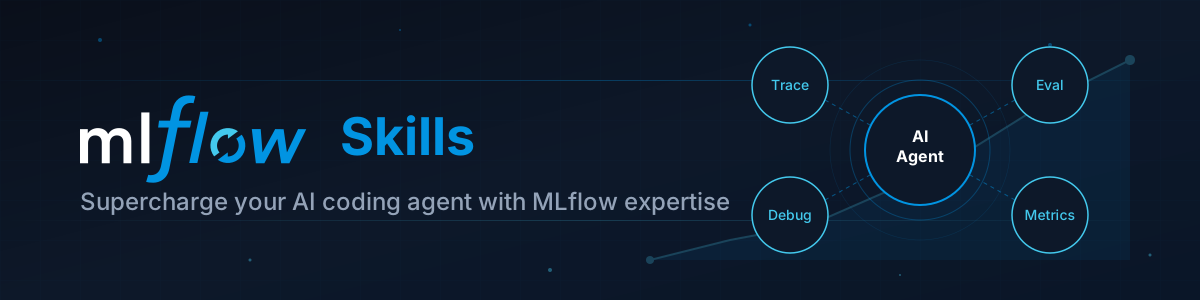
MLflow Skills for Coding Agents
Turn your favorite coding agent into an LLMOps expert with MLflow skills.
Build, debug, and evaluate GenAI applications with confidence. These skills give your AI coding assistant deep knowledge of MLflow's tracing, evaluation, and observability features.
Works with any coding agent that support Skills, including Claude Code, Cursor, Codex CLI, Gemini CLI, and OpenCode.
Why MLflow Skills?
Building production-ready AI agents is hard. You need observability to understand what your agent is doing, evaluation to measure quality, and debugging tools when things go wrong. MLflow provides SDKs and best practices for all of these operations, and with skills we bring them directly into the environment where LLM agent development happens. Now you can go to your favorite coding agent and just ask:
- "Add tracing to my LangChain app" → Instruments your code automatically
- "Why did this trace fail?" → Analyzes spans, finds root causes, suggests fixes
- "Evaluate my agent's accuracy" → Sets up datasets, scorers, and runs evaluation
- "Improve my agent and verify your work" → Gives the coding agent reproducible and verifiable mechanism with MLflow eval to hill climb on quality
- "Show me token usage trends" → Queries metrics and analyze trends
Available Skills
Observability & Debugging
| Skill | Description |
|---|---|
| instrumenting-with-mlflow-tracing | Instruments Python and TypeScript code with MLflow Tracing. Supports OpenAI, Anthropic, LangChain, LangGraph, LiteLLM, and more. |
| analyze-mlflow-trace | Debugs issues by examining spans, assessments, and correlating with your codebase. |
| analyze-mlflow-chat-session | Debugs multi-turn chat conversations by reconstructing session history and finding where things went wrong. |
| retrieving-mlflow-traces | Powerful trace search and filtering by status, session, user, time range, or custom metadata. |
| debug-agent | Root-causes agent failures from existing MLflow traces without requiring a code change or evaluation suite. |
Evaluation & Metrics
| Skill | Description |
|---|---|
| agent-evaluation | End-to-end agent evaluation workflow — dataset creation, scorer selection, evaluation execution, and results analysis. |
| build-a-scorer | Designs a small, cheap-to-run scorer suite from scratch — elicits quality criteria with you, routes each to code checks, built-in scorers, or LLM judges, then ships the implementation. |
| querying-mlflow-metrics | Fetches aggregated metrics (token usage, latency, error rates) with time-series analysis and dimensional breakdowns. |
Helping New Users
| Skill | Description |
|---|---|
| mlflow-onboarding | Guides new users through MLflow setup based on their use case (GenAI apps vs traditional ML). |
| searching-mlflow-docs | Searches official MLflow documentation efficiently using the llms.txt index. |
Installation
Using skills installer
npx skills add mlflow/skills
Direct Installation from Source
git clone https://github.com/mlflow/skills.git
cp -r mlflow-skills/* ~/.claude/skills/
Change the ~/.claude/skills/ directory to the appropriate location for your coding agent, e.g., ~/.codex/skills/ for Codex.
Project-Level Installation
Add skills to your project for team sharing:
cd your-project
git clone https://github.com/mlflow/skills.git .skills/mlflow
# Or as a submodule:
git submodule add https://github.com/mlflow/skills.git .skills/mlflow
Auto-Suggestion Hook (Optional)
The hooks/ directory contains a UserPromptSubmit hook that automatically detects MLflow-related patterns in your prompts and surfaces the right skill before the agent responds — no need to remember which skill does what.
Install the Hook
Step 1: Copy the hook somewhere permanent:
cp hooks/mlflow-suggest-hook.py ~/.claude/hooks/mlflow-suggest-hook.py
Step 2: Add it to your Claude Code settings (~/.claude/settings.json):
{
  "hooks": {
    "UserPromptSubmit": [
      {
        "type": "command",
        "command": "python3 ~/.claude/hooks/mlflow-suggest-hook.py"
      }
    ]
  }
}
Step 3: Start a new session. When you ask something like "Add tracing to my app", you'll see:
💡 Use the `instrumenting-with-mlflow-tracing` skill to add MLflow tracing.
See hooks/README.md for the full keyword-to-skill mapping and troubleshooting.
Quick Examples
Instrument Your App with Tracing
> Add MLflow tracing to my OpenAI app

The coding agent will:
1. Detect your LLM framework
2. Add the right autolog call
3. Configure experiment tracking
4. Verify traces are being captured
Debug a Failed Trace
> Analyze trace tr-abc123 — why did it return the wrong answer?

The coding agent will:
1. Fetch the trace and examine all spans
2. Check assessments for quality signals
3. Walk the span tree to find the failure point
4. Correlate with your codebase to identify root cause
5. Suggest specific fixes
Evaluate Agent Quality
> Set up evaluation for my customer support agent

The coding agent will:
1. Discover existing evaluation datasets
2. Help create test cases if needed
3. Select appropriate scorers (correctness, relevance, etc.)
4. Run evaluation and analyze results
5. Generate improvement recommendations
Query Usage Metrics
> Show me token usage trends for the last 7 days

The coding agent will:
1. Query the MLflow metrics API
2. Generate time-series breakdowns
3. Identify cost spikes or anomalies
4. Suggest optimization opportunities
Requirements
- MLflow 3.8+ (Instructions and code examples are tested with MLflow 3.8)
Contributing
We welcome contributions! Here's how to help:
- Report issues — Found a skill giving incorrect advice? Open an issue
- Suggest improvements — Have ideas for better workflows? We'd love to hear them
- Add new skills — See skill authoring best practices and file a pull request
Creating a New Skill
We recommend using the skill-creator from Anthropic's skills repository as a starting point.
License
Apache License 2.0 — see LICENSE for details.
Links
Built with care for the MLflow community
Похожие ресурсы

LangChain Skills
SkillLangChain's official skill collection: framework selection, quickstarts, middleware, persistence, human-in-the-loop approval, RAG and eval design across LangChain, LangGraph and Deep Agents, in Python and TypeScript. Also installable as a Claude Code plugin. Still in early development.
langchain-ai/langchain-skills1.3k
Agent SDK Dev
PluginScaffolds a Claude Agent SDK project in Python or TypeScript interactively with /new-sdk-app, then a verifier agent checks dependencies, config and code against official best practices. Maintained by Anthropic.
anthropics/claude-code151k
OpenAI Developers
PluginBuild with OpenAI best practices inside Codex: call the OpenAI API, build and deploy agents with the Agents SDK, create ChatGPT apps and prepare submission materials, and create API keys directly. Maintained by OpenAI; Codex only.
openai/plugins7.5k
Ollama
CLIDownload and run open models such as Gemma locally with one command. Provides a REST API and Python/JS libraries, and ollama launch can point Claude Code, Codex and other agents at local models.
ollama/ollama183kClaude API
SkillReference for the Claude API and Anthropic SDK: model selection and pricing, streaming, tool use, prompt caching, Managed Agents and more, plus workflows for model migration and prompt audits. Official Anthropic skill.
anthropics/skills182k
Gemini API Dev
SkillTeaches agents to code against the latest Gemini API and Python/TypeScript SDKs: multi-turn chat, function calling, structured output, and image and speech generation, while avoiding deprecated older models. Maintained by Google's Gemini team.
google-gemini/gemini-skills4.3k