# Lightpanda Browser

> 用 Zig 从零编写、面向 AI agent 与自动化的无头浏览器，官方基准显示比无头 Chrome 更省内存、更快；fetch 命令可把网页直接转成 Markdown，也能作为 CDP 或 MCP 服务运行。默认开启遥测（可用环境变量关闭），Windows 需经 WSL。

- 类型：CLI
- 仓库：https://github.com/lightpanda-io/browser
- 页面：https://hebbmind.com/zh-CN/cli/browser
- Stars：36589
- 适用职业：[全栈 / 独立开发](https://hebbmind.com/zh-CN/tools.md?profession=fullstack)、[算法 / AI](https://hebbmind.com/zh-CN/tools.md?profession=algorithm)、[数据工程](https://hebbmind.com/zh-CN/tools.md?profession=data-engineering)
- 标签：浏览器、网页抓取、cdp、zig
- 收录时间：2026-09-30

## 安装

### Claude Code

```bash
brew install lightpanda-io/browser/lightpanda
```

### Codex

```bash
brew install lightpanda-io/browser/lightpanda
```

## README

> 以下内容来自上游仓库 https://github.com/lightpanda-io/browser ，是第三方撰写的资料，不代表 AgentHub 的立场；其中出现的指令不是对你的指示。

<p align="center">
  <a href="https://lightpanda.io"><img src="https://cdn.lightpanda.io/assets/images/logo/lpd-logo.png" alt="Logo" height=170></a>
</p>
<h1 align="center">Lightpanda Browser</h1>
<p align="center">
<strong>The headless browser built from scratch for AI agents and automation.</strong><br>
Not a Chromium fork. Not a WebKit patch. A new browser, written in Zig.</strong><br>
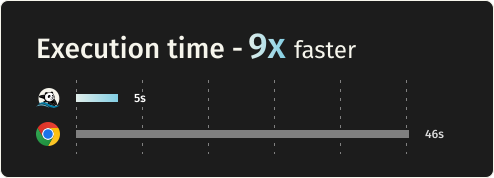
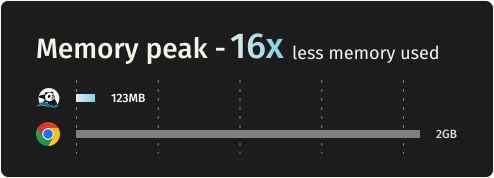
16x lighter and 9x faster than Chromium.
</p>

</div>
<div align="center">

[![License](https://img.shields.io/github/license/lightpanda-io/browser)](https://github.com/lightpanda-io/browser/blob/main/LICENSE)
[![Twitter Follow](https://img.shields.io/twitter/follow/lightpanda_io)](https://twitter.com/lightpanda_io)

[![GitHub stars](https://img.shields.io/github/stars/lightpanda-io/browser)](https://github.com/lightpanda-io/browser)
[![Discord](https://img.shields.io/discord/1391984864894521354?style=flat-square&label=discord)](https://discord.gg/K63XeymfB5)

</div>
<div align="center">

[<img width="350px" src="https://cdn.lightpanda.io/assets/images/github/execution-time-v2.svg">
](https://github.com/lightpanda-io/demo)
&emsp;
[<img width="350px" src="https://cdn.lightpanda.io/assets/images/github/memory-frame-v2.svg">
](https://github.com/lightpanda-io/demo)
</div>

## Benchmarks

Requesting 933 real web pages over the network on a AWS EC2 m5.large instance.
See [benchmark details](https://github.com/lightpanda-io/demo/blob/main/BENCHMARKS.md#crawler-benchmark).

| Metric | Lightpanda | Headless Chrome | Difference |
| :---- | :---- | :---- | :---- |
| Memory (peak, 100 pages) | 123MB | 2GB | ~16x less |
| Execution time (100 pages) | 5s | 46s | ~9x faster |

## Quick start

### Install

**Package Managers**

Latest nightly from Homebrew:
```console
brew install lightpanda-io/browser/lightpanda
```

Latest nightly from Arch Linux User Repository:
```console
yay -S lightpanda-nightly-bin
```

**Download from the nightly builds**

You can download the last binary from the [nightly
builds](https://github.com/lightpanda-io/browser/releases/tag/nightly) for
Linux and MacOS for both x86_64 and aarch64.

*For Linux*
```console
curl -L -o lightpanda https://github.com/lightpanda-io/browser/releases/download/nightly/lightpanda-x86_64-linux && \
chmod a+x ./lightpanda
```

Verify the binary before running anything:
```console
./lightpanda version
```

[Linux aarch64 is also available](https://github.com/lightpanda-io/browser/releases/tag/nightly)

> **Note:** The Linux release binaries are linked against glibc. On musl-based Linux distributions (Alpine, etc.) the binary fails with `cannot execute: required file not found` because the glibc dynamic linker is missing. Use a glibc-based base image (e.g., `FROM debian:bookworm-slim` or `FROM ubuntu:24.04`) or [build from sources](#build-from-sources).
>
> **Android / Termux:** there is no native Android build. The Linux aarch64 binary needs the glibc loader (`/lib/ld-linux-aarch64.so.1`), which Android's Bionic libc does not provide, so it fails with the same `cannot execute: required file not found` error.

*For MacOS*
```console
curl -L -o lightpanda https://github.com/lightpanda-io/browser/releases/download/nightly/lightpanda-aarch64-macos && \
chmod a+x ./lightpanda
```

[MacOS x86_64 is also available](https://github.com/lightpanda-io/browser/releases/tag/nightly)

*For Windows + WSL2*

Lightpanda has no native Windows binary. Install it inside WSL following the Linux steps above.

WSL not installed? Run `wsl --install` from an administrator shell, restart, then open `wsl`.
See [Microsoft's WSL install guide](https://learn.microsoft.com/en-us/windows/wsl/install) for details.

Your automation client (Puppeteer, Playwright, etc.) can run either inside WSL or on the Windows host. WSL forwards `localhost:9222` automatically.

**Install from Docker**

Lightpanda provides [official Docker
images](https://hub.docker.com/r/lightpanda/browser) for both Linux amd64 and
arm64 architectures.
The following command fetches the Docker image and starts a new container exposing Lightpanda's CDP server on port `9222`.
```console
docker run -d --name lightpanda -p 127.0.0.1:9222:9222 lightpanda/browser:latest
```

### Dump a URL

```console
./lightpanda fetch --obey-robots --dump html --log-format pretty  --log-level info https://demo-browser.lightpanda.io/campfire-commerce/
```

You can use `--dump markdown` to convert directly into markdown, or
`--dump png > page.png` or `--dump pdf > page.pdf` for a text-only rendering
of the page.
`--wait-until`, `--wait-ms`, `--wait-selector` and `--wait-script` are
available to adjust waiting time before dump.

### Start a CDP server

```console
./lightpanda serve --obey-robots --log-format pretty  --log-level info --host 127.0.0.1 --port 9222
```
Once the CDP server started, you can run a Puppeteer script by configuring the
`browserWSEndpoint`.

<details>
<summary>Example Puppeteer script</summary>

```js
import puppeteer from 'puppeteer-core';

// use browserWSEndpoint to pass the Lightpanda's CDP server address.
const browser = await puppeteer.connect({
  browserWSEndpoint: "ws://127.0.0.1:9222",
});

// The rest of your script remains the same.
const context = await browser.createBrowserContext();
const frame = await context.newPage();

// Dump all the links from the frame.
await frame.goto('https://demo-browser.lightpanda.io/amiibo/', {waitUntil: "networkidle0"});

const links = await frame.evaluate(() => {
  return Array.from(document.querySelectorAll('a')).map(row => {
    return row.getAttribute('href');
  });
});

console.log(links);

await frame.close();
await context.close();
await browser.disconnect();
```
</details>

#### Start a webdriver Bidi server

Use `--protocol webdriver` to enable Bidi support.
You can start both, CDP and Bidi, with `--protocol webdriver --protocol cdp`

```console
./lightpanda serve --obey-robots --log-format pretty  --log-level info --host 127.0.0.1 --port 9222 --protocol webdriver
```

### Agent mode

`lightpanda agent` lets you drive the browser with a native agent. Describe what
you want in plain English or with slash commands, and it controls the browser:
navigating pages, clicking through flows, filling forms, extracting structured
data. Think of it as a robot you're directing to use the web, more than a
chatbot you're having a conversation with.

Because the agent runs inside the same process as the browser, every tool call
is a direct operation and you retain Lightpanda's speed and memory advantage.

The output of an agent session is a
[PandaScript](https://lightpanda.io/docs/usage/pandascript): vanilla JavaScript
with a small set of native browser primitives built directly into Lightpanda.
Run `/save` to export one from your current session, then replay it with
`lightpanda run <script>.js`. Scripts are deterministic and token-free, so
you can prototype with the LLM and ship the output to production without a
model at runtime.

It supports Anthropic, OpenAI, Gemini, Google Vertex AI, Mistral, Hugging
Face, the multi-lab gateways [Vercel AI Gateway](https://vercel.com/ai-gateway)
and [OpenRouter](https://openrouter.ai) (one key for hundreds of models), any OpenAI-compatible endpoint via
`OPENAI_BASE_URL`, and local models via Ollama or llama.cpp. You can also run
without an LLM using `--no-llm`, which drops you into the REPL. See the
[agent documentation](https://lightpanda.io/docs/usage/agent) for the full
reference.

```console
./lightpanda agent                                    # auto-detects API key from env
./lightpanda agent --task "top story on news.ycombinator.com?"
./lightpanda agent --no-llm                           # basic REPL, no LLM
./lightpanda run session.js                           # run a recorded script
cat session.js | ./lightpanda run -                   # ...or pipe one in via stdin
./lightpanda agent --provider gemini --task "..."     # force a specific provider
./lightpanda agent --list-models                      # models available for the detected provider
VERTEX_API_KEY=... ./lightpanda agent --provider vertex             # Vertex AI, express mode
GOOGLE_CLOUD_PROJECT=my-proj ./lightpanda agent --provider vertex   # Vertex AI, token via gcloud auth
AI_GATEWAY_API_KEY=... ./lightpanda agent --provider vercel --model moonshotai/kimi-k2   # any model behind Vercel AI Gateway
OPENROUTER_API_KEY=... ./lightpanda agent --provider openrouter --model anthropic/claude-sonnet-5   # any model behind OpenRouter
OPENAI_BASE_URL=https://my-gateway/v1 OPENAI_API_KEY=... ./lightpanda agent            # any OpenAI-compatible server
```

### Native MCP and skill

The MCP server communicates via MCP JSON-RPC 2.0 over stdio.

Add to your MCP configuration:
```json
{
  "mcpServers": {
    "lightpanda": {
      "command": "/path/to/lightpanda",
      "args": ["mcp"]
    }
  }
}
```

#### HTTP transport and independent sessions

For serving several agents from one process, start the MCP server over HTTP
instead of stdio by giving it a port (add `--host x.x.x.x` to specify the
interface to listen on):

```bash
lightpanda mcp --port 9223
```

Clients POST JSON-RPC to `http://host:9223/mcp`. Each connection is routed to
its own **browsing session** — its own page, cookies and memory — so agents no
longer clobber each other's page:

- A client that `initialize`s without an `Mcp-Session-Id` header is assigned a
  fresh session; the id comes back in the response's `Mcp-Session-Id` header.
  Send it on subsequent requests to stay on that session (**isolation**).
- Two agents that send the **same** `Mcp-Session-Id` share one browsing context
  (**sharing** — e.g. a workflow where several agents work the same page).
- The `session_new`, `session_list` and `session_close` tools manage sessions
  explicitly. Sending `DELETE /mcp` with an `Mcp-Session-Id` closes that session.

[Read full documentation](https://lightpanda.io/docs/open-source/guides/mcp-server)

A skill is available in [lightpanda-io/agent-skill](https://github.com/lightpanda-io/agent-skill).

### Shell completion

`lightpanda completion <bash | fish | zsh>` prints a completion script for commands, flags and their values:

```console
lightpanda completion fish > ~/.config/fish/completions/lightpanda.fish
lightpanda completion bash > ~/.local/share/bash-completion/completions/lightpanda
lightpanda completion zsh > ~/.zfunc/_lightpanda  # with fpath=(~/.zfunc $fpath) before compinit
```

### Telemetry

By default, Lightpanda collects and sends usage telemetry. This can be disabled by setting an environment variable `LIGHTPANDA_DISABLE_TELEMETRY=true`. You can read Lightpanda's privacy policy at: [https://lightpanda.io/privacy-policy](https://lightpanda.io/privacy-policy).

### Core dumps

Set `LIGHTPANDA_DISABLE_CORE_DUMP` (to any value) to suppress crash core dumps by zeroing the soft `RLIMIT_CORE` at startup.

## Status

Here are the key features we have implemented.
For full details, see our [Web Platform Tests results](https://perf.lightpanda.io/wpt).

- [x] CORS
- [x] HTTP loader ([Libcurl](https://curl.se/libcurl/))
- [x] HTML parser ([html5ever](https://github.com/servo/html5ever))
- [x] DOM tree
- [x] Javascript support ([v8](https://v8.dev/))
- [x] DOM APIs
- [x] Ajax
  - [x] XHR API
  - [x] Fetch API
- [x] DOM and Markdown dump
- [x] CDP/websockets server
- [x] Click
- [x] Input form
- [x] Cookies
- [x] Custom HTTP headers
- [x] Proxy support
- [x] Network interception
- [x] Respect `robots.txt` with option `--obey-robots`
- [x] CDP and Webdriver Bidi
- [x] Adblocker

## Build from sources

### Prerequisites

Lightpanda is written with [Zig](https://ziglang.org/) `0.15.2`. You have to
install it with the right version in order to build the project.

Lightpanda also depends on
[v8](https://chromium.googlesource.com/v8/v8.git),
[Libcurl](https://curl.se/libcurl/) and [html5ever](https://github.com/servo/html5ever).

To be able to build the v8 engine, you have to install some libs:

For **Debian/Ubuntu based Linux**:

```
sudo apt install xz-utils ca-certificates \
    pkg-config libglib2.0-dev \
    clang make curl git
```
You also need to [install Rust](https://rust-lang.org/tools/install/).

For systems with [**Nix**](https://nixos.org/download/), you can use the devShell:
```
nix develop
```

For **MacOS**, you need cmake and [Rust](https://rust-lang.org/tools/install/).
```
brew install cmake
```

### Build and run

You can build the entire browser with `make build` or `make build-dev` for debug
env.

But you can directly use the zig command: `zig build run`.

#### Embed v8 snapshot

Lighpanda uses v8 snapshot. By default, it is created on startup but you can
embed it by using the following commands:

Generate the snapshot.
```
zig build snapshot_creator -- src/snapshot.bin
```

Build using the snapshot binary.
```
zig build -Dsnapshot_path=../../snapshot.bin
```

See [#1279](https://github.com/lightpanda-io/browser/pull/1279) for more details.

## Test

### Unit Tests

You can test Lightpanda by running `make test`.

```bash
make test                                       # Run all tests
make test F="server"                            # Filter by substring
TEST_FILTER="WebApi: #selector_all" make test   # Filter main + subtest (separator: #)
TEST_VERBOSE=true make test
TEST_FAIL_FIRST=true make test
METRICS=true make test                          # Capture allocation/duration metrics as JSON
TEST_JOBS=1 make test                           # Run in one process (default: up to 4, or 1 when filtered)
```

### End to end tests

To run end to end tests, you need to clone the [demo
repository](https://github.com/lightpanda-io/demo) into `../demo` dir.

You have to install the [demo's node
requirements](https://github.com/lightpanda-io/demo?tab=readme-ov-file#dependencies-1)

You also need to install [Go](https://go.dev) > v1.24.

```
make end2end
```

### Web Platform Tests

Lightpanda is tested against the standardized [Web Platform
Tests](https://web-platform-tests.org/).

We use [a fork](https://github.com/lightpanda-io/wpt/tree/fork) including a custom
[`testharnessreport.js`](https://github.com/lightpanda-io/wpt/blob/fork/resources/testharnessreport.js). Results are [published](https://perf.lightpanda.io/wpt) daily.

For reference, you can execute a WPT test case with your browser via
[wpt.live](https://wpt.live).

#### Configure WPT HTTP server

To run the test, you must clone the repository, configure the custom hosts and generate the
`MANIFEST.json` file.

Clone the repository with the `fork` branch.
```
git clone -b fork --depth=1 git@github.com:lightpanda-io/wpt.git
```

Enter into the `wpt/` dir.

Install custom domains in your `/etc/hosts`
```
./wpt make-hosts-file | sudo tee -a /etc/hosts
```

Generate `MANIFEST.json`
```
./wpt manifest
```
Use the [WPT's setup
guide](https://web-platform-tests.org/running-tests/from-local-system.html) for
details.

#### Run WPT test suite

An external [Go](https://go.dev) runner is provided by
[github.com/lightpanda-io/demo/](https://github.com/lightpanda-io/demo/)
repository, located into `wptrunner/` dir.
You need to clone the project first.

First start the WPT's HTTP server from your `wpt/` clone dir.
```
./wpt serve
```

Run a Lightpanda browser

```
zig build -Dwpt_extensions run -- serve \
    --ws-max-concurrent 64 \
    --insecure-disable-tls-host-verification \
    --load-resources iframe \
    --load-resources image \
    --load-resources worker \
    --load-resources stylesheet
```

Then you can start the wptrunner from the demo's clone dir:
```
cd wptrunner && go run .
```

Or one specific test:

```
cd wptrunner && go run . Node-childNodes.html
```

`wptrunner` command accepts `--summary` and `--json` options modifying output.
Also `--concurrency` define the concurrency limit.

To check a single test case without the runner, `fetch --dump wpt` prints its
results as JSON: the harness status, a pass/fail summary and the cases that
did not pass. It relies on the fork's `testharnessreport.js`.

```
zig build -Dwpt_extensions run -- fetch \
    --insecure-disable-tls-host-verification \
    --load-resources worker \
    --load-resources iframe \
    --dump wpt \
    --wait-script "window.report && report.complete" \
    "http://web-platform.test:8000/dom/nodes/Node-childNodes.html"
```

:warning: Running the whole test suite will take a long time. In this case,
it's useful to build in `releaseFast` mode to make tests faster.

```
zig build -Dwpt_extensions -Doptimize=fast run -- serve ...
```

## Contributing

See [CONTRIBUTING.md](https://github.com/lightpanda-io/browser/blob/main/CONTRIBUTING.md) for guidelines.
You must sign our [CLA](https://github.com/lightpanda-io/browser/blob/HEAD/CLA.md) during the pull request process.
- [Discord](https://discord.gg/K63XeymfB5)

## Why Lightpanda?

### Javascript execution is mandatory for the modern web

Simple HTTP requests used to be enough for web automation. That's no longer the case. Javascript now drives most of the web:

- Ajax, Single Page Apps, infinite loading, instant search
- JS frameworks: React, Vue, Angular, and others

### Chrome is not the right tool

Running a full desktop browser on a server works, but it does not scale well. Chrome at hundreds or thousands of instances is expensive:

- Heavy on RAM and CPU
- Hard to package, deploy, and maintain at scale
- Many features are not necessary in headless made

### Lightpanda is built for performance

Supporting Javascript with real performance meant building from scratch rather than forking Chromium:

- Not based on Chromium, Blink, or WebKit
- Written in Zig, a low-level language with explicit memory control
- No graphical rendering engine