Give your coding agent a video editor.
Claude Code, Cursor, Codex or any MCP client edits your footage with local FFmpeg, then checks its own output.
No cloud · No API keys · Python standard library
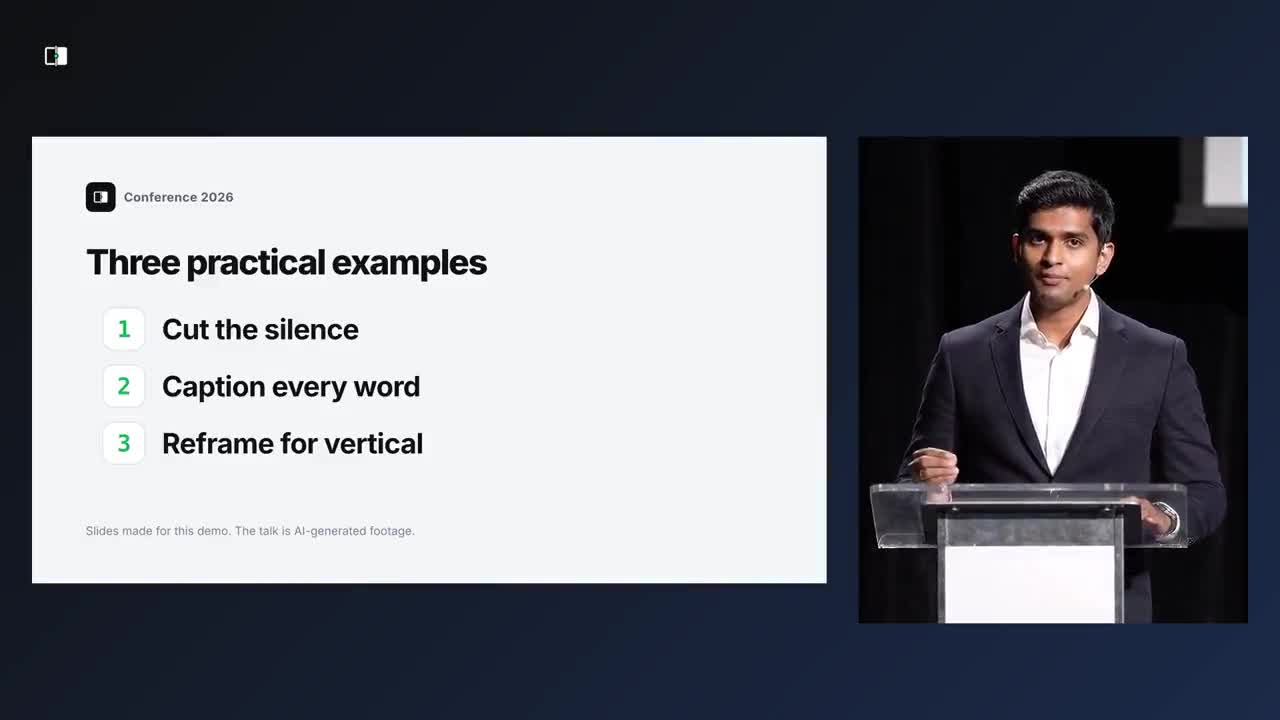
Twelve clips edited by asking: colour, slow motion and reframing, a talk laid out with its slides and cut into a captioned short, a pause removed, a green-screen composite, a levelled horizon, and three phone clips (stabilised, a night shot lifted and denoised, 60 fps slowed down). Watch them (English and Japanese) · the request and the exact commands. Nine clips are AI-generated with Google Veo; three are shot on a phone.
### Review page
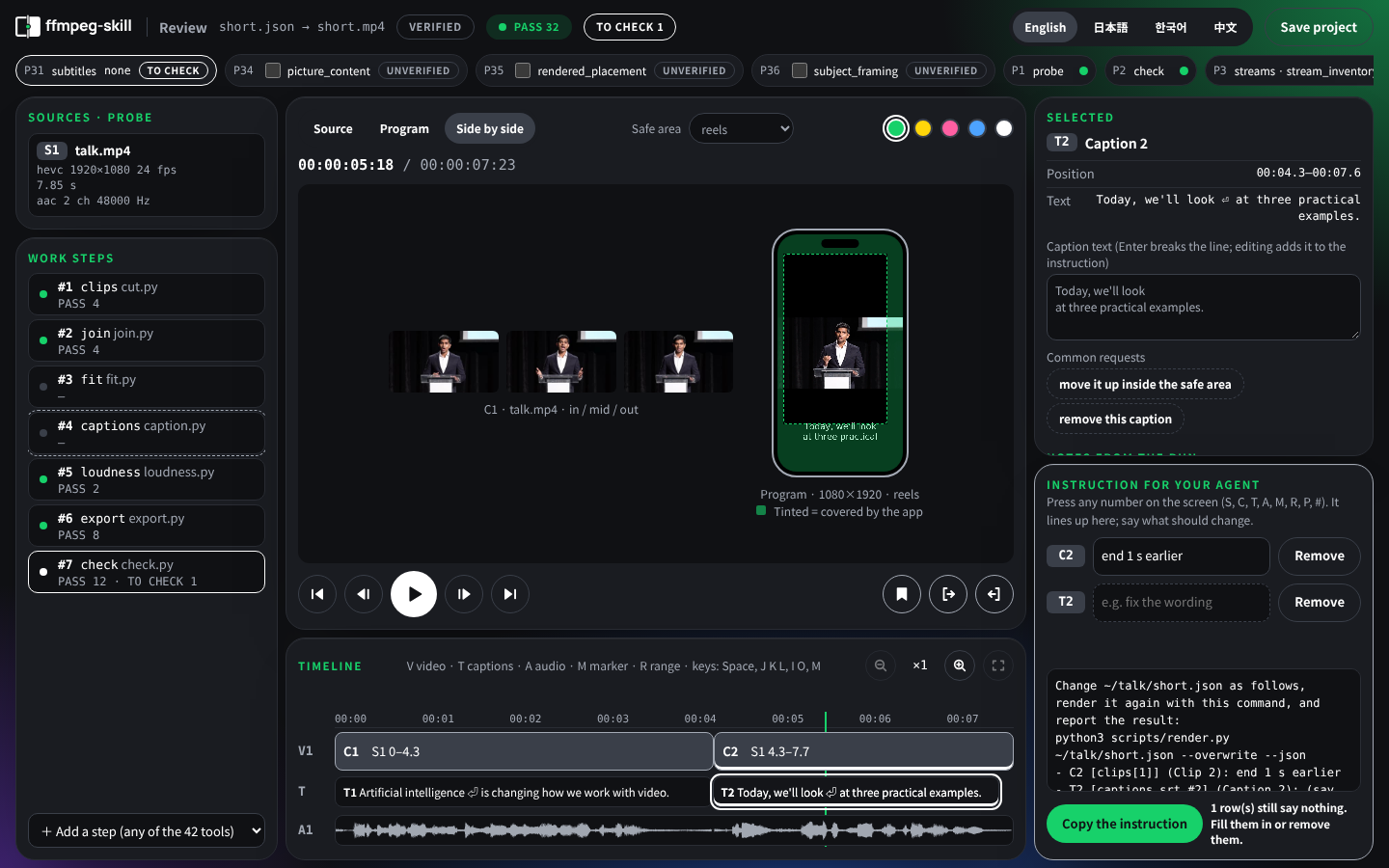
After an edit, ask your agent for the review page ("show me the review page"), or run `npx ffmpeg-skill review project.json --result run.json` yourself (`python3 scripts/_review.py` from a checkout). It writes one local HTML file. It shows the sources, every step with its checks, the result in a phone frame with the platform's safe area, and a timeline. Press the number of a clip or a caption, write what should change, and copy the instruction it builds back to your agent. Nothing is uploaded; the page speaks English, Japanese, Korean and Chinese.
The talk above as a vertical short, on the review page (AI-generated footage).
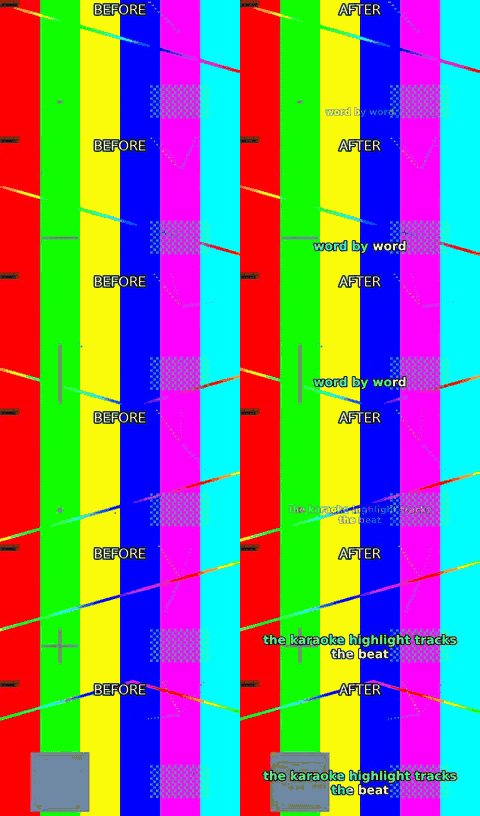
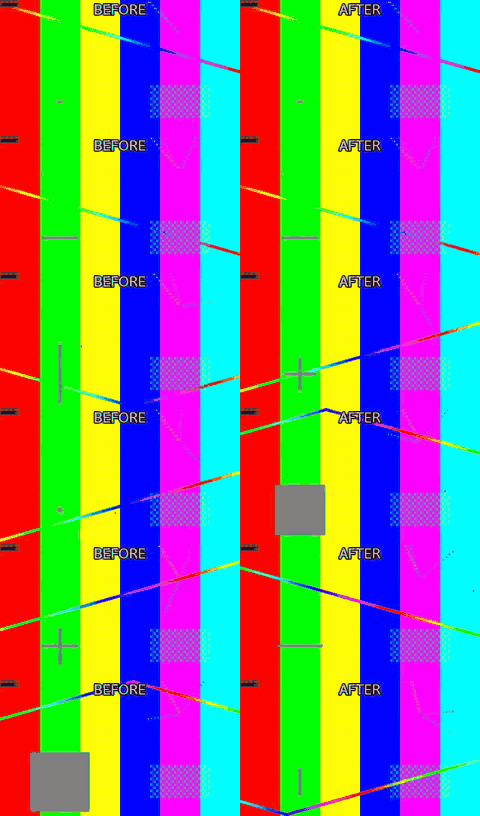
Left half is the input, right half is what the command produced. **[Every before/after demo, with the exact command under each one →](https://github.com/kajisho5/ffmpeg-skill/blob/HEAD/docs/demos.md)** — all of it built by `python3 demos/build.py`, so you can rebuild every frame of it yourself. The pictures come from [demos/footage/](https://github.com/kajisho5/ffmpeg-skill/blob/HEAD/demos/footage/README.md): clips AI-generated with Google Veo (the people and places do not exist) and a few shot on a phone. The sound is synthetic, and a few demos (HDR10, a panorama) use a synthetic picture.
`ffmpeg-skill` is an [Agent Skill](https://docs.anthropic.com/en/docs/agents-and-tools/agent-skills) for Claude Code, Cursor, Codex and any agent that reads `SKILL.md`. It teaches the agent a fixed workflow (probe → edit losslessly where possible → check → verify) and ships **42 tools** that do the actual work with `ffmpeg` / `ffprobe`: cut, join, silence removal, fit to duration and aspect, captions and karaoke, overlays and motion graphics, HDR → SDR and LUTs, audio clean-up and typed dynamics, sync with drift correction, multicam, loudness, delivery checks, whole-edit project rendering, batch folders. Every tool is also callable as an MCP tool (`tools/list` advertises a core 12 by default to keep client context small, with `FFMPEG_SKILL_MCP_FULL=1` listing all 42; every tool is reachable by name through `tools/call` either way), and the whole set is described by a machine-readable contract.
If `ffmpeg` and `python3` are on your PATH, it works: offline, on footage you would rather not upload.
- **Protect your source files.** A destination that matches a declared input is refused. Direct edits require `--overwrite` to replace an existing output. A `batch --watch` job can replace an unchanged file it delivered on an earlier pass. The `-y` in the dry-run command takes effect only after the tool checks the destination.
- **Call typed tools.** The agent supplies named options such as `--aspect 9:16` and `--fit pad`. The tool builds the FFmpeg command and filter graph.
- **Verify the edit.** The tools probe the source and the written file, so the agent can check the actual duration, frame size and audio before reporting success.
> **SPEC** (Self-Producing Execution Contract): each tool's `input_schema` — the part of its
> contract and MCP tool definition that has to track the CLI flag-for-flag — is never
> hand-authored beside the code. It is derived, at run time, from the same `argparse` parser that
> already defines the CLI, and CI fails the build if any of it drifts.
> → [full explanation](#what-is-spec)
---
## Standalone, and in an ecosystem
**Standalone**, this is a local FFmpeg engine: probe → edit → verify, `npx ffmpeg-skill` and nothing else. No API key, no account, no other repo required. Everything above and below this section describes that standalone tool, and none of it changes if you never read the rest of this one.
**In [kajisho5](https://github.com/kajisho5)'s wider video-production ecosystem**, this repo is the *hands*: it cuts, measures and exports files, and reports back in structured JSON. It does not decide what to cut, whether a deliverable is approvable, what makes a highlight interesting, or what a caption should say (the user's cue text is burned as written, never rewritten to fit) — those are a *brain*'s job, sitting in front of this engine, not inside it.
| You want to... | Use |
|---|---|
| Cut / join / measure / export a file right now | **this repo** (`ffmpeg-skill`), standalone |
| Decide cut points, approve a deliverable, plan a whole edit | [`video-production-agent`](https://github.com/kajisho5/video-production-agent) / [`AI-video-production-OS`](https://github.com/kajisho5/AI-video-production-OS) |
| Build a typed editing graph across a workspace, without writing raw `ffmpeg` | [`video-editing-skill`](https://github.com/kajisho5/video-editing-skill) / [`audio-production-skill`](https://github.com/kajisho5/audio-production-skill) |
| Put Remotion motion graphics (animated captions, silence jump cuts, audio-peak motion) on a real recording | [`remotion-ffmpeg-skill`](https://github.com/kajisho5/remotion-ffmpeg-skill): its compositions take their length, fps, frame, silences, scene cuts, audio peaks and beats from this repo's `probe.py`, `silence.py` and `scenes.py`. It verifies its render with `check.py` and `look.py`, composites a graphics layer with `overlay.py` (`--place` for its `--sparse` mode), and delivers through `render.py --template` |
Other repos in the ecosystem — [`media-analysis-skill`](https://github.com/kajisho5/media-analysis-skill), [`transcription-skill`](https://github.com/kajisho5/transcription-skill), [`subtitle-skill`](https://github.com/kajisho5/subtitle-skill), [`thumbnail-skill`](https://github.com/kajisho5/thumbnail-skill), [`color-grading-skill`](https://github.com/kajisho5/color-grading-skill), [`motion-graphics-skill`](https://github.com/kajisho5/motion-graphics-skill), [`qc-skill`](https://github.com/kajisho5/qc-skill) — read this repo's `contract --json`, its tools' `--json` output and `doctor`, the same way any agent framework would; this repo does not call into any of them. The dependency runs one way.
---
**Contents**
[Standalone, and in an ecosystem](#standalone-and-in-an-ecosystem) · [Why](#why) · [Quick start](#quick-start) · [How it works](#how-it-works) · [Design principles](#design-principles) · [Tools](#tools) · [Audio](#audio-is-a-first-class-input) · [Built for agents](#built-for-agents) · [FAQ](#faq) · [FFmpeg compatibility](#ffmpeg-compatibility) · [Tested on real footage](#tested-on-real-footage) · [Install](#install) · [Requirements](#requirements) · [Development](#development) · [Docs](#docs)
---
## Why
An agent that "knows FFmpeg" still guesses: it assumes a frame rate, picks a codec the container cannot hold, re-encodes a file that only needed a stream copy, and reports "done" without opening the result. This skill takes the guessing out:
- **Real files first.** Every job starts with `probe.py`; the agent decides from the measured duration, fps, resolution, colour and audio layout, not from the file name.
- **Structured tools, not shell strings.** Each operation is a script with typed arguments. Nothing runs through a shell; no filter graph is accepted from the caller.
- **A contract the agent can read.** `contract --json` states, for every tool, what it takes, what it writes, which FFmpeg components it needs and how the result is verified. The MCP surface is derived from it.
- **Verification after execution.** The result is probed, checked against the destination's spec and, when the picture changed, looked at as a contact sheet.
- **Local first.** No cloud, no API keys, no Python dependencies. Optional local transcription is used when a speech engine (Parakeet or a whisper) is installed, never required — by `caption.py --transcribe` and, since 1.17, by `silence.py --transcribe` (with `--filler`, or since 3.6 with `--sentence-min-silence` / `--sentence-margin-tail`); both take a transcript you already have instead, and both refuse with the install lines rather than guessing. Both take `--engine` and `--model`; `FFMPEG_SKILL_ASR_ENGINE` and `FFMPEG_SKILL_ASR_MODEL` set this machine's defaults (e.g. `large-v3-turbo` where that whisper.cpp model is installed; without either, auto and `base`). The engine runs on your machine and the audio is never uploaded; parakeet-mlx, faster-whisper and openai-whisper download their model weights the first time they run (parakeet-mlx's default from Hugging Face).
## Paper
The design discipline behind this skill — per-operation verification for AI agents — is written up as a position paper. The paper scores ffmpeg-skill itself as only partially conformant with the discipline it defines.
Kajiyama, S. (2026). *What Is Verification-Driven Coding? — A Discipline for Not Trusting Generation.* Zenodo. https://doi.org/10.5281/zenodo.23720216
## Quick start
One command does steps 0 to 2 below: `npx ffmpeg-skill setup` installs the skill for every agent it finds on the machine (`~/.claude`, `~/.cursor`, `~/.codex` or `~/.agents`; Claude Code when it finds none), installs FFmpeg when `ffmpeg` does not run (`brew install ffmpeg-full`, `winget install --id Gyan.FFmpeg -e` or `sudo apt-get install -y ffmpeg`, printed before it runs; `--no-ffmpeg` never runs a package manager), and ends with `doctor`, whose exit status it returns. On a system with none of those three package managers it installs the skill, says FFmpeg is still missing, and exits non-zero. It needs Node 16+ and Python 3.10+, and installs neither.
```bash
npx ffmpeg-skill setup
```
The same steps one at a time:
```bash
# 0. FFmpeg itself, once (Ubuntu/Debian shown; macOS and Windows are in the Install table below)
sudo apt install ffmpeg
# 1. install the skill for Claude Code (Cursor: --cursor, Codex: --codex, all three: --all)
npx ffmpeg-skill
# 2. check the machine: ffmpeg, ffprobe and every FFmpeg component the tools need
npx ffmpeg-skill doctor
# 3. (for agent frameworks) read the machine-readable contract
npx ffmpeg-skill contract --json | head -40
```
Captions from speech (`caption.py --transcribe`) need one local speech engine, installed separately. `pip install faster-whisper` is the simplest; the first run downloads its model, and the audio never leaves the machine. Without an engine, everything else works, `doctor` lists the engine as missing optional, and `--transcribe` refuses with the install line for each engine it supports.
Already installed? re-run `npx ffmpeg-skill` to refresh `~/.claude/skills/ffmpeg-skill`. Copies are not updated automatically.
`doctor`'s overall `ok` and a single tool's `usable` are different signals: `ok` is false when anything *some* tool requires is missing, so one missing filter (a plain Homebrew `ffmpeg` without `subtitles`, or a build without libvidstab) turns it false even though most tools still run. Check `doctor --json`'s `tools` field for the per-tool answer, not just `ok`.
Then talk to your agent:
> "Take `interview.mp4`, keep 0:45–1:20 and 5:00–5:25, and make it a 60-second Reel."
The agent runs `probe.py`, `cut.py --segments 0:45-1:20,5:00-5:25 --accurate`, `fit.py --aspect 9:16 --fit crop`, `export.py --preset reels`, `check.py --platform reels` and `look.py`, then reports "final.mp4: 60.00 s, 1080×1920, 30 fps, AAC stereo" with the contact sheet it inspected.
### Deliver to a platform
One command per destination, with the app's own UI taken into account:
```bash
python3 $S/render.py talk.mp4 --template tiktok --cues cues.txt
```
That fills the shipped `templates/tiktok.json`: 9:16 crop, captions popped word by word *above*
TikTok's description bar and clear of its like column, −14 LUFS, the `tiktok` export preset, and
a `check.py --platform tiktok` on the file it wrote. The caption size comes from the delivery
table, so since 1.17.1 the filled project also states `"fit_size": "on"`: a size nobody asked for
shrinks to fit the cue instead of splitting the sentence across two cues. A template that states
its own `fit_size`, and a `--brand` that states a caption size, still win, and a project with
`"fit_size": "off"` renders the captions 1.17.0 rendered. Templates ship for `tiktok`, `reels`,
`shorts`, `youtube-shorts`, `youtube`, `x`, `linkedin`, `facebook`, `podcast` and `audiogram`;
`--template all` (or a comma-separated list) renders the seven video destinations (`tiktok`, `reels`, `shorts`, `youtube`, `x`, `linkedin`, `facebook`) from the same edit and
writes a `_pack.md` table of what each one produced. Files land next to the input unless
`-o` says otherwise, and `--dry-run` shows every planned command rather than a result.
`render.py --list-templates` prints them with their frames, limits and safe zones. Alias
spellings work everywhere a platform is named (`youtube-shorts` = `shorts`, `ig` = `reels`,
`twitter` = `x`, `fb` = `facebook`).
The tools also work on their own, from any shell:
```bash
S=~/.claude/skills/ffmpeg-skill/scripts
python3 $S/probe.py input.mp4 --compact
python3 $S/fit.py input.mp4 --duration 60 --method trim --aspect 9:16 --dry-run # plan a trim and reframe
python3 $S/export.py input.mp4 --preset reels --json # structured result with a probe of the output
```
On Windows in Git Bash, `python3` is only on PATH if Python was installed from the Microsoft Store; a python.org install exposes `python` (or the `py` launcher) instead — replace `python3` with `python` above if you see a "command not found". `bin/install.js` and `doctor`/`contract` already handle this for you; only the raw script examples above need it spelled out manually.
More requests and the commands behind them: [examples/README.md](https://github.com/kajisho5/ffmpeg-skill/blob/HEAD/examples/README.md). To see everything run end-to-end on generated footage: `npm run demo` (the gallery in [docs/demos.md](https://github.com/kajisho5/ffmpeg-skill/blob/HEAD/docs/demos.md)).
## How it works
```mermaid
flowchart TD
U[User request] --> A[AI agent Claude Code · Cursor · Codex]
A -->|reads| S[SKILL.md workflow, request → tool map, report format]
A -->|runs| T[Structured tool scripts/<name>.py, typed argparse flags]
T --> C[Contract input schema · role · capabilities · verification policy]
C --> D[Capability detection doctor: available / missing / unknown]
D --> F[FFmpeg execution no shell, stream copy when possible]
F --> V[Verification probe · check · look.py contact sheet]
V --> R[Structured result --json: status, output, commands, probe]
R --> A
```
Over MCP the same tools are reached through a transport that holds no tool table of its own:
```mermaid
flowchart LR
M[MCP client Claude Desktop · Cursor · any client] --> P[mcp/server.py stdio JSON-RPC]
P -->|tools/list| C[Contract-derived ToolSpecs names · order · inputSchema]
P -->|tools/call| T[scripts/<name>.py]
C -.derived from.-> K[scripts/_contract.py]
T -.described by.-> K
```
Names, order and `inputSchema` in `tools/list` are translated from each tool's argparse parser at start-up, so a new flag or a new script appears in MCP with no edit to `mcp/`. A test copies the skill, adds, removes and edits a script, and reads `tools/list` again to prove it.
## Design principles
These are the rules the skill file gives the agent and the code enforces.
1. **Probe first.** No tool decides from the file name. `probe.py` measures duration, fps (with variable-frame-rate detection), resolution, rotation, bit depth, HDR format including Dolby Vision, colour tags and every audio stream before anything is cut.
2. **Lossless when possible.** `cut.py` and `loudness.py` stream-copy what they do not need to touch (`join.py` re-encodes so it can crossfade and conform mismatched clips; `--copy --transition none` joins clips that already match by stream copy). Re-encoding happens only when it must: frame-accurate cuts, filters, format changes, or a keyframe farther than the tolerance.
3. **Plan before render.** Every tool takes `--dry-run` (print the ffmpeg command lines, write nothing; `verify` ignores it), `--plan FILE` (the dry run saved as a plan with fingerprinted inputs that `render.py FILE` executes later, refusing if an input changed; `render` and `verify` refuse it), `--json` (structured result with a probe of the output), `--fast` (preview quality), `--progress` (percent and ETA), `--timeout` (a hung ffmpeg is killed and reported, never waited on forever; Ctrl-C or SIGTERM likewise stops the running ffmpeg, removes its partial output and reports `kind: interrupted`) and `--overwrite` (explicit consent before an existing output is replaced). A test runs every tool whose contract says its dry run runs no ffmpeg (`ffmpeg_execution: none`, plus `cut` and `metadata` without their measuring flags) under `--dry-run` behind a fake ffmpeg and asserts that no ffmpeg call happened and no file appeared; another runs every tool the contract says supports `--dry-run` (all but `verify`) behind an ffmpeg that logs each decode, and asserts that no file appeared and that every tool that decoded is one the contract lists as `analysis_only`.
4. **Machine-readable contract.** `contract --json` describes all 42 tools: input schema generated from the parser, output schema, role, required and conditional FFmpeg capabilities, dry-run support, the verification tools to run afterwards, whether a visual check is required, `mutates_input: false`. `provides` lists all 42 by a cross-repository Capability id (`ffmpeg-skill.cut`, `ffmpeg-skill.loudness`, ...) for [`kajisho5/AI-video-production-OS`](https://github.com/kajisho5/AI-video-production-OS)'s `CapabilityContract.provides` — see `docs/contract.md`.
5. **Contract-derived MCP.** `mcp/server.py` builds its `tools/list` from the contract. Tool names, order and `inputSchema` cannot drift from the scripts; a test keeps the two byte-identical.
6. **Capability detection.** `doctor` reads `ffmpeg -encoders / -decoders / -filters / -bsfs` and reports which of the components the tools need are present on this build (libx264, libass, zscale, loudnorm, xfade, …), before a job fails inside ffmpeg.
7. **Unknown is not missing.** When a listing cannot be read (a layout the parser does not know, ffmpeg exiting non-zero) the affected capabilities are `unknown`: never `missing`, never silently `available`. An installed filter is not reported absent; a failed detection is not a pass.
8. **Verify the result.** The output is probed, and when the picture changed (captions, overlays, crops, colour, transitions) the agent runs `look.py` and inspects the PNG. The report is not finished until its `Look:` line names that image; audio-only jobs say `Look: not needed`. **"Inspects" means the calling agent's own vision, not a feature of this skill:** `look.py` only renders a PNG; nothing in this repository detects faces, products, subjects, or "the interesting part" of a frame or a scene. When a crop or reframe needs to keep a specific part of the frame (`fit.py --fit crop --crop-x/-y`, see [Tools](#tools)), it is the multimodal agent looking at that PNG and choosing the anchor — a non-visual caller (a script, a CLI user without eyes on the sheet) has to supply that decision itself, and the default is a plain centre crop. Likewise `scenes.py --highlights` ranks candidate scenes by a measured proxy (`--rank-by audio` or `--rank-by duration`), never by content; it is the agent that turns a look at the sheet into a judgement.
9. **One label per report.** A finished job is `Done:`, a failure or a refusal is `Failed:`, and a partial result is `Done:` with the shortfall named in `Notes:` — never a third label such as `Done (partially):`.
10. **Keep originals.** No tool overwrites its input. Outputs are new files named `_.` unless told otherwise, and a test hashes every input after the run.
## Tools
42 public tools, all Python 3.10+ standard library, all with `--help`, `--dry-run`, `--json`, `--plan FILE` (a dry run written as a plan `render.py` executes later), non-zero exit and a reason on stderr on failure. `--json-brief` (1.11.0) prints the same result document trimmed to what a caller acts on — status, output, `verified`, a compact `summary` of the output probe, the tool's own keys and the command count instead of the command lines — for roughly a third of the bytes; `--json` itself is unchanged. Every re-encoding tool except `export.py`, `render.py` and `batch.py` (a preset or the project decides there) takes `--codec h264|hevc|av1|prores` and `--quality N` (1.8) and, with `export.py`, `--hw`/`--no-hw` (Apple VideoToolbox on Apple Silicon, opt-in; see `doctor` below), and every time flag takes seconds, `mm:ss`, `hh:mm:ss.fff` or SMPTE `hh:mm:ss:ff` with an optional `@fps` suffix (1.9).
**Analysis and inspection**
| Tool | What it does |
|---|---|
| `probe.py` | Duration, fps (+ VFR detection), resolution, codecs, bit depth, HDR format incl. Dolby Vision (`hdr` for a real PQ/HLG/DV transfer only, `bt2020_or_hdr` also for BT.2020 SDR), colour space, rotation, every audio stream; `--analyze` flags Log footage |
| `scenes.py` | Scene changes, audio peaks, highlight proposals (`--rank-by audio` loudest, or `--rank-by duration` longest — both proxies, not "best") and a per-scene sheet; cut list for `cut.py --segments`; `--beats` measures the music's beat grid (tempo, beat times, confidence); `--shots` classifies each shot static/pan/motion by measured optical flow; `--audio-peaks` lists per-second dBFS; `--speech` reports a speech-vs-music ratio, not a classification |
| `look.py` | Contact sheet, single frames, side-by-side comparison as PNG so the agent can see what it made; `--safe NAME` shades the zones a platform's own UI covers; `--guides title,action,4:3` outlines the broadcast safe areas (on the PNG only) |
**Editing**
| Tool | What it does |
|---|---|
| `cut.py` | In/out or multi-segment cuts, lossless `-c copy` first, re-encode fallback, `--accurate` for frame-exact video and sample-exact audio, `--smart` for a frame-exact H.264 cut that re-encodes only the partial GOPs at the cut points (matched to the source, verified against its packets and frames) and copies the rest, an SDR HEVC source re-encodes as HEVC (`--no-keep-hevc` for x264), a single `.mp4`/`.mov` copy keeps its edit list, so the picture starts at `--start` unless a keyframe lands later (`start_snapped` then says so; `--no-edit-list` for 2.x's shifted start), `--vfr-guard` to choose the VFR check (`sampled` by default); reports `precision`; `--snap beats` moves the in/out points onto a measured beat, or refuses when there is no measurable pulse ; `--remove A-B,...` drops ranges and keeps the rest |
| `join.py` | Concatenate clips with xfade transitions, normalising size, fps, sample rate and channel layout (the widest clip's, or `--channels`); audio-only inputs are joined as audio; `--list parts.txt` reads generated segments (TTS lines) and checks every one first — missing, empty or unreadable parts are all named in one refusal, or skipped and reported with `--on-missing skip` ; `--copy --transition none` joins clips with matching streams by stream copy, measured afterwards, and refuses a mismatch by name; `--transition none --audio-lead S` / `--audio-lag S` make a J-cut / L-cut (the next sound starts S before its picture / the last sound runs S past the picture change; sync kept) |
| `silence.py` | Detect and remove dead air (jump cuts) with a margin around speech (`--margin`, 0.2 s each side); list or export the cut list, or a source-to-output time map (`--timemap`, JSON or CSV); reports the level at every cut and warns where one may land in a breath or a word's tail; `--filler` also removes filler words, but only where a speech engine timed them; `--speech-aware` keeps a breath inside a sentence and cuts only at sentence-boundary pauses, composing with `--filler` through the same `keep_ranges()`; `--margin-lead` / `--margin-tail` keep different amounts before and after speech, and with word timings `--sentence-min-silence` / `--sentence-margin-tail` give the pause after a sentence end (the transcript's punctuation) its own floor and tail |
| `fit.py` | Fit to a duration (choose a method for large speed changes), aspect ratio (pad, crop or blurred fill) or exact size. `picture` measures the written frame. `crop_check` flags discarded motion or detail and can suggest `--crop-x`/`--crop-y`. Rotate 90/180/270, flip h/v and force constant fps. |
| `crop.py` | Crop to an exact pixel rectangle (`--x --y --width --height`) — distinct from `fit.py --fit crop`, which crops to an aspect ratio it computes itself |
| `cropdetect.py` | Measure existing black letterbox/pillarbox bars and report the `crop.py`-ready rectangle that removes them — analysis only, writes no file; `--motion-centre` reports the per-second motion centroid instead, for a 9:16 reframe — report only, the calling agent picks the crop, no auto-reframing |
| `deinterlace.py` | Deinterlace interlaced source footage (`yadif`), `--mode frame`/`field`, `--parity` |
| `denoise.py` | Reduce video noise/grain (`hqdn3d`), `--strength low/medium/high` or individual spatial/temporal overrides |
| `redact.py` | Blur, pixelate, or (`--mode delogo`) interpolate away an exact pixel rectangle for the whole clip. The box is given: nothing here finds a face, a plate or a logo, and `delogo` is a border blend, not inpainting |
| `sphere.py` | Extract a flat rectilinear viewport from a 360/spherical video (`--yaw --pitch --roll --h-fov --v-fov`); no subject tracking, only the aim you give it |
| `straighten.py` | Rotate by an arbitrary angle for horizon correction (`--degrees`, `--fit crop/pad`) — distinct from `fit.py --rotate`'s exact 90-degree turns |
| `insert.py` | Turn a still image into a silent, fixed-duration video clip (title card, end slate) at an exact frame size / fps, with an optional Ken Burns zoom/pan |
| `background.py` | Generate a solid-colour or two-colour gradient clip at an exact size/duration — no input file; `--transparent` writes a fully transparent canvas (ProRes 4444, QuickTime Animation, PNG or VP9 with alpha) to draw graphics on |
| `reverse.py` | Reverse playback (video and, unless `--no-audio`, audio) |
| `stabilize.py` | Two-pass motion stabilisation (`vidstabdetect`/`vidstabtransform`) |
| `sequence.py` | Numbered (`frame_%04d.png`) or glob-matched still images into a video |
| `waveform.py` | Render an audio track as a waveform or spectrum video. Use `--at` for a waveform PNG at a cut time, or `--image` for a video audiogram with `--platform`, `--title` and burnt-in captions |
| `freeze.py` | Hold a frame for N seconds (`--at`, `--hold`, `--mode insert/extend`) — an end-card hold or a comedic beat |
| `pad.py` | Add black/silent padding at the start and/or end of the timeline (`--start`, `--end`) — distinct from `fit.py --fit pad`'s per-frame letterbox bars |
| `speedramp.py` | Step through different constant speeds across a clip via `--segment START-END:FACTOR` (repeatable) — distinct from `fit.py`'s single whole-clip speed factor |
| `loop.py` | Repeat a clip `--times` N or to a target `--duration` — for background loops and filling a fixed slot length; `--crossfade` smooths the seam, `--boomerang` plays it forward then backward |
| `broll.py` | Cut away to a B-roll clip over the A-roll for a window (`--insert B --at T --duration D`, repeatable) and come back; A's length and audio untouched by default |
| `metadata.py` | Write container chapter markers from a `TIME TITLE` text file and title/artist/comment tags, every stream copied bit for bit; `--auto-chapters` proposes the markers from measured pauses and scene cuts and names them `Chapter N` for you to rename |
| `grid.py` | Composite `--cols`x`--rows` clips into one grid, each cell letterboxed and labelled with its filename by default (`--label none` to skip) |
**Audio**
| Tool | What it does |
|---|---|
| `audio.py` | Voice clean-up chain at three strengths (`--voice light\|medium\|strong`), FFT denoise, typed compressor / limiter / gate, music bed with sidechain ducking (`--duck-amount/-threshold/-attack/-release`), a never-ducked effects bed (`--effects`), `--stereo-widen`, fades, 5.1 → stereo, track replacement, extraction (`-o out.wav`), `--audio-stream N`, a tempo change that keeps the pitch (`--tempo`, atempo stages in 0.5–2.0) and an exact length in samples (`--length-samples`), resampling (`--sample-rate`) and one channel by index (`--channel N`), each read back from the output; `--track FILE` (repeatable) with `--track-name` / `--track-lang` writes the input's sound and each file's as separate named, language-tagged audio tracks in a `.mov`, `.mkv` or `.mp4`, each as it is, read back from the output |
| `sync.py` | Offset between two recordings by audio cross-correlation (1 ms, pure Python), clock-drift correction; aligned video or audio out (audio-to-audio only — no lip-sync/face detection); a third or later camera is an additional `more_sources` positional (`sync.py REF A B ...`), the `second` positional itself keeps its name |
| `loudness.py` | Two-pass EBU R128 `loudnorm` to −14 LUFS / −1 dBTP or any target (`--lra` for the range), video stream-copied; the written file is measured again and re-encoded until it meets `--tp` (lossy encoders overshoot); `--measure-only`; `--versions streaming,ebu-r128,broadcast-jp` (or `LUFS/TP` pairs) writes one file per target from one master, each measured after and listed in `versions` (`output` is null), `verified` only when every version met its own target |
**Picture**
| Tool | What it does |
|---|---|
| `caption.py` | Burn SRT/ASS with font, size, colour, outline, position; build SRT from timed plain text; wraps to the safe area — with `--platform`, the destination's own left/right safe zone, which since 1.17.2 is also what the burnt ASS states as its side margins — with a phrase-aware breaker (`--wrap phrase\|measured`) and `--max-lines`/`--min-duration`/`--offset`; `--mode mux` takes a repeated `--srt file:lang` for several language-tagged, toggleable tracks in one file; picks a font by script for non-Latin text (`--lang`); animated and word-by-word karaoke timed to the speech energy or real word timings; `--fit-size` shrinks the size until a cue fits `--max-lines` instead of splitting the sentence (on by default on the delivery-template path since 1.17.1, where the size comes from the platform table); says `caption text unchanged` when it burned the cues exactly as given; optional local transcription |
| `overlay.py` | Logos, watermarks and titles with position, time range, opacity, fades; `--platform NAME` keeps them clear of that destination's UI; `--video` for picture-in-picture, `--chromakey` for green-screen compositing, `--place` to lay ranges of a layer at chosen times; `--keep-alpha` composites onto a transparent canvas or alpha clip and writes the result with its alpha; a VP9 layer with alpha keeps its transparency |
| `graphics.py` | Lower-thirds, title cards, chapter chips, progress bars, countdowns, corner bugs, social stickers, opening hook cards and meme captions drawn by FFmpeg from a brand kit; `--platform NAME` keeps them inside that destination's safe zone; `--text-render` routes shaping scripts through libass and `--emoji-assets` composites colour emoji; `--keep-alpha` renders a template on a transparent canvas as a per-element alpha layer |
| `color.py` | HDR10 / HLG / Dolby Vision → SDR BT.709 tone mapping, DV layer stripping, 3D LUT (.cube), colour-tag rewriting, typed primary correction (exposure/contrast/saturation/gamma/white balance/lift-gain/levels/curves); `--keep-alpha` grades an alpha clip and keeps its alpha, checked frame by frame; `--legalize bt709\|ebu-r103`: a legal-range clamp after the 4:2:0 conversion, measured on the written file |
**Delivery**
| Tool | What it does |
|---|---|
| `export.py` | Presets `youtube`, `youtube4k`, `reels`, `tiktok`, `shorts`, `linkedin`, `facebook`, `x`, `youtube-hdr` (HEVC Main10, source HDR tags kept), `youtube-av1`, `prores`, `dnxhr-lb`/`sq`/`hq`/`hqx`/`444`, the alpha masters `prores4444`/`prores4444xq`/`qtrle`/`vp9-alpha`/`hap-alpha` (alpha read back), `key-fill` (a switcher's fill + key pair), `h265`, `gif`, `copy`, all tagged BT.709 unless they carry HDR or are an editing master (`prores`, `dnxhr-*`: the source's tags kept, codec, profile and pixel format read back) (a BT.601-matrix or RGB source is converted to BT.709, not relabelled); `--normalize` meets the platform's loudness in the same call (`render.py` turns it on by default for platform presets) ; `--max-mb MB` fits the file under a size limit by a two-pass encode and measures it ; `--preset copy --repair` remuxes a damaged file (timestamps regenerated, corrupt packets dropped) and counts the errors before and after |
| `proxy.py` | Small, low-bitrate proxy for downstream AI analysis/preview/editing decisions — resize by `--width`/`--scale`, proxy-grade `--quality` (default 30), `--fps`, `--no-audio`; not a delivery preset |
| `check.py` | PASS / WARN / FAIL against YouTube, Shorts, Reels, TikTok, X, LinkedIn, Facebook, broadcast and podcast specs, from the same delivery table the export presets and templates read (podcast also reports chapter markers and channel count), with the fix for each failure and a `format` / `judgement` kind per row; a length or file size over the table's upload limit is a WARN marked `basis: guidance` (platforms change these, the uploader checks the current one), while `--max-duration` / `--max-mb` state the caller's own limit and FAIL when a `--platform` is named (with none, an over-length is WARN like every judgement row); `--content` adds black-frame, frozen-frame, silence, short audio-dropout, single-frame-flash and flat-first-frame rows ; `--compare REF` measures SSIM/PSNR against a reference, and with `--expect-changed SPAN\|none` fails when the picture changed outside the spans the caller declared; `--levels bt709\|ebu-r103` counts the luma and chroma samples outside the broadcast legal range, per clip and per window, with min/max Y/U/V; `--expect-identity` checks that the file is the one a run reported writing (`output_identity`) |
| `report.py` | Single-file HTML delivery report: before/after sheets, media facts, loudness, compliance, the commands run; `--pack` renders a social pack table |
**Orchestration**
| Tool | What it does |
|---|---|
> README 较长,以上为前 40000 个字符。完整内容:https://github.com/kajisho5/ffmpeg-skill