
glTF Transform
CLI读取、编辑与优化 glTF 2.0 3D 模型的 SDK 和命令行工具:optimize 一条命令批量优化,也可单独做 Draco、Meshopt 几何压缩与纹理缩放、WebP、KTX2 压缩,适合处理游戏与网页 3D 资产。
glTF Transform



glTF 2.0 SDK for JavaScript and TypeScript, on Web and Node.js.
Introduction
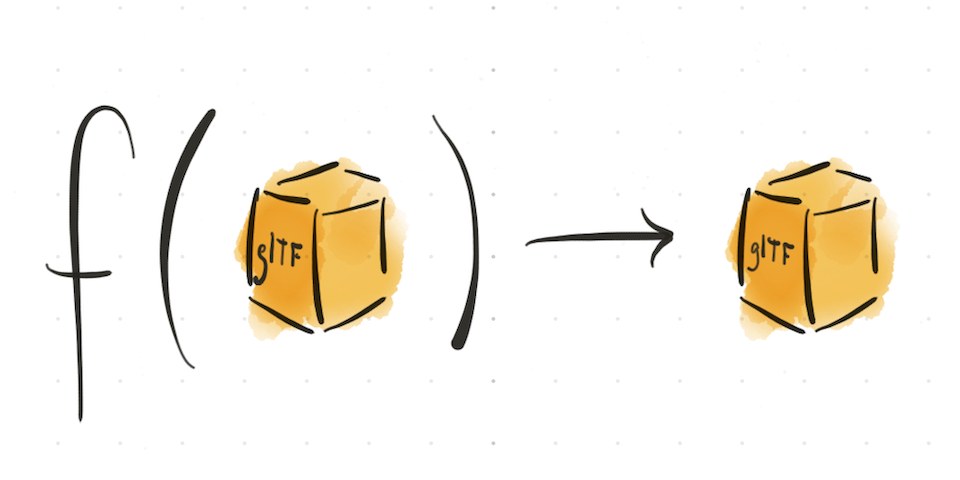
glTF Transform supports reading, editing, and writing 3D models in glTF 2.0 format. Unlike 3D modeling tools — which are ideal for artistic changes to geometry, materials, and animation — glTF Transform provides fast, reproducible, and lossless control of the low-level details in a 3D model. The API automatically manages array indices and byte offsets, which would otherwise require careful management when editing files. These traits make it a good choice for bundling, splitting, or optimizing an existing model. It can also be used to apply quick fixes for common issues, to build a model procedurally, or to easily develop custom extensions on top of the glTF format. Because the core SDK is compatible with both Node.js and Web, glTF Transform may be used to develop offline workflows and web applications alike.
Packages:
@gltf-transform/core: Core SDK, providing an expressive API to read, edit, and write glTF files.@gltf-transform/extensions: Extensions (optional glTF features) for the Core SDK.@gltf-transform/functions: Functions for common glTF modifications, written using the core API.@gltf-transform/cli: Command-line interface (CLI) to apply functions to glTF files quickly or in batch.
Scripting API
Install the scripting packages:
npm install --save @gltf-transform/core @gltf-transform/extensions @gltf-transform/functions
Read and write glTF scenes with platform I/O utilities WebIO, NodeIO, or DenoIO:
import { Document, NodeIO } from '@gltf-transform/core';
import { ALL_EXTENSIONS } from '@gltf-transform/extensions';
import draco3d from 'draco3dgltf';

// Configure I/O.
const io = new NodeIO()
    .registerExtensions(ALL_EXTENSIONS)
    .registerDependencies({
        'draco3d.decoder': await draco3d.createDecoderModule(), // Optional.
        'draco3d.encoder': await draco3d.createEncoderModule(), // Optional.
    });

// Read from URL.
const document = await io.read('path/to/model.glb');

// Write to byte array (Uint8Array).
const glb = await io.writeBinary(document);
To perform changes to an existing glTF Document, import off-the-shelf scripts from the Functions package, or write your own using API classes like Material, Primitive, and Texture.
import { resample, prune, dedup, draco, textureCompress } from '@gltf-transform/functions';
import sharp from 'sharp'; // Node.js only.

await document.transform(
    // Losslessly resample animation frames.
    resample(),
    // Remove unused nodes, textures, or other data.
    prune(),
    // Remove duplicate vertex or texture data, if any.
    dedup(),
    // Compress mesh geometry with Draco.
    draco(),
    // Convert textures to WebP (Requires glTF Transform v3 and Node.js).
    textureCompress({
        encoder: sharp,
        targetFormat: 'webp',
        resize: [1024, 2024],
    }),
    // Custom transform.
    backfaceCulling({cull: true}),
);

// Custom transform: enable/disable backface culling.
function backfaceCulling(options) {
    return (document) => {
        for (const material of document.getRoot().listMaterials()) {
            material.setDoubleSided(!options.cull);
        }
    };
}
To learn how glTF Transform works, and the architecture of the scripting API, start with Concepts. To try out the scripting API without installing anything, visit gltf.report/, load a glTF model, and open the Script tab.
Command-line API
Install the CLI, supported in Node.js LTS versions.
npm install --global @gltf-transform/cli
List available CLI commands:
gltf-transform --help
Optimize everything all at once:
gltf-transform optimize input.glb output.glb --texture-compress webp
Or pick and choose your optimizations, building a custom pipeline.
Compress mesh geometry with Draco or Meshoptimizer:
# Draco (compresses geometry).
gltf-transform draco input.glb output.glb --method edgebreaker

# Meshopt (compresses geometry, morph targets, and keyframe animation).
gltf-transform meshopt input.glb output.glb --level medium
Resize and compress textures with Sharp, or improve VRAM usage and performance with KTX2 and Basis Universal:
# Resize textures.
gltf-transform resize input.glb output.glb --width 1024 --height 1024

# Compress textures with WebP.
gltf-transform webp input.glb output.glb --slots "baseColor"

# Compress textures with KTX2 + Basis Universal codecs, UASTC and ETC1S.
gltf-transform uastc input.glb output1.glb \
    --slots "{normalTexture,occlusionTexture,metallicRoughnessTexture}" \
    --level 4 --rdo --rdo-lambda 4 --zstd 18 --verbose
gltf-transform etc1s output1.glb output2.glb --quality 255 --verbose
... and much more.
Credits
See Credits.
License
Copyright 2024, MIT License.
相關資源
glTF Transform CLI
CLI检查、压缩与优化 glTF/GLB 3D 模型的命令行工具,支持 Draco 与 Meshopt 网格压缩、纹理缩放及 WebP/KTX2 压缩,一条 optimize 命令即可整体优化。
donmccurdy/glTF-Transform2k
SVGO
CLISVG 优化命令行工具与 Node.js 库:删除编辑器元数据、注释、隐藏元素和冗余属性来压缩 SVG,可递归处理整个目录,并通过插件配置精细控制优化规则。
svg/svgo22.7k
Three.js Loaders
SkillThree.js 资源加载参考:用 GLTFLoader 加载模型,加载纹理、图片与 HDR 环境贴图,用 LoadingManager 统一管理多个加载器并显示进度,以及异步加载的写法,附代码示例。
CloudAI-X/threejs-skills3.6k
Scenario Agent Skills
SkillScenario 官方技能集:通过 Scenario MCP 生成可直接交付的图片、视频、配音配乐、贴图与 3D 素材,覆盖产品图、广告、分镜和游戏美术;另含驱动 Blender、Maya、ZBrush 等软件的专家技能。需要 Scenario 账号(有免费额度)。
scenario-labs/skills1k
pngquant
CLI有损 PNG 压缩命令行工具:把图片转成保留透明通道的 8 位 PNG,体积通常缩小 60%–80%,可整批压缩并设定质量区间,适合给公众号配图、课件插图和网页切图瘦身。macOS 可用 Homebrew 安装,无需账号。
kornelski/pngquant5.8k
fontTools
CLI字体处理工具集:pyftsubset 按实际用到的文字裁剪字体并输出 WOFF2,给中文网页字体瘦身;ttx 把字体转成可读写的 XML,便于查看和修改。适合让 agent 批量处理字体文件。需要 Python 3.11+,安装时带 woff 扩展才能输出 WOFF2;裁剪商用字体前先确认授权允许。
fonttools/fonttools5.3k