
MiniMax CLI (mmx)
CLIMiniMax 官方命令行工具,面向 agent 设计:在终端里调用 MiniMax 模型做文本对话,生成图像、视频与语音,并支持语音转写、图像理解和联网搜索,国内站与国际站均可接入。需要 MiniMax Token Plan 套餐。
The official CLI for the MiniMax AI Platform
Built for AI agents. Generate text, images, video, and speech — from any agent or terminal.


中文文档 · Global Platform · CN Platform · Example
Features
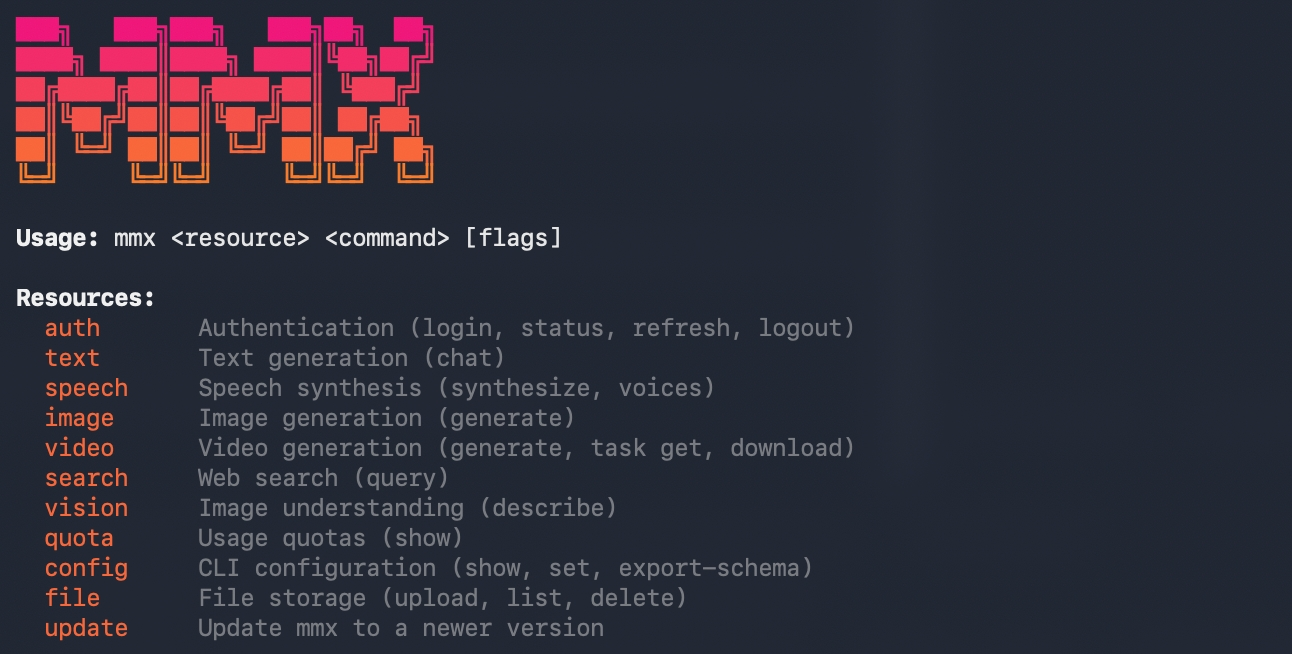
- Text — Multi-turn chat, streaming, system prompts, JSON output
- Image — Text-to-image with aspect ratio and batch controls
- Video — Async video generation with progress tracking
- Speech — TTS with 30+ voices, speed control, streaming playback; speech-to-text transcription (json, verbose_json, srt, vtt)
- Vision — Image understanding and description
- Search — Web search powered by MiniMax
- Dual Region — Seamless Global (
api.minimax.io) and CN (api.minimaxi.com) support
Install
# For AI agents (OpenClaw, Cursor, Claude Code, etc.): add skill to your agent
npx skills add MiniMax-AI/cli -y -g

# Or install CLI globally for terminal use
npm install -g mmx-cli
Requires Node.js 18+
Quick Start
# Authenticate (interactive — choose MiniMax OAuth or paste an API key)
mmx auth login

# Or non-interactive
mmx auth login --api-key sk-xxxxx

# Start creating
mmx text chat --message "What is MiniMax?"
mmx image "A cat in a spacesuit"
mmx speech synthesize --text "Hello!" --out hello.mp3
mmx speech transcribe --file meeting.mp3
mmx video generate --prompt "Ocean waves at sunset"
mmx search "MiniMax AI latest news"
mmx vision photo.jpg
mmx quota
Releasing
Maintainers publish releases by pushing a SemVer Git tag; the release workflow derives the npm package version from that tag. See the release guide.
Commands
mmx text
text chat and text repl default to MiniMax-M3.1-Flash-Preview. An explicit --model or saved default-text-model takes precedence. This preview currently requires M Plan or MiniMax Code; with a pay-as-you-go key, select MiniMax-M3 explicitly. See the model guide.
mmx text chat --message "Write a poem"
mmx text chat --model MiniMax-M3.1-Flash-Preview --message "Hello" --stream
mmx text chat --system "You are a coding assistant" --message "Fizzbuzz in Go"
mmx text chat --message "user:Hi" --message "assistant:Hey!" --message "How are you?"
cat messages.json | mmx text chat --messages-file - --output json
mmx image
mmx image "A cat in a spacesuit"
mmx image generate --prompt "A cat" --n 3 --aspect-ratio 16:9
mmx image generate --prompt "Logo" --out-dir ./out/
mmx video
# Hailuo-2.3 (Video Generation V1)
mmx video generate --prompt "Ocean waves at sunset" --download sunset.mp4
mmx video generate --prompt "A robot painting" --async

# MiniMax-H3 (Video Generation V2)
mmx video generate --api-key "$MINIMAX_API_KEY" --model MiniMax-H3 --prompt "Ocean waves at sunset"
mmx video generate --api-key "$MINIMAX_API_KEY" --model MiniMax-H3 --prompt "The subject walks forward" --image start.jpg
mmx video generate --api-key "$MINIMAX_API_KEY" --model MiniMax-H3 --prompt "Keep the same character" --reference-image character.png --reference-video motion.mp4

mmx video task get --task-id 123456
mmx video task get --task-id 424010985738629 --model MiniMax-H3
mmx video download --file-id 176844028768320 --out video.mp4
For MiniMax-H3, local files and Base64 data URIs are preflight-checked against the documented limits: image 30 MB, reference video 50 MB, reference audio 15 MB, and total JSON request body 64 MB. The API validates dimensions, aspect ratio, duration, frame rate, and codecs for all media.
--region is an existing global CLI option, not an H3 parameter. Normal video generation does not need it; the CLI uses the saved or automatically detected region. H3 defaults to 2K, 5 seconds, and 16:9 for text-to-video.
mmx speech
mmx speech synthesize --text "Hello!" --out hello.mp3
mmx speech synthesize --text "Stream me" --stream | mpv -
mmx speech synthesize --text "Hi" --voice English_magnetic_voiced_man --speed 1.2
echo "Breaking news" | mmx speech synthesize --text-file - --out news.mp3
mmx speech voices
# Speech-to-text (asr-1.0)
mmx speech transcribe --file meeting.mp3
mmx speech transcribe --file call.mp3 --language zh
mmx speech transcribe --file talk.mp3 --response-format verbose_json --output json
mmx speech transcribe --file talk.mp3 --response-format srt --out talk.srt
mmx speech transcribe --file long.mp3 --stream
mmx speech transcribe accepts wav, aiff, flac, m4a, mp3, aac, opus, and ogg files up to
50 MB and 500 seconds. Audio above 50 MB is rejected locally before upload; the 500 second
limit is enforced by the API. Omitting --language enables mixed-language recognition.
--response-format json (default) prints the transcript, verbose_json adds speakers and
per-segment timestamps, and srt / vtt return subtitle documents. n_speakers and
segments are part of the response, so pass --output json to see them. --stream prints
incremental text and requires json; when stdout is not a terminal it accumulates into a single
JSON result unless --output text is passed. mmx speech recognize is an alias for
mmx speech transcribe.
mmx vision
mmx vision photo.jpg
mmx vision describe --image https://example.com/img.jpg --prompt "What breed?"
mmx vision describe --file-id file-123
mmx search
mmx search "MiniMax AI"
mmx search query --q "latest news" --output json
The
/v1/coding_plan/searchAPI returns at most 10 results per call and does not currently expose a pagination parameter (see #107). Refine your query if you need different results.
mmx auth
mmx auth login                              # interactive: pick OAuth (Global / China) or paste an API key
mmx auth login --api-key sk-xxxxx           # save an API key directly
mmx auth login --recommend                  # skip the menu, pick OAuth region interactively
mmx auth login --recommend --region=global  # OAuth → api.minimax.io
mmx auth login --recommend --region=cn      # OAuth → api.minimaxi.com
mmx auth status
mmx auth refresh
mmx auth logout
mmx auth status is the canonical way to verify active authentication.
OAuth uses the Device Authorization Grant (RFC 8628) with PKCE —
the CLI opens your browser, you enter a code, and access_token + refresh_token
are saved to ~/.mmx/config.json. Tokens refresh automatically (5-min buffer);
manual refresh via mmx auth refresh.
API key auth auto-detects the correct region by probing both Global and CN.
Useful for CI/CD (mmx auth login --api-key sk-xxxxx), or pass per-command via --api-key.
OAuth and API key are mutually exclusive — logging in with one clears the other.
Credential priority: --api-key flag > OAuth (config) > api_key (config).
Environment variables
| Variable | Description |
|---|---|
MINIMAX_REGION | global or cn. |
MINIMAX_BASE_URL | Override the API base URL. |
MINIMAX_OUTPUT | text or json. |
MINIMAX_TIMEOUT | Request timeout in seconds. |
MINIMAX_VERBOSE | 1 to enable verbose HTTP logging. |
MMX_CONFIG_DIR | Directory containing the config.json file (default: ~/.mmx). Set this when mmx runs from a subprocess, service, or CI job whose home directory differs from where you logged in. |
mmx config · mmx quota
mmx quota
mmx config show
mmx config set --key region --value cn
mmx config set --key default-text-model --value MiniMax-M3.1-Flash-Preview
mmx config export-schema | jq .
mmx agent setup
Configure MiniMax for Claude Code, Codex, Grok Build, OpenCode, Hermes, Pi, or Oh my Pi while preserving unrelated settings. Run without options for the interactive wizard; supplying options makes the command non-interactive and suitable for scripts.
mmx agent setup
mmx agent setup --agent codex --agent claude-code --api-key "$MINIMAX_API_KEY" --region global
mmx agent setup --all --api-key "$MINIMAX_API_KEY" --region cn --output json
mmx agent setup --agent oh-my-pi --api-key "$MINIMAX_API_KEY" --region global
# --agent omp is an alias for --agent oh-my-pi
agent setup defaults to MiniMax-M3.1-Flash-Preview for subscription keys and to MiniMax-M3 for pay-as-you-go keys (sk-api-...). In non-interactive mode, --model overrides this selection.
The command verifies the key and selected region before writing. Existing files are backed up when changed; use --dry-run to preview without a live request. In the interactive wizard, compatible agents that are missing from PATH can be installed from a second multi-select list using their official packages or installer scripts. The Hermes install uses its official core CLI stages and skips optional system packages, Node workspace, browser, computer-use, setup, and gateway stages. After installation, mmx applies the MiniMax configuration while preserving installer settings. Agents that fail a platform or prerequisite check are explained and left configuration-only. Non-interactive invocations remain configuration-only, and the command never launches an agent.
Oh my Pi uses its native ~/.omp/agent/models.yml and config.yml (existing .yaml files are updated in place). Configuration honors OMP_PROFILE / PI_PROFILE, PI_CONFIG_DIR, and the default-profile PI_CODING_AGENT_DIR override. Run omp once to migrate legacy JSON-only configuration before using setup. Interactive installation uses the official prebuilt-binary installer, so it does not require Bun or npm.
mmx update
mmx update
mmx update latest
Thanks to
License
相關資源
MiniMax MCP
MCPMiniMax 官方 MCP:文本转语音、声音克隆与声音设计、文生图、视频生成。需要 MiniMax API Key,Key 与 API Host 的国内/国际区域须一致,按量计费。
MiniMax-AI/MiniMax-MCP1.6k
Higgsfield
PluginHiggsfield 官方 Codex 插件:接入其远程 MCP,用文字或照片生成图片和视频,如把产品图做成视频广告、让静图动起来,并内置无人出镜解说、旁白配音、烧录字幕三个流程。需登录 Higgsfield 账号,生成按积分计费。
openai/plugins7.5k
fal.ai Skills
Skillfal.ai 官方技能合集:让 agent 用 genmedia 命令行调用 fal 上千个模型,做文生图、图生视频、配音、商品图与广告素材、分镜短片,并附各模型的提示词写法。需要 fal.ai 账号与 API Key(按量付费),并先安装 genmedia CLI。
fal-ai-community/skills251genmedia CLI
CLIfal 官方推出的 agent 优先命令行工具,可检索并调用 fal.ai 上 1200 多个图像、视频、语音生成模型,查看参数与价格、上传素材、下载结果,输出结构化 JSON,适合批量出图和制作宣传素材。需要 fal.ai API Key,按调用量付费。
fal-ai-community/genmedia-cli80
MCP Servers for Google Cloud Genmedia APIs
MCPGoogle Cloud 团队开源的生成式媒体 MCP 合集(实验项目):Nano Banana 生图改图、Veo 生成视频、Gemini TTS 与 Chirp 配音、Lyria 配乐、AVTool 合成音视频,可做宣传短片、课件插图与播客。各能力分别注册;需开通计费的 Google Cloud 项目并用 gcloud 登录,AVTool 另需 FFmpeg。
GoogleCloudPlatform/genmedia-creative-studio1.2k
Pixelle MCP
MCP把 ComfyUI 工作流零代码转成 MCP 工具,覆盖文本、图像、语音、视频的生成与转换;可接本地 ComfyUI 或 RunningHub 云端。需先用 uvx pixelle 启动服务并配置大模型。
ATH-MaaS/Pixelle-MCP1.1k