
CCPM
Skill软件项目的规格驱动管理流程:先引导头脑风暴写出 PRD,再拆成 Epic 与带依赖的任务并同步为 GitHub Issues,可随时询问站会进度、下一步与阻塞项,也能派多个 agent 并行写代码。需要 Git、已登录的 gh 命令行和一个 GitHub 仓库。
CCPM – The Project Manager Agent






Spec-driven development for AI agents – ship faster better using PRDs, GitHub issues, and multiple agents running in parallel.
Stop losing context. Stop blocking on tasks. Stop shipping bugs. CCPM gives your AI agent a structured PM brain: turn ideas into PRDs, PRDs into epics, epics into GitHub issues, and issues into production code — with full traceability at every step.
[!IMPORTANT] 📢 CCPM is now an AGENT SKILL! It works with any Agent Skills–compatible harness that supports skills: Claude Code, Codex, OpenCode, Factory, Amp, Cursor, and more.
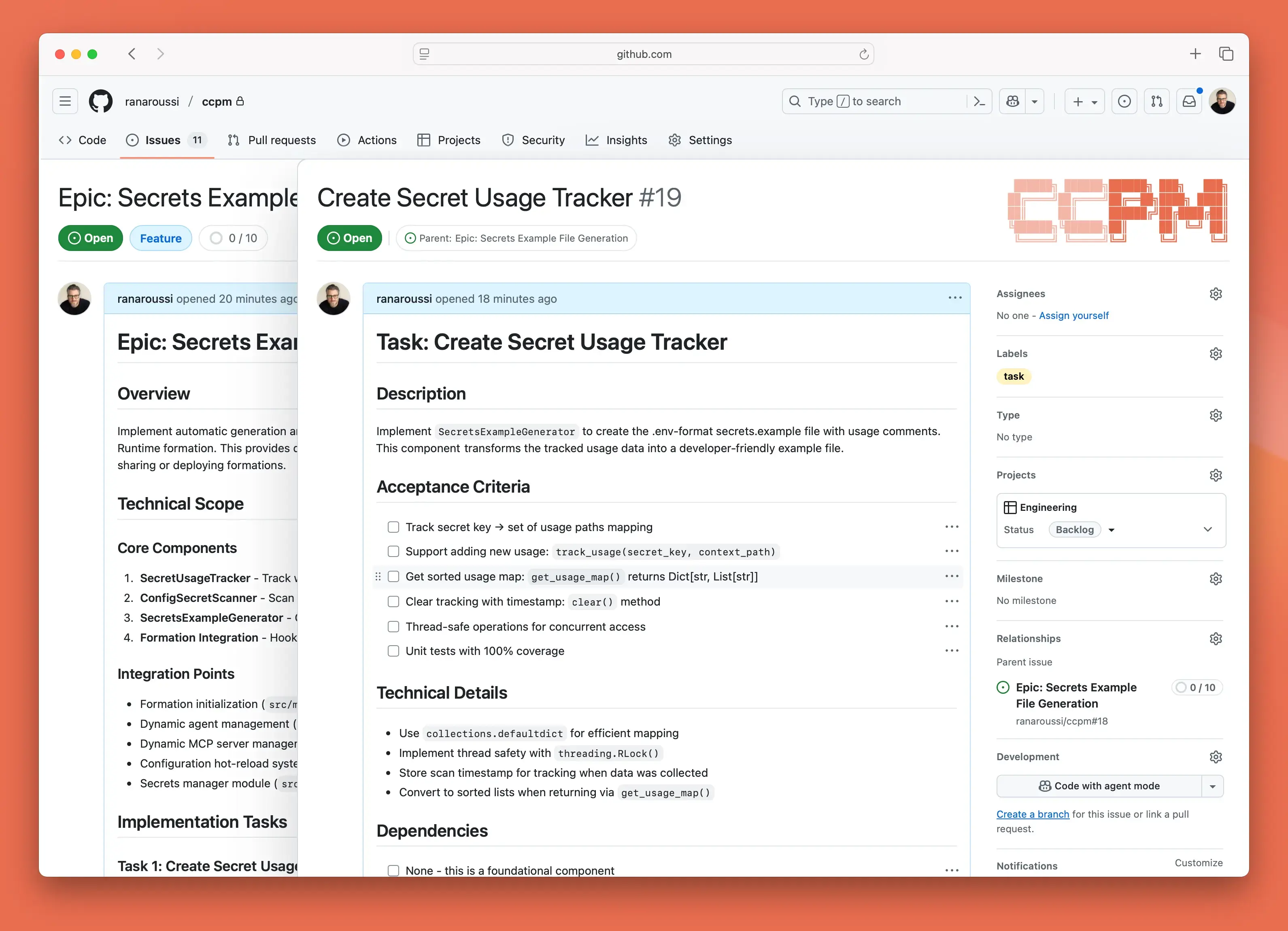
Table of Contents
- Background
- The Workflow
- What Makes This Different
- Why GitHub Issues
- Core Principle: No Vibe Coding
- The Parallel Execution System
- Key Features & Benefits
- Install
- Usage
- Workflow Phases
- Skill Structure
- Example Flow
- Proven Results
- Local vs Remote
- Technical Notes
- Who's Behind this Project
[!NOTE] Check out proof to get your agents capture visual proof of work of terminal output, browser interactions, and mobile simulator recordings.
Background
Every team struggles with the same problems:
- Context evaporates between sessions, forcing constant re-discovery
- Parallel work creates conflicts when multiple agents touch the same code
- Requirements drift as verbal decisions override written specs
- Progress becomes invisible until the very end
CCPM solves all of that.
The Workflow
graph LR
    A[PRD Creation] --> B[Epic Planning]
    B --> C[Task Decomposition]
    C --> D[GitHub Sync]
    D --> E[Parallel Execution]
See It In Action
"I want to build a notification system — where do we start?"
→ Guided brainstorming + PRD creation

"break down the notification-system epic"
→ Parallelizable task files with dependencies

"sync the notification-system epic to GitHub"
→ Epic issue + sub-issues + worktree

"start working on issue 42"
→ Parallel stream analysis + multiple agents launched

"what's our standup for today?"
→ Instant report from project files
What Makes This Different
| Traditional AI Development | CCPM |
|---|---|
| Context lost between sessions | Persistent context across all work |
| One agent, one task | Parallel agents on independent streams |
| Vibe coding from memory | Spec-driven with full traceability |
| Progress hidden in chat logs | Transparent audit trail in GitHub |
| Scattered status updates | Structured standup, blocked, next |
Why GitHub Issues
Most AI coding workflows operate in isolation — a single session with no shared state. CCPM uses GitHub Issues as the source of truth, which unlocks something fundamentally different:
Team collaboration — multiple agents (or humans) work on the same project simultaneously. Progress is visible in real-time through issue comments.
Seamless handoffs — an agent can start a task, a human can finish it, or vice versa. No "what did the AI do?" meetings.
Single source of truth — no separate databases or project management tools. Issue state is project state. Comments are the audit trail.
Works with what you have — no dependency on GitHub Projects. Integrates with existing labels, milestones, and PR workflows.
Core Principle: No Vibe Coding
Every line of code must trace back to a specification.
CCPM enforces a strict 5-phase discipline:
- 🧠 Brainstorm — think deeper than comfortable
- 📝 Document — write specs that leave nothing to interpretation
- 📐 Plan — architect with explicit technical decisions
- ⚡ Execute — build exactly what was specified
- 📊 Track — maintain transparent progress at every step
No shortcuts. No assumptions. No regrets.
The Parallel Execution System
Issues Aren't Atomic
Traditional thinking: one issue = one agent = one task
Reality: a single "Implement user authentication" issue is actually:
- Agent 1: Database tables and migrations
- Agent 2: Service layer and business logic
- Agent 3: API endpoints and middleware
- Agent 4: UI components and forms
- Agent 5: Test suites and documentation
All running simultaneously in the same worktree.
The Math of Velocity
| Approach | Agents working | Wall time |
|---|---|---|
| Traditional (serial) | 1 | 5x |
| CCPM (parallel streams) | 5 | 1x |
Context Stays Clean
Each agent handles its own context in isolation. Your main conversation becomes the conductor — it never drowns in implementation details. Agents read from .claude/epics/ and commit progress back through Git.
Key Features & Benefits
🧠 Context preservation — project state lives in files, not in your head or chat history. Start a session anywhere, any time.
⚡ Parallel execution — tasks marked parallel: true run concurrently across multiple agents without conflicts.
🔗 GitHub native — works with tools your team already uses. No dependency on the Projects API.
📊 Full traceability — every decision documented. PRD → Epic → Task → Issue → Code → Commit.
🤖 Deterministic ops run as scripts — status, standup, search, validate all run as bash scripts: fast, consistent, no LLM token cost.
🌐 Harness-agnostic — follows the agentskills.io open standard. Works with Factory, Claude Code, Amp, OpenCode, Codex, Cursor, and more.
Install
CCPM is a standard Agent Skill. Point your harness at skill/ccpm/ — that's it.
Clone the repo
git clone https://github.com/automazeio/ccpm.git
Factory / Droid
# Symlink into your skills directory
ln -s /path/to/ccpm/skill/ccpm ~/.factory/skills/ccpm
Claude Code
In your project root, add a skills/ directory and symlink or copy the skill:
ln -s /path/to/ccpm/skill/ccpm .claude/skills/ccpm
Any other Agent Skills–compatible harness
Point it at skill/ccpm/. It follows the agentskills.io standard and works out of the box.
Prerequisites
gitandghCLI (authenticated:gh auth login)- A GitHub repository for your project
Usage
CCPM activates automatically when your agent detects PM intent. Just talk naturally — no special syntax needed.
Natural language triggers
| What you say | What happens |
|---|---|
| "I want to build X" / "let's plan X" | Brainstorming + PRD creation |
| "parse the X PRD" / "create an epic for X" | PRD → technical epic |
| "break down the X epic" | Epic decomposition into tasks |
| "sync the X epic to GitHub" | Issues created, worktree set up |
| "start working on issue N" | Analysis + parallel agents launched |
| "standup" / "what's our status" | Bash script runs instantly |
| "what's next" / "what's blocked" | Priority queue from project files |
| "close issue N" | Local + GitHub updated |
| "merge the X epic" | Tests, merge, cleanup |
Workflow Phases
1. Plan — Capture requirements
"I want to build a notification system — push, email, and in-app"
CCPM conducts guided brainstorming before writing anything. It asks about the problem, users, success criteria, constraints, and what's out of scope — then creates a structured PRD at .claude/prds/<name>.md.
When ready: "parse the notification-system PRD" → produces a technical epic at .claude/epics/notification-system/epic.md with architecture decisions, technical approach, and task preview.
2. Structure — Break it down
"break down the notification-system epic into tasks"
Each task gets a file with acceptance criteria, effort estimate, depends_on, parallel, and conflicts_with metadata. Tasks are intelligently batched for parallel creation. ≤10 tasks per epic by default.
3. Sync — Push to GitHub
"sync the notification-system epic to GitHub"
Creates an epic issue, creates sub-issues for each task, renames local files to match GitHub issue numbers, sets up a dedicated worktree (../epic-notification-system/), and creates a mapping file for reference.
4. Execute — Start building
"start working on issue 42"
Analyzes the issue for independent work streams, launches parallel agents scoped to their own files, and sets up progress tracking. Each agent commits with Issue #N: description and coordinates through Git.
5. Track — Know where things stand
"standup" / "what's blocked" / "what's next"
All tracking operations run as bash scripts — instant output, no LLM overhead. The scripts scan .claude/epics/ and report what's in progress, what's next, and what's blocked.
Skill Structure
skill/ccpm/
├── SKILL.md                  # Entry point — detects intent, routes to reference
└── references/
    ├── plan.md               # PRD writing + parsing to epic
    ├── structure.md          # Epic decomposition into tasks
    ├── sync.md               # GitHub sync, progress comments, close, merge
    ├── execute.md            # Issue analysis + parallel agent launch
    ├── track.md              # Status, standup, search, next, blocked
    ├── conventions.md        # File formats, frontmatter schemas, git rules
    └── scripts/              # Bash scripts for deterministic operations
        ├── status.sh
        ├── standup.sh
        ├── epic-list.sh
        ├── search.sh
        └── ...               # 14 scripts total
Your project files live in .claude/ in your project root:
.claude/
├── prds/                     # Product requirement documents
├── epics/
│   └── <feature>/
│       ├── epic.md           # Technical epic
│       ├── <N>.md            # Task files (named by GitHub issue number after sync)
│       ├── <N>-analysis.md   # Parallel work stream analysis
│       └── updates/          # Agent progress tracking
└── (archived epics)
Files are the source of truth — plain markdown that lives in your repo, no external services.
Example Flow
You: "I want to build a payment integration with Stripe — subscriptions and one-time charges"

CCPM: Asks 5 clarifying questions about scope, users, success criteria...

You: [answers]

CCPM: ✅ PRD created: .claude/prds/payment-integration.md
      Ready to create the technical epic?

You: "yes, parse it"

CCPM: ✅ Epic created: .claude/epics/payment-integration/epic.md
      8 task categories identified. Ready to decompose?

You: "break it down"

CCPM: ✅ Created 7 tasks — 5 parallel, 2 sequential
      Ready to push to GitHub?

You: "sync it"

CCPM: ✅ Epic #1234 created
      ✅ 7 sub-issues created (#1235–#1241)
      ✅ Worktree: ../epic-payment-integration/

You: "start working on issue 1235"

CCPM: Analyzed 3 parallel streams:
      Stream A: Stripe client setup ✓ Started
      Stream B: Webhook handler ✓ Started
      Stream C: Database models ⏸ Waiting on A

You: "what's our standup?"

CCPM: [runs standup.sh instantly]
      📅 Daily Standup — 2026-03-18
      🔄 In Progress: Issue #1235 (payment-integration) — 60%
      ⏭️ Next: Issue #1236 — Subscription billing logic
      📊 Tasks: 2 in progress, 5 open, 0 closed
Proven Results
Teams using this system report:
- 89% less time lost to context switching
- 5–8 parallel tasks vs 1 previously
- 75% reduction in bug rates — due to detailed task breakdown before coding
- Up to 3× faster feature delivery
Benchmark
In structured evals comparing CCPM-equipped agents vs baseline (no skill):
| Scenario | With CCPM | Without |
|---|---|---|
| PRD creation (brainstorm-first, correct paths) | ✅ 4/4 | ❌ 2/4 |
| Issue execution (analysis + worktree checks) | ✅ 4/4 | ❌ 0/4 |
| Standup (runs script, real data) | ✅ 3/3 | ❌ 1/3 |
| Overall | 100% | 27.7% |
Local vs Remote
| Operation | Local | GitHub |
|---|---|---|
| PRD creation | ✅ | — |
| Implementation planning | ✅ | — |
| Task breakdown | ✅ | ✅ (on sync) |
| Execution | ✅ | — |
| Progress updates | ✅ | ✅ (on sync) |
| Final deliverables | — | ✅ |
Technical Notes
GitHub integration — uses gh-sub-issue extension for proper parent-child relationships. Falls back to task lists if not installed. Install with: gh extension install yahsan2/gh-sub-issue
File naming — tasks start as 001.md, 002.md during decomposition. After GitHub sync, renamed to {issue-id}.md (e.g. 1234.md). Issue #1234 = file 1234.md.
Design decisions — intentionally avoids GitHub Projects API complexity. All operations work on local files first for speed. GitHub sync is explicit and controlled. Worktrees provide clean git isolation for parallel work.
Looking for v1? — The original /pm:* Claude Code slash command system is preserved on the v1 branch.
Who's behind this project
CCPM was developed at Automaze for developers who ship, by developers who ship.
If CCPM helps your team ship better software:
- ⭐ Star this repository to show your support
- 🐦 Follow @aroussi on X for updates and tips
[!TIP] Ship faster with Automaze. We partner with founders to bring their vision to life, scale their business, and optimize for success. Visit Automaze to book a call ›
相關資源

BMad Method
Skill敏捷 AI 驱动开发方法:内置分析师、产品经理、UX 设计师等角色技能,把想法整理成产品简报、PRD 与 PRFAQ,再拆成任务交给 agent 实现。需 Claude Code 等支持技能的工具,并装好 Node.js、Git 与 uv,之后让 bmad 技能执行 bmad setup。
bmad-code-org/BMAD-METHOD54.2k
notion-spec-to-implementation
Skill从 Notion 读取 PRD 或功能规格,梳理需求与待澄清点,生成实施计划页并拆出任务,把规格、计划与任务互相关联并持续更新进度。收录于 OpenAI 官方插件仓库(开发者标注为 Notion),需要连接 Notion MCP。
openai/plugins7.5k
Spec Kit
CLIGitHub 官方的规格驱动开发工具包:specify CLI 为 Copilot、Claude Code、Codex 等 agent 初始化规格、计划与任务流程,先写规格再实现,另有缺陷修复与想法评估流程。需要 Python 3.11+ 与 uv。
github/spec-kit142k
Task Master
CLI把 PRD 解析成带依赖关系的任务清单,让 Claude Code、Cursor 等 agent 按序领取下一项、拆分子任务、更新进度,同时提供 CLI 与 MCP。需要至少一个模型 API Key,也可复用 Claude Code / Codex 登录。
eyaltoledano/claude-task-master28.2kTask Master
MCP把 PRD 解析成带依赖关系的任务清单,让 Cursor、Claude Code 等编码 agent 逐项拆解、实现并跟踪进度,也可当 CLI 使用。需配置至少一个模型 API Key,或复用 Claude Code / Codex CLI 登录。
eyaltoledano/claude-task-master28.2kTaskmaster
Plugin把需求文档(PRD)解析成带依赖关系的任务列表,支持复杂度分析、任务拆解与调研;插件打包了斜杠命令、子代理与 MCP 服务。需配置模型 API Key,或复用 Claude Code / Codex CLI 登录。
eyaltoledano/claude-task-master28.2k